
A primordial sea deity governing tides, depths, and maritime order.
It represents oceanic authority, divine boundary, and sea sovereignty.
Primary Sources
Classical & Mythological Records
Kojiki and Nihon Shoki accounts of Watatsumi and sea deities
Ryūgū-jō and ocean-palace mythology
海神・龍宮・海界支配神に関する古代神話資料
Modern Folklore References
Yanagita Kunio — sea deities and oceanic guardian beliefs
Komatsu Kazuhiko — yōkai and deities of maritime boundaries
Watatsumi – The Ancient Sea Deity Who Rules Depth, Tide, and Silence in Japanese Myth
Watatsumi is one of the oldest and most elemental deities in Japanese myth—a god of the sea not as surface or spectacle, but as depth, weight, and inevitability. Unlike violent storm gods or monstrous sea yōkai, Watatsumi does not rage.
He governs.
Watatsumi embodies the sea as a sovereign force.
Origins in Primordial Myth
Watatsumi appears in early Japanese mythological texts such as the Kojiki and Nihon Shoki. He is often identified as Ōwatatsumi-no-Kami or simply Watatsumi, a deity born from the primal generation of gods.
In some traditions, Watatsumi is the ruler of Ryūgū-jō, the Dragon Palace beneath the sea—a realm beyond human time and perception.
The sea was not chaotic.
It was ordered—by a god.
Domain of Depth Rather Than Surface
Watatsumi’s authority is not over waves or weather alone, but over the unseen:
Ocean depth
Tides and currents
Marine life
Boundaries between land and sea
Time that flows differently beneath water
Where humans see water as passage, Watatsumi rules it as territory.
The deeper you go, the stronger his presence becomes.
Appearance Beyond Human Form
Watatsumi rarely appears directly. When he does, descriptions are symbolic rather than literal:
A vast, draconic or serpentine presence
A regal figure associated with dragons or sea kings
An unseen pressure rather than a visible body
More often, Watatsumi is represented through environment—still waters, deep currents, or overwhelming silence.
He is felt, not seen.
Relationship with Humans
Watatsumi is not hostile, but he is indifferent. Humans who enter the sea do so at his discretion.
In myth, he grants blessings—safe passage, abundant fishing, calm waters—but also enforces boundaries. Those who disrespect the sea may never return.
He does not punish emotionally.
He corrects naturally.
Watatsumi and the Dragon Palace
One of Watatsumi’s most famous associations is Ryūgū-jō, the undersea palace visited by Urashima Tarō. This realm represents separation from human time and consequence.
Those who enter Watatsumi’s domain may return changed—or not at all.
The sea remembers differently.
Symbolism and Themes
Sovereignty of Nature
The sea obeys no human law.
Depth Over Display
Power exists where eyes cannot reach.
Time Distortion
The ocean alters duration.
Indifference as Authority
Lack of malice does not mean safety.
Related Concepts
Umi-bōzu (海坊主)
Colossal sea spirits.
→ Umi-bōzu
Ryūgū (竜宮)
Undersea palaces.
Marebito (稀人)
Otherworldly visitors.
→ Marebito
Aramitama (荒御魂)
Violent divine aspects.
→ Aramitama
Watatsumi in Art and Cultural Memory
Watatsumi is depicted in shrine iconography, mythological illustrations, and ritual contexts rather than horror imagery. He is revered, not feared—yet never treated casually.
Shrines dedicated to sea deities often emphasize calm, depth, and continuity.
Respect replaces confrontation.
Modern Cultural Interpretations

This blade symbolizes absolute maritime sovereignty and tidal judgment.
It visualizes oceanic law condensed into weapon form.
Modern interpretations often view Watatsumi as a symbol of ecological power and oceanic scale — forces far beyond human control.
Psychologically, he represents the unconscious: deep, vast, and governing without emotion.
In some modern visual reinterpretations, Watatsumi manifests as a yōtō — a blade with a deep-blue core that seems to absorb surrounding light. The sword embodies dominance rather than motion.
Watatsumi remains relevant because the sea remains dominant.
Modern Reinterpretation – Watatsumi as the Condition of Absolute Depth
Watatsumi does not threaten. Watatsumi does not pursue. Watatsumi does not need to act.
The “beautiful girl” form does not represent a god, a ruler, or a mythic personality. She does not command. She does not declare.
Her unmoving presence represents the condition of overwhelming depth — the state in which existence itself becomes authority.
She does not intervene. She does not react. She remains.
In this visual form, Watatsumi becomes a contemporary yokai of absolute depth — a spirit that exists as the condition that the sea governs simply by continuing.
Musical Correspondence
The accompanying track translates depth into sound. Low drones, slow tidal pulses, and extended reverberation evoke pressure that never releases.
Silence acts not as absence, but as scale — framing sound as mass rather than event.
Together, image and sound form a unified reinterpretation layer — a modern folklore artifact of still authority and sovereign depth.

She embodies oceanic sovereignty and tidal authority.
Her presence reflects sea-bound law made visible.
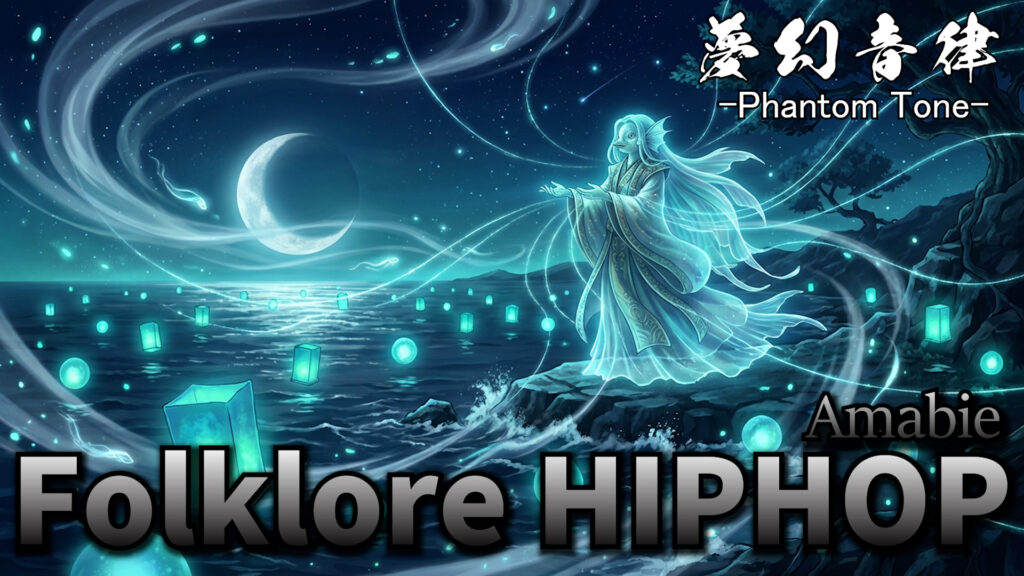
Amabie
Genre: Japanese Folklore Hip-Hop, Ritual Lo-Fi Poetry Produced by: Phantom Tone | Suno AI | Kotetsu Co., Ltd. Tags: #AIgeneratedMusic #JapaneseHipHop #Folklore…
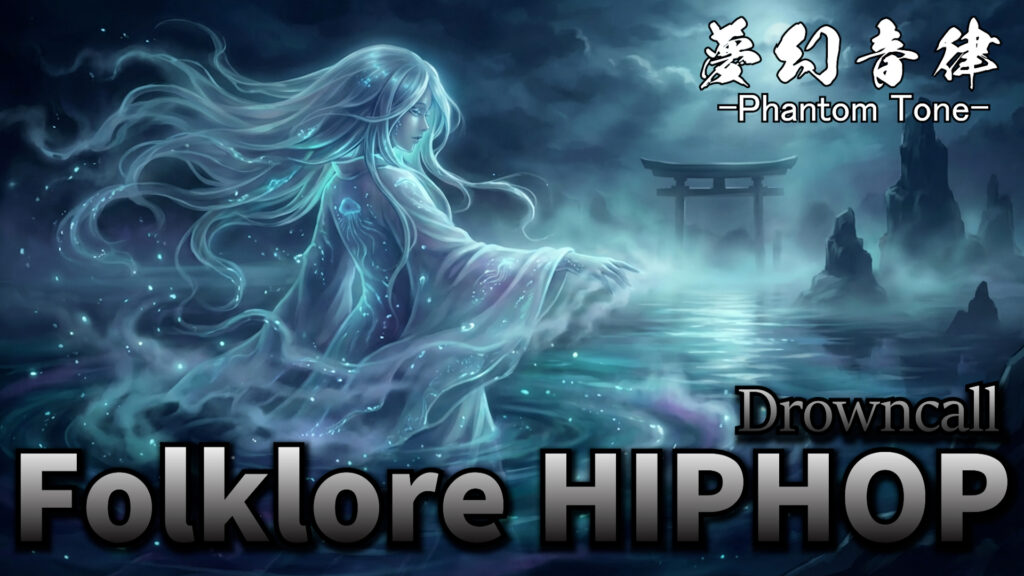
Drowncall
Genre: Japanese Folklore Hip-Hop, Ritual Lo-Fi Poetry Produced by: Phantom Tone | Suno AI | Kotetsu Co., Ltd. Tags: #AIgeneratedMusic #JapaneseHipHop #Folklore…