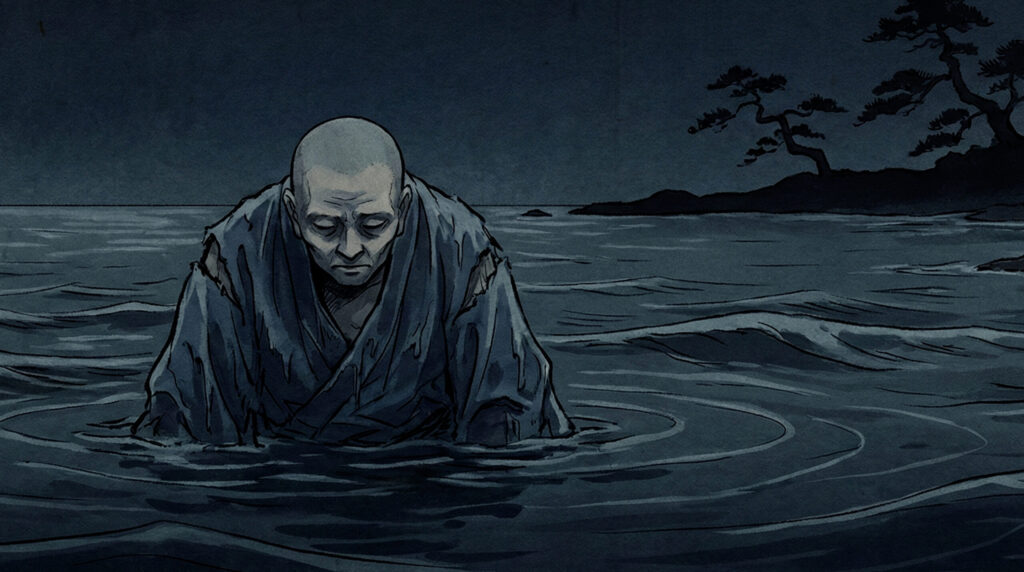
A blind monk-like sea apparition that questions passing sailors.
It represents maritime riddles, fatal hesitation, and sea-bound judgment.
Primary Sources
Classical & Mythological Records
Edo-period umizatō blind sea-spirit accounts
Coastal monk-like sea apparition folktales
海座頭・盲目海僧怪異に関する沿岸説話資料
Modern Folklore References
Yanagita Kunio — blind sea spirit beliefs
Komatsu Kazuhiko — yōkai of monk-like marine apparitions
Umizatō – Blind Sea Spirits of Depth and Dread in Japanese Folklore
Umizatō are among the most eerie and regionally grounded figures in Japanese maritime folklore: blind, monk-like beings said to inhabit offshore waters and coastal depths. Neither wholly human nor fully monstrous, they emerge from the sea as omens of danger, illness, or death, confronting sailors and fishermen with unsettling proximity rather than overt attack.
Often described as bald-headed, with the bearing of a blind monk (zatō), umizatō blur the line between human suffering and supernatural threat. Their presence is quiet but decisive. They do not roar or chase; they ask questions, demand offerings, or simply appear—forcing a choice whose consequences are dire.
Umizatō embody the sea not as open horizon, but as intimate peril.
Origins and Coastal Context
Legends of umizatō are found primarily in coastal regions, shaped by communities whose lives depended on unpredictable waters. The sea, a source of sustenance, was also a site of sudden loss. Within this environment, umizatō emerged as figures that personified maritime anxiety—especially the fear of unseen hazards below the surface.
The term “zatō” historically referred to blind itinerant monks or musicians. By attaching this image to the sea, folklore fused social marginality with oceanic danger. Umizatō thus reflect both human vulnerability and the sea’s indifference.
Unlike pan-Japanese yōkai, umizatō are distinctly maritime, inseparable from boats, tides, and offshore encounters.
Appearance and Demeanor
Descriptions of umizatō are restrained and unsettling:
Bald or shaven head
Monk-like posture or attire
Eyes closed or absent, suggesting blindness
Pale or shadowed skin
Emergence from water near boats or shores
They often surface suddenly beside vessels, sometimes at night or in fog. Their stillness contrasts with the motion of waves, heightening unease. The familiarity of their human form makes their presence more disturbing than overt monstrosity.
They look like people who should not be there.
The Question and the Weight
A recurring motif in umizatō lore is the question. The spirit asks a simple query—often about numbers, possessions, or intent. Answers must be given carefully. A wrong response may result in capsized boats, illness, or death.
Some stories advise silence; others suggest specific replies taught through tradition. Knowledge becomes survival. The danger lies not in physical strength, but in misunderstanding.
This structure transforms the encounter into a test of composure under pressure—mirroring the realities of life at sea.
Sea, Blindness, and Vulnerability
Blindness is central to umizatō symbolism. It suggests a being that does not “see” in human terms, yet perceives something deeper—fate, weakness, or impending death. For sailors navigating unseen currents and submerged hazards, this resonates powerfully.
The umizatō’s blindness also reflects the human condition at sea: progress without full knowledge, decisions made amid uncertainty. In this way, the spirit mirrors the sailor’s own vulnerability back at them.
Symbolism and Themes
The Sea as Interrogator
Umizatō represent the sea’s demand for respect and caution.
Knowledge as Protection
Survival depends on knowing the right response, not strength.
Human Likeness as Threat
Their near-human form destabilizes expectations of danger.
Marginality and Fear
They fuse social outsider imagery with natural peril.
Related Concepts
Umi-bōzu (海坊主)
Colossal sea spirits.
→ Umi-bōzu
Funayūrei (船幽霊)
Ghosts of drowned sailors.
→ Funayūrei
Onibi (鬼火)
Will-o’-the-wisp spirits.
→ Onibi
Marebito (稀人)
Otherworldly visitors.
→ Marebito
Umizatō in Folktales and Local Memory
Stories of umizatō are typically brief and instructional, passed down among fishing communities. They serve as cautionary tales, embedding practical wisdom within supernatural narrative.
Unlike heroic legends, these tales end quietly—boats turn back, storms subside, or tragedy strikes without spectacle. The lesson persists even when details fade.
This quiet transmission reinforces umizatō as lived folklore rather than distant myth.
Modern Cultural Interpretations

This blade symbolizes fatal hesitation and maritime judgment.
It visualizes sea-bound riddles condensed into weapon form.
In modern retellings, umizatō are sometimes absorbed into broader categories of sea monsters or ghostly apparitions. However, their traditional power lies in specificity — the question, the pause, and the choice.
Contemporary interpretations may frame them as symbols of risk assessment, mental pressure, or the psychological toll of dangerous labor — maintaining their relevance without sensationalism.
In some modern visual reinterpretations, umizatō manifest as a yōtō — a blade marked with forked decision-lines along its edge. The sword embodies hesitation rather than pursuit.
Umizatō persist because danger still demands choice.
Modern Reinterpretation – Umizatō as the Condition of Forced Choice
Umizatō does not hunt. Umizatō does not chase. Umizatō does not punish.
The “beautiful girl” form does not represent danger, monsters, or judgment. She does not threaten. She does not pursue.
Her blind, unmoving presence represents the moment when the sea demands response — the condition in which hesitation becomes consequence.
She does not ask to know. She asks to bind. Her question is not curiosity — it is pressure.
In this visual form, Umizatō becomes a contemporary yokai of forced choice — a spirit that exists as the condition that the sea closes distance and requires decision.
Musical Correspondence
The accompanying track translates pressure into sound. Low drones, restrained pulses, and suspended harmonic tension evoke water held beneath a hull.
Silence acts not as rest, but as hesitation — framing sound as the charged space before answer.
Together, image and sound form a unified reinterpretation layer — a modern folklore artifact of closeness, pressure, and unavoidable response.
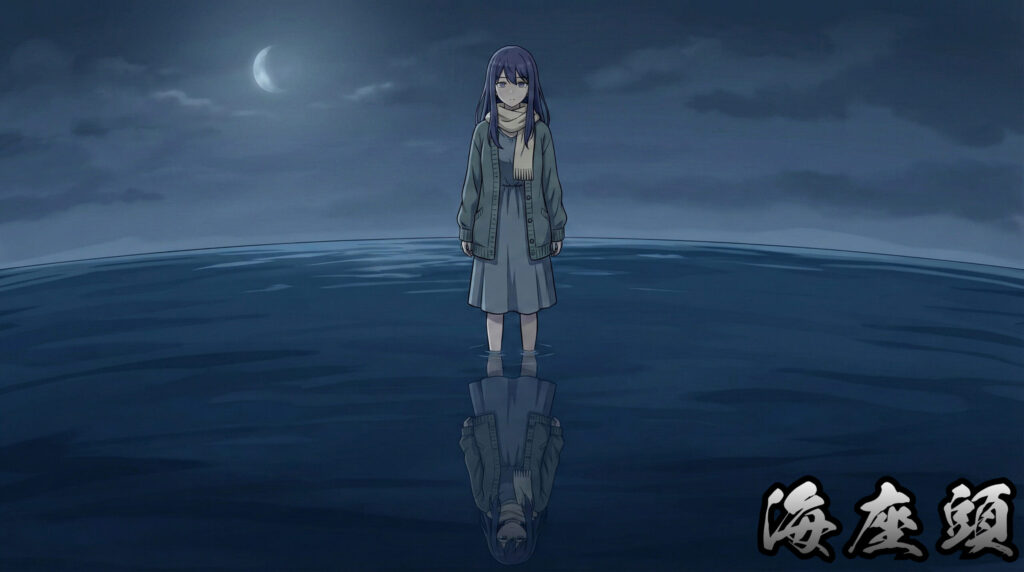
She embodies fatal hesitation and maritime riddles.
Her presence reflects sea-bound judgment made visible.
Dreamy and stylish
Genre: Ritual Japanese HipHop / Darkwave Folklore Produced by: Phantom Tone | Suno AI | Kotetsu Co., Ltd. Tags: #JapaneseHipHop #AIgeneratedMusic #Yokai #Phant…