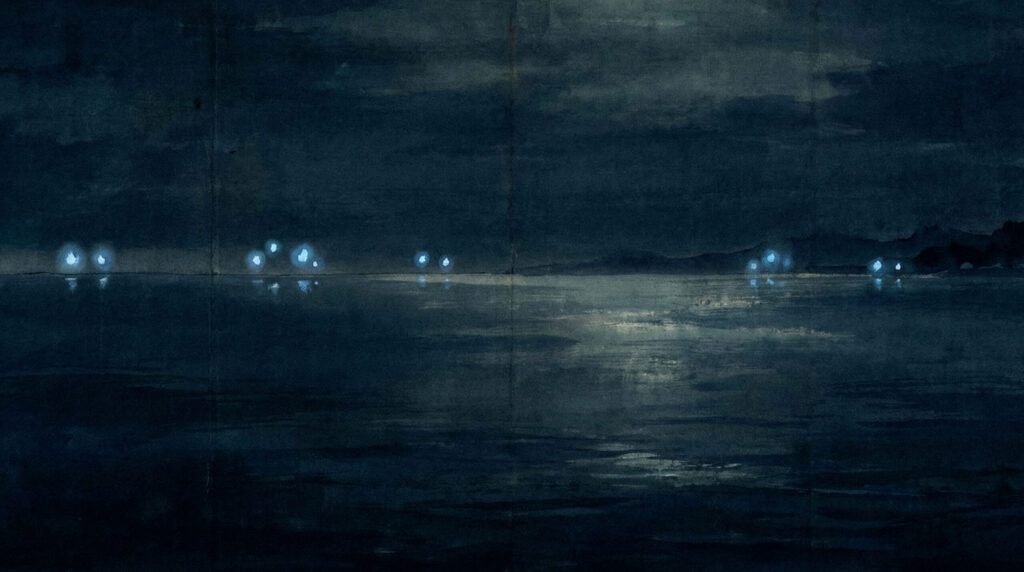
A mysterious ghostly light appearing over coastal waters at night.
It represents maritime omen, boundary fire, and sea-bound warning.
Primary Sources
Classical & Mythological Records
Edo-period coastal shiranui light phenomena and sea-omen lore
Kyūshū coastal shiranui sightings in maritime chronicles
不知火・海上怪火・海難前兆に関する沿岸説話資料
Modern Folklore References
Yanagita Kunio — shiranui and sea-omen beliefs
Komatsu Kazuhiko — yōkai of mysterious coastal lights
Shiranui – Mysterious Lights of the Sea in Japanese Folklore
Shiranui(不知火) are mysterious lights said to appear over the sea along the western coasts of Kyushu, most notably in the Yatsushiro Sea and Ariake Sea. Unlike many yokai that are personified beings, shiranui are best understood as a phenomenon at the boundary between natural occurrence, folklore, and supernatural interpretation.
They are not described as spirits with intention or emotion. Instead, shiranui manifest as unexplained lights that appear suddenly, multiply, and drift across the dark sea—eliciting awe, fear, and speculation from those who witness them.
Early Records and Historical Accounts
One of the earliest and most famous references to shiranui appears in the Kojiki and Nihon Shoki traditions associated with Emperor Keikō. According to later interpretations, the emperor witnessed strange lights at sea during his campaign in Kyushu. When questioned, local people replied that the phenomenon was called “shiranui”—literally, “unknown fire.”
By the medieval and early modern periods, shiranui were recorded in regional documents and travel accounts as recurring maritime anomalies. These descriptions consistently emphasize:
- Appearance on specific nights
- Calm sea conditions
- Lights that divide, multiply, and drift
The repetition of similar details across centuries suggests a phenomenon that was experienced collectively, not merely imagined individually.
Shiranui as a Liminal Phenomenon
Shiranui occupy a unique position in Japanese folklore because they resist simple classification.
They are:
- Not spirits of the dead
- Not gods or yokai with personalities
- Not clearly controllable or communicative
Instead, they function as threshold phenomena, appearing at the boundary between land and sea, known and unknown, explanation and mystery. This liminality is central to their cultural impact.
The sea itself has long been regarded in Japan as a realm of danger, transition, and otherness. Shiranui, appearing just above the waterline, reinforce this perception.
Natural Explanations and Folk Interpretation
From the Edo period onward, scholars and observers proposed natural explanations for shiranui, including:
- Atmospheric refraction
- Combustion of gases
- Optical illusions caused by temperature layers
However, no single explanation has been universally accepted, and many proposed conditions fail to account fully for the reported behavior of the lights.
Importantly, folk belief did not require definitive explanation. Shiranui were accepted as events that should be observed, not approached, reinforcing the idea that some aspects of nature resist human mastery.
Symbolism and Cultural Meaning
The Unknown Made Visible
The name “shiranui” itself emphasizes uncertainty. These lights symbolize the presence of something real yet ungraspable—visible proof that not all phenomena can be named or controlled.
Warnings and Boundaries
In some traditions, shiranui were regarded as ominous signs, discouraging travel or fishing on certain nights. They thus functioned as informal boundary markers, defining when and where humans should not intrude.
Nature Beyond Human Intention
Unlike yokai driven by emotion or will, shiranui have no moral stance. They neither punish nor reward. This neutrality makes them unsettling: they exist entirely outside human concerns.
Related Concepts
Onibi (鬼火)
Will-o’-the-wisp spirits.
→ Onibi
Funayūrei (船幽霊)
Ghosts of drowned sailors.
→ Funayūrei
Watatsumi (海神)
Sea deities.
→ Watatsumi
Marebito (稀人)
Otherworldly visitors.
→ Marebito
Regional Belief and Transmission
Shiranui traditions are strongly localized. The phenomenon is primarily associated with specific coastal regions of Kyushu, and knowledge of it was transmitted through:
- Fishermen’s oral tradition
- Local chronicles
- Seasonal observation
This regional specificity reinforces the idea that shiranui are tied to particular landscapes rather than universal mythic patterns.
Modern Cultural Interpretations

This blade symbolizes maritime omen and boundary fire.
It visualizes sea-bound warning condensed into weapon form.
In modern Japan, shiranui are often discussed through scientific inquiry, tourism narratives, or symbolic reinterpretation. While sightings are rare or disputed today, the concept of shiranui remains powerful as a symbol of unexplained natural forces, a reminder of pre-modern observational culture, and an example of folklore grounded in lived experience.
In contemporary media, shiranui are sometimes reimagined as supernatural flames or spirits, but these portrayals usually simplify the original ambiguity.
In some modern visual reinterpretations, shiranui manifest as a yōtō — a blade that seems to waver in outline, as if its edge cannot be fixed in place. The sword embodies uncertainty rather than threat.
Shiranui persist because not every light offers explanation.
Modern Reinterpretation – Shiranui as the Light That Refuses Definition
Shiranui does not explain. It does not answer. It does not resolve.
The “beautiful girl” form does not represent spirits, flames, or omens. She does not teach. She does not guide.
Her wavering presence represents the moment when observation loses authority — light that appears without meaning and vanishes without reason.
She does not threaten. She does not promise. She does not remain.
In this visual form, Shiranui becomes a contemporary yokai of undefined presence — a spirit that exists only while certainty has failed.
Musical Correspondence
The accompanying track translates uncertainty into sound. Shimmering tones, drifting harmonics, and layered echoes evoke lights that appear and disperse across dark water.
Silence acts not as rest, but as disappearance — framing sound as something that fades rather than concludes.
Together, image and sound form a unified reinterpretation layer — a modern folklore artifact of presence that refuses explanation and leaves nothing behind.
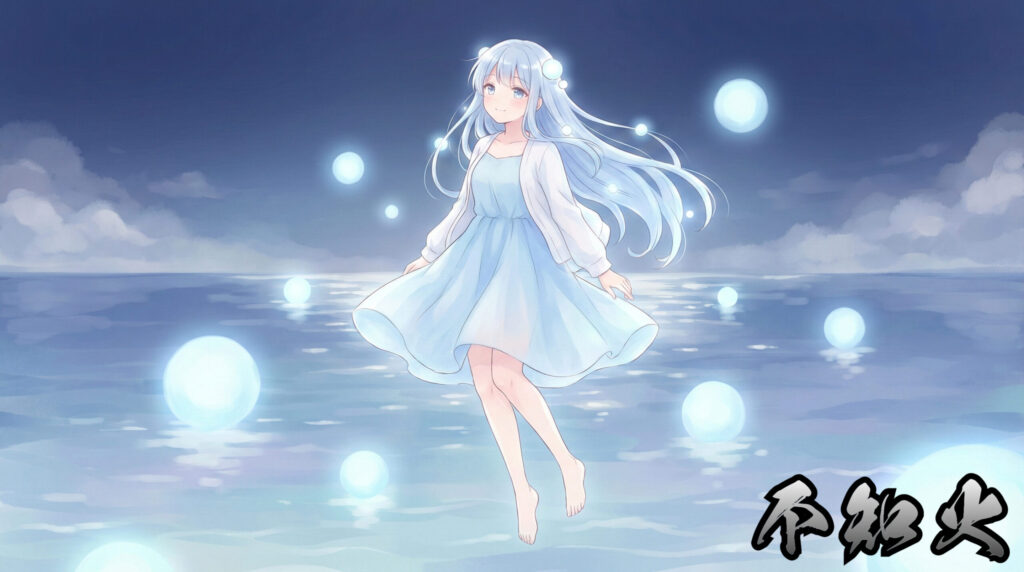
She embodies boundary fire and sea-bound omen.
Her presence reflects maritime warning made visible.
Dreamy and stylish
Genre: Ritual Japanese HipHop / Darkwave Folklore Produced by: Phantom Tone | Suno AI | Kotetsu Co., Ltd. Tags: #JapaneseHipHop #AIgeneratedMusic #Yokai #Phant…