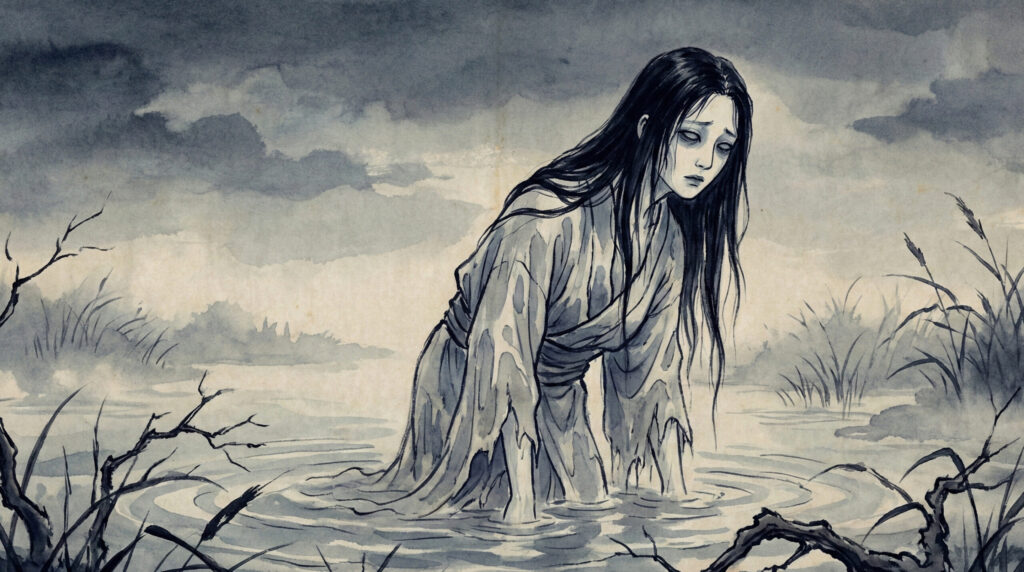
A drowned human spirit bound to rivers and wells.
It represents aquatic death, lingering sorrow, and water-bound haunting.
Primary Sources
Classical & Mythological Records
Edo-period water-death spirit and drowned-corpse lore
River and well-bound drowning spirit accounts
水死人・溺死霊・水辺死霊に関する沿岸説話資料
Modern Folklore References
Yanagita Kunio — drowned spirits and water-bound dead
Komatsu Kazuhiko — yōkai of drowning and aquatic death
Mizushinin – Those Claimed by Water and Bound to Its Depths in Japanese Folklore
Mizushinin refers not to a single yōkai, but to a category of beings in Japanese folklore: people who died in water and did not return to the world of the living—or the dead—cleanly. They remain tied to the place of drowning.
They are not summoned.
They are not chosen.
They are left behind.
Mizushinin embody death that water does not release.
Origins in Drowning and Improper Passage
In traditional belief, death required proper rites to ensure passage to the afterlife. Drowning disrupted this process. Bodies were lost, rites delayed, or spirits unsettled.
Mizushinin emerged as an explanation for this rupture: souls caught between water and shore, belonging fully to neither.
The river continues.
The dead do not.
Not Yōkai, Not Ghost
Mizushinin occupy an uneasy position:
- Not yōkai born of intent or transformation
- Not onryō driven by vengeance
- Not kami elevated through worship
They are defined by circumstance, not desire.
Death happened too suddenly.
The spirit did not move on.
Appearance as Residual Humanity
Accounts of Mizushinin emphasize partial recognition:
Human-shaped silhouettes beneath water
Pale limbs drifting unnaturally
Faces obscured by surface distortion
Eyes open, but unfocused
They resemble the living just enough to disturb.
They look like someone you might have known.
Behavior: Pull Without Malice
Mizushinin are often said to cause further drownings, but not through aggression:
They grasp reflexively
They cling when approached
They draw others down seeking release
They mistake the living for anchors
This is not revenge. It is desperation.
They do not wish harm.
They wish weight.
Relationship with Humans
Humans historically responded to Mizushinin with avoidance and ritual:
Avoiding certain waters
Offering prayers or memorial markers
Conducting rites to appease unsettled spirits
Acknowledgment allows release. Ignorance prolongs presence.
The dead wait for recognition.
Mizushinin Among Water Entities
Mizushinin occupy the final stage in the water sequence:
- Suisei – water as essence
- Kawahime – water as invitation
- Idonozoki – water as gaze
- Mizushinin – water as consequence
They are not the cause.
They are the result.
Symbolism and Themes
Death Without Closure
Rites interrupted.
Water as Possession
The element claims bodies.
Accidental Haunting
Presence without intent.
The Weight of Memory
The past pulls downward.
Related Concepts
Funayūrei (船幽霊)
Ghosts of drowned sailors.
→ Funayūrei
Kappa (河童)
River-dwelling yokai.
→ Kappa
Onryō (怨霊)
Vengeful spirits.
→ Onryō
Muen-botoke (無縁仏)
Unclaimed spirits.
→ Muen_botoke
Mizushinin in Folklore Memory
Stories of Mizushinin often explain repeated drownings in the same location. Survivors describe being pulled by something human-shaped but unresisting.
The horror lies in familiarity.
It feels like being held by the dead.
Modern Cultural Interpretations

This blade symbolizes drowning death and water-bound haunting.
It visualizes aquatic loss condensed into weapon form.
Modern interpretations often view Mizushinin as metaphors for unresolved trauma — experiences that drag forward because they were never processed.
Psychologically, they represent grief that pulls others into stagnation.
In some modern visual reinterpretations, Mizushinin manifest as a yōtō — a blade that seems perpetually wet. The sword leaves a fading water-trail, embodying loss that continues to move.
Mizushinin persist because some losses are never properly mourned.
Modern Reinterpretation – Mizushinin as the Weight That Never Rose
Mizushinin does not wander. It does not cry. It does not ask to be remembered.
It remains.
The “beautiful girl” form does not represent water. She does not explain drowning. She does not portray sorrow.
Her silent presence represents loss that was never processed — weight that stayed when life moved on.
She does not rise. She does not follow. She does not resolve.
In this visual form, Mizushinin becomes a contemporary yokai of suspended consequence — a spirit that exists only while something unprocessed still holds the water in place.
Musical Correspondence
The accompanying track transforms submersion into sound. Low sinking drones, slow descending harmonies, and fading melodic fragments evoke gravity without release.
Silence acts not as rest, but as depth — framing sound as something that sinks rather than ends.
Together, image and sound form a unified reinterpretation layer — a modern folklore artifact of loss that never rose.
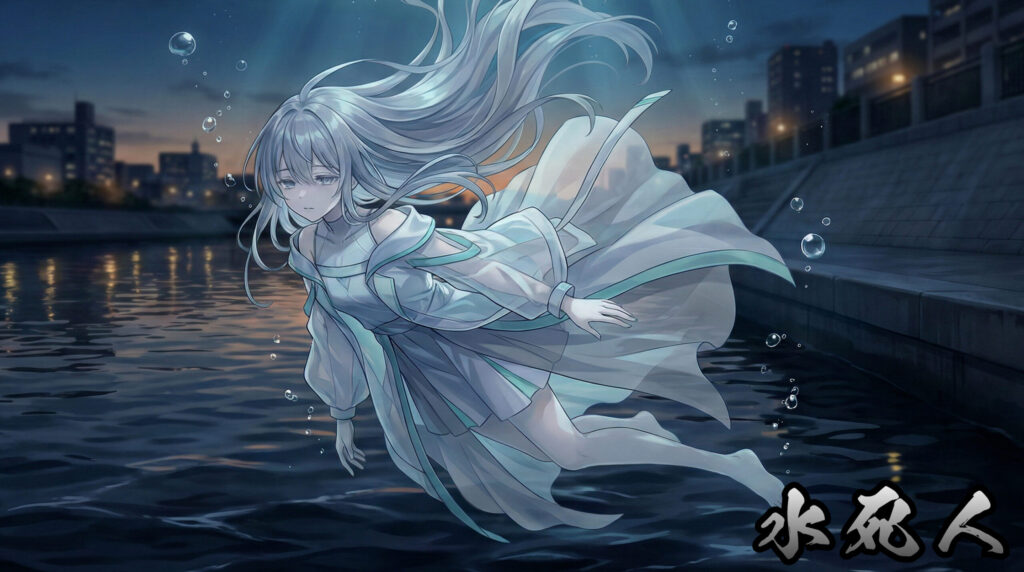
She embodies aquatic sorrow and water-bound haunting.
Her presence reflects drowning loss made visible.
Dreamy and stylish
Genre: Ritual Japanese HipHop / Darkwave Folklore Produced by: Phantom Tone | Suno AI | Kotetsu Co., Ltd. Tags: #JapaneseHipHop #AIgeneratedMusic #Yokai #Phant…