
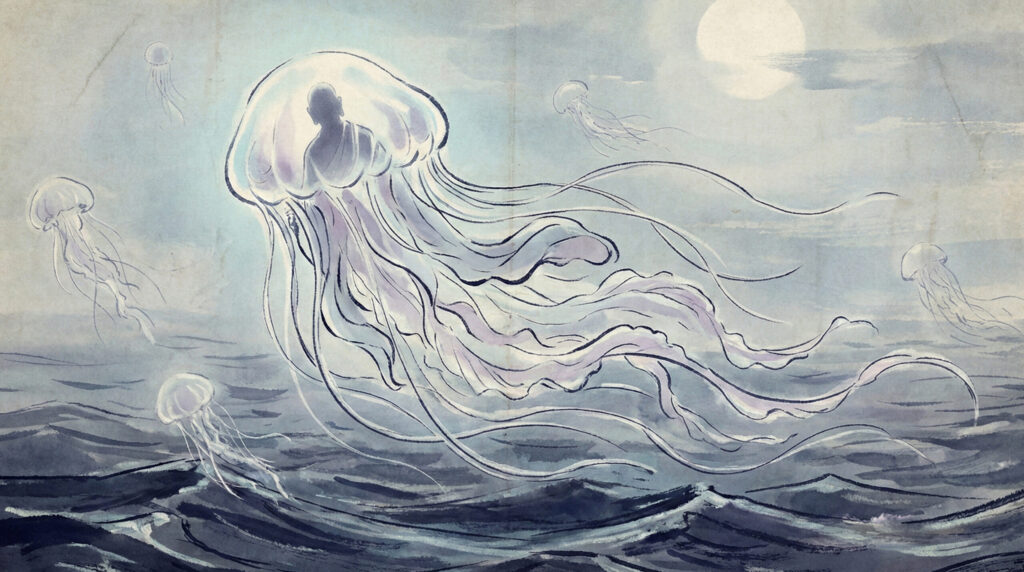
A monk-like jellyfish yokai appearing in coastal waters.
It represents maritime illusion, drowning fear, and sea-bound trickery.
Primary Sources
Classical & Mythological Records
Edo-period marine monk-spirit and jellyfish-yōkai lore
Coastal temple and sea-monster folktales involving kurage-like apparitions
海月坊・海僧怪異に関する沿岸説話資料
Modern Folklore References
Yanagita Kunio — marine monk and sea-spirit beliefs
Komatsu Kazuhiko — yōkai of jellyfish and monk apparitions
Kuragebō – The Boneless Presence That Drifts Between Life and Sea in Japanese Folklore
Kuragebō is a sea yōkai associated with jellyfish—soft-bodied, translucent beings that drift without bone, intent, or clear direction. Unlike aggressive sea monsters, Kuragebō does not pursue or attack.
It floats.
It touches.
And it lingers.
Kuragebō embodies danger without hostility.
Origins in Coastal Observation and Drift
Coastal communities long observed jellyfish as uncanny lifeforms: alive yet structureless, present yet directionless. Their sudden blooms and stinging touch created fear without visible aggression.
Kuragebō emerged as the personification of this unease—a monk-like presence tied to the sea’s quiet, drifting hazards.
The sea does not always strike.
Sometimes, it brushes against you.
From Water Dead to Sea Residue
Where Mizushinin represents those claimed by water through death, Kuragebō represents what remains when water erases intention entirely.
The jellyfish has no bones.
Kuragebō has no purpose.
This makes it unsettling: something alive that does not mean anything.
Appearance: Monastic Drift
Descriptions of Kuragebō vary, but share key traits:
A humanoid silhouette beneath translucent mass
Tentacle-like extensions resembling sleeves
A head or hood evoking a monk’s cowl
Movement slow, vertical, and passive
It does not swim. It drifts—like prayer without words.
Behavior Without Malice
Kuragebō does not hunt. Its danger is incidental:
Touch causes pain or paralysis
Contact disorients swimmers
Proximity induces panic
Presence spreads without warning
Victims suffer not because Kuragebō intends harm, but because they encounter it.
The sea does not apologize.
Relationship with Humans
Humans historically responded to jellyfish blooms with avoidance rather than confrontation. Kuragebō reflects this response: a being that should not be challenged, only respected through distance.
It cannot be reasoned with.
It cannot be frightened away.
It simply exists where you should not be.
Kuragebō Among Sea Entities
Kuragebō occupies a distinct position:
- Suisei – water as essence
- Kawahime – water as allure
- Mizushinin – water as consequence
- Kuragebō – water as residue
It is not cause or punishment.
It is aftermath.
Symbolism and Themes
Structureless Life
Existence without skeleton.
Drift Over Direction
Movement without agency.
Contact as Harm
Touch replaces attack.
Sea as Indifferent Medium
Meaning dissolves in water.
Related Concepts
Umibōzu (海坊主)
Colossal sea spirits.
→ Umibōzu
Funayūrei (船幽霊)
Ghosts of drowned sailors.
→ Funayūrei
Onibi (鬼火)
Will-o’-the-wisp spirits.
→ Onibi
Marebito (稀人)
Otherworldly visitors.
→ Marebito
Kuragebō in Folklore Memory
Kuragebō appears in yōkai catalogs and coastal lore as a visual metaphor rather than a narrative antagonist. It explains pain without cause and fear without pursuit.
The memory is not of being chased—
but of being touched.
Modern Cultural Interpretations

This blade symbolizes maritime illusion and drowning terror.
It visualizes jellyfish-like trickery condensed into weapon form.
Modern interpretations often see Kuragebō as a metaphor for passive harm — systems or environments that injure without intention.
Psychologically, it represents anxiety triggered by contact with something incomprehensible yet alive.
In some modern visual reinterpretations, Kuragebō manifests as a yōtō — a blade whose edge diffuses like drifting filaments. The sword seems to sting rather than cut, embodying harm without hostility.
Kuragebō persists because not all danger announces itself.
Modern Reinterpretation – Kuragebō as the Harm That Exists Before Intention
Kuragebō does not threaten. He does not warn. He does not pursue.
He exists.
The “beautiful girl” form does not explain poison. She does not symbolize danger. She does not represent fear.
Her quiet presence represents contact that injures before meaning — harm that arrives without motive, reason, or awareness.
She does not choose. She does not notice. She does not decide.
In this visual form, Kuragebō becomes a contemporary yokai of passive harm — a spirit that exists only while something can be touched without being understood.
Musical Correspondence
The accompanying track transforms passive contact into sound. Soft drifting textures, blurred harmonic motion, and slow pulsing tones evoke presence that harms without intention.
Silence acts not as rest, but as suspension — framing sound as something that touches before it explains.
Together, image and sound form a unified reinterpretation layer — a modern folklore artifact of harm that exists without will.
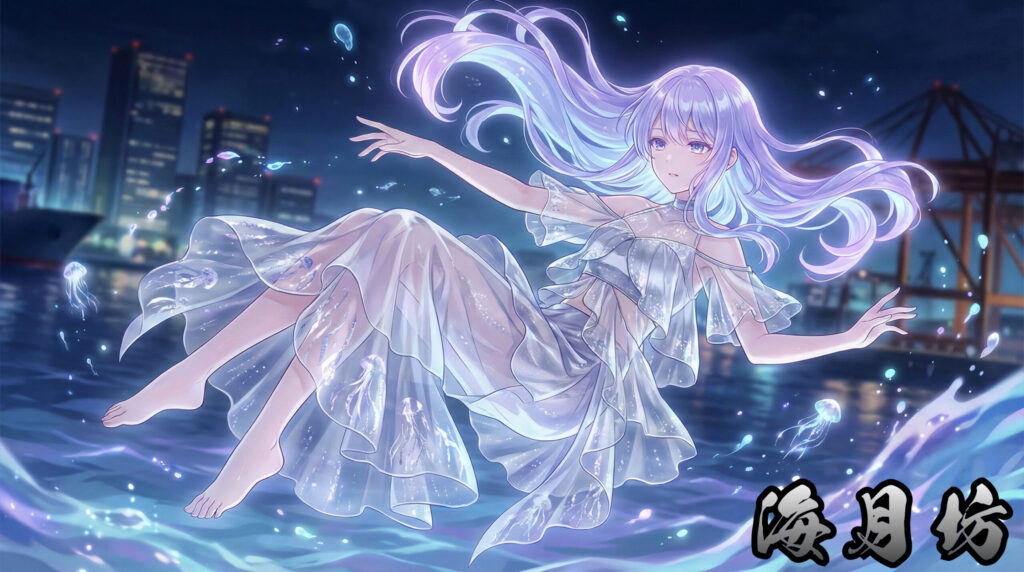
She embodies maritime illusion and drifting danger.
Her presence reflects sea-bound trickery made visible.
Drowncall
Genre: Japanese Folklore Hip-Hop, Ritual Lo-Fi Poetry Produced by: Phantom Tone | Suno AI | Kotetsu Co., Ltd. Tags: #AIgeneratedMusic #JapaneseHipHop #Folklore…

Amabie
Genre: Japanese Folklore Hip-Hop, Ritual Lo-Fi Poetry Produced by: Phantom Tone | Suno AI | Kotetsu Co., Ltd. Tags: #AIgeneratedMusic #JapaneseHipHop #Folklore…