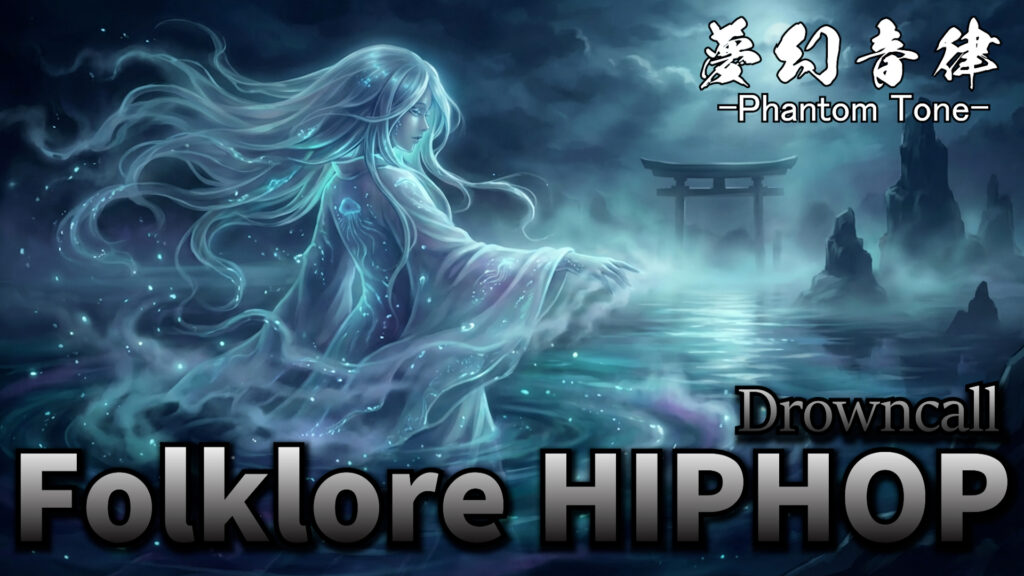
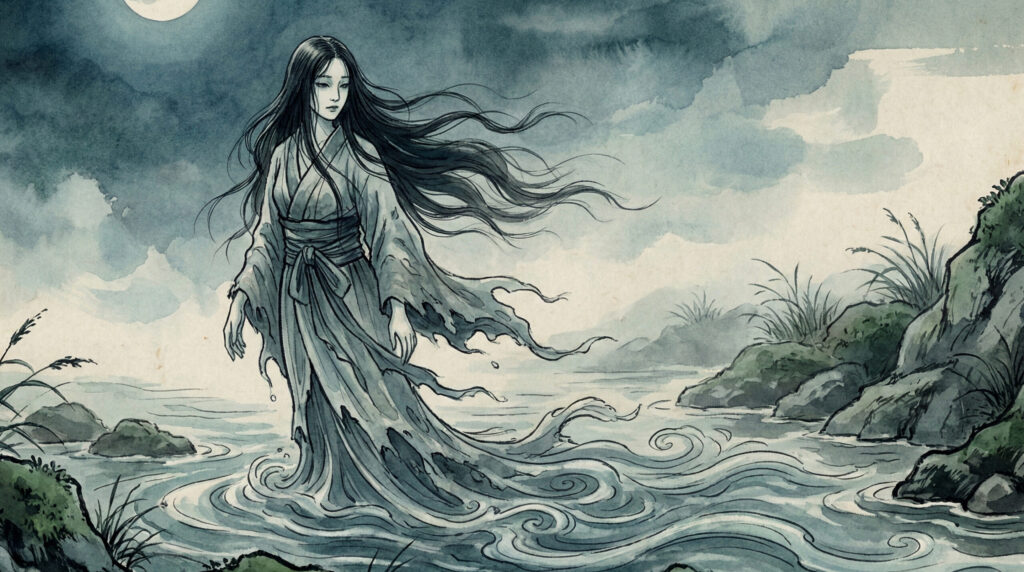
A river-bound maiden spirit appearing near waterways and crossings.
It represents liminality, aquatic femininity, and boundary guardianship.
Primary Sources
Classical & Mythological Records
Medieval river-spirit maiden lore and water-bound feminine deities
Setsuwa collections describing river-born maidens and boundary women
川姫・川女・水辺巫女に関する中世説話資料
Modern Folklore References
Yanagita Kunio — river maiden and water-bound female spirit beliefs
Komatsu Kazuhiko — yōkai of river maidens and aquatic liminality
Kawahime – The River Maiden Who Draws Humans Between Flow and Stillness in Japanese Folklore
Kawahime is a feminine spirit associated with rivers in Japanese folklore, embodying water once it acquires voice, intention, and allure. She is neither the raw essence of water nor a sovereign deity, but a personified presence that mediates between humans and flowing currents.
She does not rush like the river.
She does not remain still like the pool.
She waits where the water chooses.
Kawahime embodies water that has learned desire.
Origins in River Worship and Boundary Places
Rivers have long functioned as boundaries in Japan—between villages, provinces, and realms of life and death. They nourish fields while claiming lives through flood and current.
Kawahime emerges from this duality as the figure who speaks for the river. Springs, bends, shallows, and fords—places where humans approach water—are her domain.
The river does not always pull.
Sometimes, it invites.
From Essence to Persona
Where Suisei represents water before form or intention, Kawahime represents the moment water becomes relatable.
She smiles.
She sings.
She beckons.
This transition marks danger. What can be spoken to can also deceive.
Appearance and Liminal Beauty
Descriptions of Kawahime emphasize beauty touched by unease:
A young woman with flowing hair like water
Pale skin reflecting moonlight
Clothing that clings or dissolves into ripples
Eyes that seem deeper than the river itself
Her beauty is not ornamental. It is functional—an extension of flow.
She is attractive because water must be approached.
Behavior: Invitation and Pull
Kawahime does not drag victims violently. Her method is suggestion:
Calling softly from the riverbank
Appearing at dusk or night
Offering help, companionship, or curiosity
Encouraging approach rather than pursuit
Those who step too close may slip, drown, or vanish. The river finishes what she begins.
She does not kill.
She leads.
Relationship with Humans
Humans historically acknowledged Kawahime through caution:
Avoiding rivers at night
Offering prayers before crossing
Teaching children not to answer voices from water
Respect keeps distance. Curiosity closes it.
The river listens through her.
Kawahime Among Water Beings
Kawahime occupies a specific layer in water folklore:
- Suisei – water as essence
- Kawahime – water as allure
- Kappa – water as rule enforcer
- Watatsumi – water as sovereign
She is intimacy before law.
Symbolism and Themes
Beauty as Hazard
Attraction precedes danger.
Thresholds of Flow
Rivers as crossings.
Feminine Personification of Nature
Care and consumption entwined.
Invitation Without Force
Choice becomes consequence.
Related Concepts
Kappa (河童)
River-dwelling yokai.
→ Kappa
Mizu no Kami (水の神)
Water deities.
Marebito (稀人)
Otherworldly visitors.
→ Marebito
Ikiryō (生霊)
Living spirit projections.
→ Ikiryō
Kawahime in Folklore Memory
Kawahime appears in scattered regional tales, often as explanation for drownings without struggle. Survivors speak of voices, figures, or moments of hesitation.
She is remembered not as attacker, but as presence.
The step was voluntary.
Modern Cultural Interpretations

This blade symbolizes aquatic femininity and river-bound guardianship.
It visualizes boundary maidens condensed into weapon form.
Modern interpretations often read Kawahime as a metaphor for seductive danger — forces that attract rather than compel.
Psychologically, she represents the pull of curiosity toward risk, especially where boundaries appear gentle.
In some modern visual reinterpretations, Kawahime manifests as a yōtō — a blade whose surface mirrors flowing water. The sword reflects invitation rather than warning, embodying danger that approaches softly.
Kawahime persists because rivers still invite approach.
Modern Reinterpretation – Kawahime as the Invitation That Moves the River
Kawahime is not a river spirit. She is not a guardian. She is not a warning.
She is invitation.
The “beautiful girl” form does not lure through force. She does not threaten. She does not announce danger.
Her quiet smile represents attraction that feels gentle — movement that begins before intention notices.
She does not pull. She does not chase. She does not block.
In this visual form, Kawahime becomes a contemporary yokai of soft approach — a spirit that exists only as long as the river still invites stepping forward.
Musical Correspondence
The accompanying track transforms invitation into sound. Flowing arpeggios, drifting harmonies, and gentle rhythmic sway evoke motion that feels kind before it becomes current.
Silence acts not as rest, but as hesitation — framing sound as attraction rather than warning.
Together, image and sound form a unified reinterpretation layer — a modern folklore artifact of approach that moves before choice becomes aware.
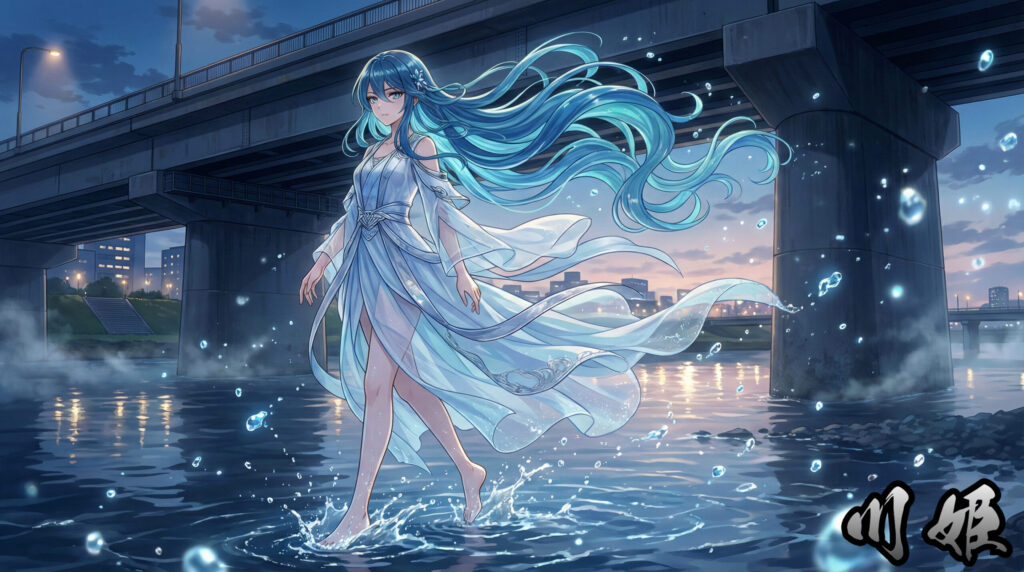
She embodies aquatic liminality and river-bound grace.
Her presence reflects boundary femininity made visible.
Amabie
Genre: Japanese Folklore Hip-Hop, Ritual Lo-Fi Poetry Produced by: Phantom Tone | Suno AI | Kotetsu Co., Ltd. Tags: #AIgeneratedMusic #JapaneseHipHop #Folklore…
Drowncall
Genre: Japanese Folklore Hip-Hop, Ritual Lo-Fi Poetry Produced by: Phantom Tone | Suno AI | Kotetsu Co., Ltd. Tags: #AIgeneratedMusic #JapaneseHipHop #Folklore…