
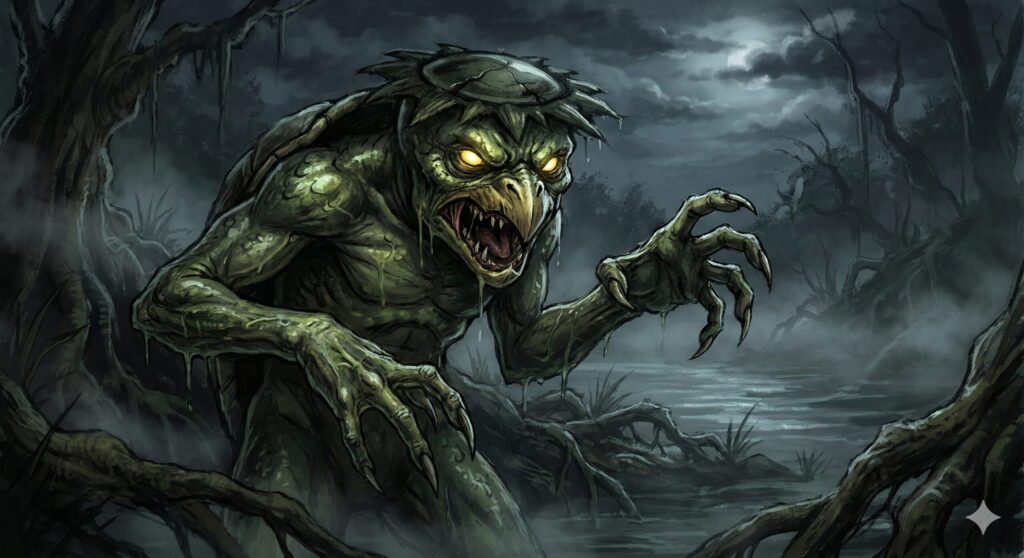
A river-dwelling yokai known for drowning victims and trickster behavior.
It represents water-bound danger, mischief, and boundary violation.
Primary Sources
Classical & Mythological Records
Medieval river-spirit lore and water-bound predator traditions
Setsuwa collections describing child-drowning water beings
河童・川霊・水辺怪異に関する中世説話資料
Modern Folklore References
Yanagita Kunio — kappa and water-bound yōkai beliefs
Komatsu Kazuhiko — yōkai of rivers, wells, and water crossings
What Is a Kappa?
The Kappa (河童), one of the most recognizable figures in Japanese folklore, is an aquatic yōkai said to inhabit rivers, ponds, irrigation channels, and forgotten waterways across rural Japan. Often depicted with a humanoid body, a turtle-like shell, and a beaked mouth, the Kappa’s most defining trait is the dish-like cavity on its head, known as the saradaba or sara, which holds water believed to be the source of its life force. Spilling or drying this water weakens the creature, making it vulnerable.
Historically, Kappa tales appear widely in Edo-period writings, Buddhist temple accounts, and oral traditions. Their behavior ranges from mischievous but harmless pranks—such as startling horses or stealing cucumbers—to more dangerous acts involving drowning or luring people into water. As with many Japanese yōkai, the Kappa embodies a dual nature: playful trickster, yet capable of causing real harm. This duality reflects Japan’s longstanding cultural negotiation with its rivers and wetlands, both vital and threatening.
Symbolism and Cultural Meaning
The Kappa symbolizes the deep respect—and fear—that communities historically held toward bodies of water. Before modern infrastructure, drowning accidents were common, especially among children. Folklore used the Kappa as a cautionary figure, warning against playing near dangerous currents. Its unpredictable temperament mirrors the volatility of rivers themselves, which could provide life-sustaining irrigation one season and destructive flooding the next.
The Kappa is also tied to agricultural rhythms. In some regions, rituals were performed to appease water spirits and ensure abundant harvests. Offerings of cucumbers, marked with family names, were thrown into rivers to secure protection or goodwill. These customs reveal the Kappa not only as a creature of fear, but as a spirit entwined with local water-based cosmologies.
Appearance and Behavior Across Regions
While core traits remain consistent, regional variations of the Kappa differ significantly. Some portray it as more amphibian, others more reptilian. In northern Japan, the Kappa appears with a fur-covered body, while in Kyushu it may have a more simian face. The creature’s behavior also shifts: sometimes a benign water sprite, other times a dangerous force that challenges humans to sumo wrestling matches or abducts livestock.
A recurring theme is the Kappa’s strict adherence to etiquette. One of the most well-known motifs is the Kappa’s compulsion to bow in return when bowed to. In doing so, the water in its head-dish spills, rendering it powerless. This narrative not only provides a folkloric weakness but also embeds the creature within the Confucian-influenced culture of ritualized respect in Japan.
Related Concepts
Kijimunā (キジムナー)
Woodland trickster spirits.
→ Kijimunā
Amefuri-bōzu (雨降り坊主)
Rain-bringing spirits.
Umibōzu (海坊主)
Colossal sea spirits.
→ Umibōzu
Marebito (稀人)
Otherworldly visitors.
→ Marebito
Kappa in Edo-Period Art and Literature
Artists such as Toriyama Sekien helped formalize the visual vocabulary of the Kappa, cementing its modern appearance. Ukiyo-e prints frequently portray it in riverbank scenes, balancing humor and unease. Edo-period literature also features Kappa as satirical figures—sometimes lampooning bureaucrats, monks, or farmers—reflecting social tensions through monstrous imagery. As with many yōkai, the Kappa becomes a mirror of the society that imagines it.
Modern Interpretations

This blade symbolizes water-bound predation and boundary violation.
It visualizes river danger condensed into weapon form.
In modern reinterpretations, Kappa is no longer framed as a playful river trickster or a folkloric mascot. It is reimagined as a yōtō — a blade forged from aquatic boundary law itself. Rather than luring victims into water, this incarnation of Kappa exists as a weapon that enforces river jurisdiction. Its edge does not merely wound; it cuts trespass from current, severing those who violate sacred waterways from safe passage. The Kappa yōtō functions as a hydrological execution instrument — a blade that restores balance by removing bodies that disrupt water-bound order. Where traditional imagery presented Kappa as a mischievous predator, its yōtō form reveals a colder truth: rivers are governed spaces, and survival within them requires compliance. Kappa endures because water still enforces law.
Modern Reinterpretation – Kappa as the Boundary That Lives in Water
Kappa are not beasts. They are not guardians. They are not myths that ended.
They are conditions.
The “beautiful girl” form does not threaten. She does not chase. She does not explain.
Her quiet, unreadable presence represents water as boundary — not resource, not scenery, but law without language.
She does not warn. She does not forgive. She simply remains where order dissolves into current.
In this visual form, Kappa becomes a contemporary yokai of unmarked regulation — a spirit that exists only where rivers still decide.
Musical Correspondence
The accompanying track transforms current into sound. Shallow pulses, restrained motion, and submerged rhythmic layers evoke water that moves without permission.
Silence acts not as rest, but as boundary — framing sound as something that defines where passage ends.
Together, image and sound form a unified reinterpretation layer — a modern folklore artifact of invisible rules written into flowing water.

She embodies river predation and mischievous danger.
Her presence reflects water-bound fear made visible.
CopperKappar
Genre: Japanese Folklore Hip-Hop, Ritual Lo-Fi Poetry, Wafū Duet Produced by: Phantom Tone | Suno AI | Kotetsu Co., Ltd. Tags: #AIgeneratedMusic #JapaneseHipHo…