
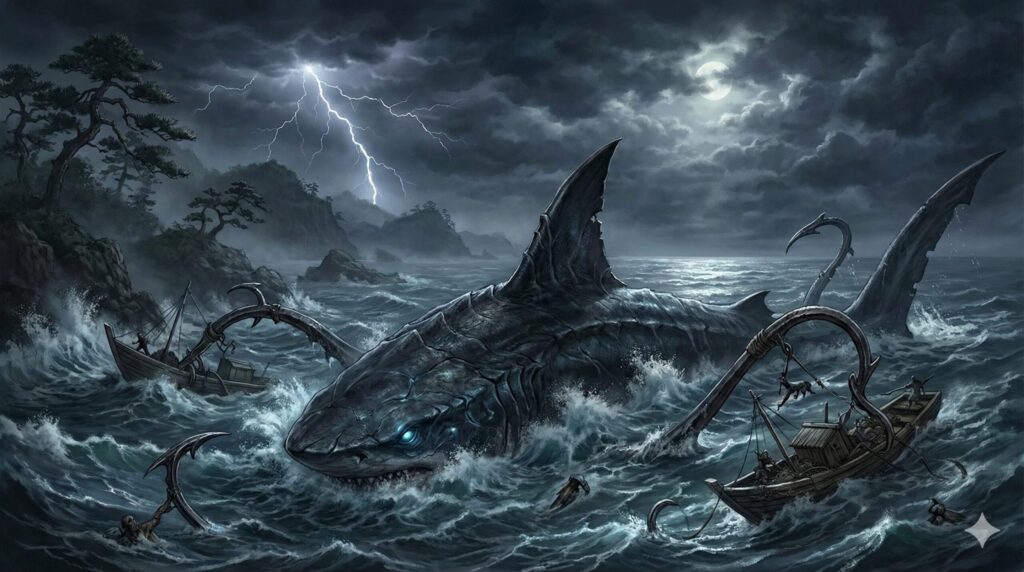
A monstrous sea creature that seizes sailors from behind.
It represents maritime ambush, sudden loss, and oceanic terror.
Primary Sources
Classical & Mythological Records
Edo-period maritime monster accounts and coastal predator lore
Sailor reports and kaidan describing sea-grabbing apparitions
磯撫で・沿岸怪異に関する江戸期航海説話資料
Modern Folklore References
Yanagita Kunio — coastal sea predator beliefs
Komatsu Kazuhiko — yōkai of maritime ambush and oceanic beasts
Isonade – Sea-Brushing Predators of Japanese Folklore
Isonade are fearsome maritime yōkai said to haunt the deep coastal waters of western Japan—massive, unseen predators that rise silently from beneath the waves to drag sailors into the sea. Unlike beasts that reveal themselves openly, isonade strike only with fragments of their body: a hooked, barbed fin; a dark shadow gliding under the surface; a sudden pull from below. Their presence is defined not by visibility, but by disappearance.
These spirits embody the ancient dread of the ocean—its vastness, its indifference, and its ability to swallow human lives without leaving a trace. In coastal villages, storms, missing fishermen, or unexplained disturbances in the water were sometimes attributed to the touch of an isonade. As such, the creature is not merely a monster but a symbol of the sea’s unpredictable and consuming power.
Origins and Early Depictions
The name isonade (磯撫) literally means “shore-brusher,” referring to its habit of gliding close to rocky coastlines, brushing its barbed tail or fins along the water's edge. Early accounts from Wakayama and nearby coastal regions describe an enormous fish-like creature whose body is almost never seen. Instead, only a dark shadow or a hooked fin emerges above the surface.
In some traditions, isonade’s appearance is an omen of stormy seas or the imminent loss of a ship. In others, it is a patient hunter, lurking beneath fishing boats and using its barbed appendages to grasp the unsuspecting.
The minimal visual detail in early lore reflects the creature’s nature: the ocean hides more than it reveals, and isonade’s existence is defined by this concealment.
From Maritime Hazard to Symbol of Oceanic Fear
While many yōkai inhabit forests or mountains, isonade belongs firmly to the deep sea. Its stories highlight the vulnerability of human life on the water. Pre-modern fishermen faced storms, whirlpools, and sudden squalls with limited understanding—and yōkai like isonade offered a supernatural explanation for disasters that seemed random and merciless.
Over time, isonade came to symbolize the unseen threats of the sea: creatures lurking in deep trenches, unseen forces tugging at boats, or shadows moving beneath the waves. Unlike sea dragons or serpents, isonade possesses no majestic form; instead, it is the horror of the unknown made manifest.
Characteristics and Behavior
Though rarely described in full, several consistent features appear across regional legends:
Barbed Tail or Fin
Isonade is said to possess a massive fin covered in hooks or spines.
It uses this appendage to strike boats, drag humans into the sea, or tear through nets.
Shadowy, Subsurface Body
Most tales emphasize that its main body remains invisible.
Only a ripple or dark mass beneath the waves gives it away.
Silent Approach
True to its name, isonade “brushes” the shore or the hull of a boat as it hunts, producing a faint scraping sound that precedes disaster.
Predatory Intent
Unlike morally ambiguous yōkai, isonade is almost always hostile.
It is a hunter—patient, quiet, and deadly.
Symbolism and Themes
Fear of the Unknown Depths
Isonade embodies what cannot be seen beneath the ocean surface.
It represents humanity’s ancient fear of deep waters and the creatures imagined within them.
The Ocean as Devourer
Where mountain yōkai guard or challenge, isonade consumes.
Its legends reflect the harsh reality of coastal life, where the sea gives life but takes it just as easily.
Unseen Forces and Sudden Loss
Because only part of the creature is visible, isonade symbolizes disasters without explanation—boats vanishing, people swept overboard, storms that arise without warning.
Nature’s Indifference
Isonade is not evil; it is indifferent.
This aligns with the broader Japanese view of nature spirits—not moral entities, but powerful forces requiring respect.
Related Concepts
Umibōzu (海坊主)
Colossal sea spirits.
→ Umibōzu
Watatsumi (海神)
Sea deities.
→ Watatsumi
Funayūrei (船幽霊)
Ghosts of drowned sailors.
→ Funayūrei
Marebito (稀人)
Otherworldly visitors.
→ Marebito
Isonade in Literature and Art
Though not as commonly depicted as land-bound yōkai, isonade appears in Edo-period yōkai scrolls and encyclopedias, often illustrated as a gigantic fish or shark-like creature with a hooked tail rising above stormy seas.
Artists and writers portray isonade in various ways:
- a vast silhouette beneath a fishing vessel,
- a barbed fin slashing through waves,
- a monstrous shadow approaching rocky shores at twilight.
The creature’s lack of a defined form has allowed artists great interpretive freedom, resulting in depictions that range from realistic to fantastical.
Regional Legends and Local Accounts
Coastal communities tell stories such as:
- fishermen pulled into the sea by an unseen force,
- boats dragged off course in calm weather,
- strange scrape marks found along hulls after foggy nights,
- warnings to avoid certain coves believed to be isonade hunting grounds.
These tales often serve both as cautionary folklore and as practical reminders of dangerous waters.
Modern Cultural Interpretations

This blade symbolizes maritime ambush and oceanic terror.
It visualizes sudden sea-bound death condensed into weapon form.
In contemporary media, isonade often appears as a deep-sea horror, a kaiju-like creature, or a symbolically rich figure in supernatural fiction.
Modern creators frequently emphasize its shadowy, partially unseen nature; the tension between beauty and terror in ocean imagery; and themes of isolation and overwhelming natural force.
In some modern visual reinterpretations, isonade manifests as a yōtō — a blade whose spine curves like a hooked fin. The sword seems to surface only briefly, embodying presence that is felt more than seen.
Its design varies widely, but it typically maintains the iconic hooked fin or barbed tail.
Modern Reinterpretation – Isonade as the Condition of Unseen Predation
Isonade is not a sea monster. It is not a creature that hunts, attacks, or seeks.
It is the condition in which the ocean already contains hunger.
The “beautiful girl” form does not explain danger. She does not represent fear, predators, or storms. She simply is.
Her distant, undefined expression represents the pressure of unseen mass — something that exists beneath perception long before it becomes threat.
She does not surface. She does not chase. She does not announce. She remains only while something below is still moving.
In this visual form, Isonade becomes a contemporary yokai of unseen presence — a spirit that exists not as a hunter, but as the condition that something vast is already there.
Musical Correspondence
The accompanying track transforms depth into sound. Low drifting drones, slow oscillating figures, and distant harmonic pressure evoke presence without shape.
Silence acts not as rest, but as submerged distance — framing sound as mass rather than motion.
Together, image and sound form a unified reinterpretation layer — a modern folklore artifact of predation that does not act, but already exists beneath the surface.
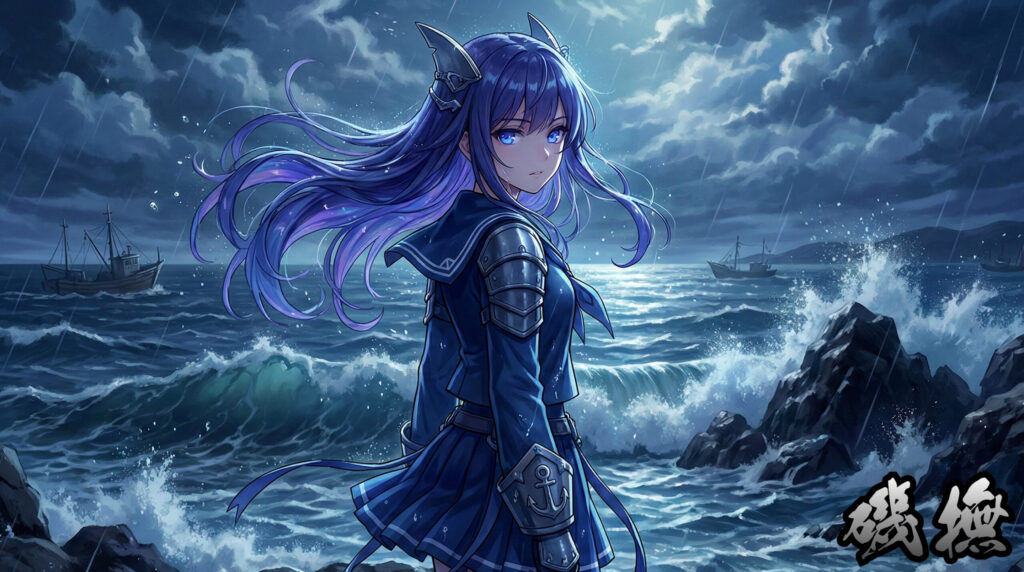
She embodies sudden maritime ambush and oceanic fear.
Her presence reflects sea-bound terror made visible.
Drowncall
Genre: Japanese Folklore Hip-Hop, Ritual Lo-Fi Poetry Produced by: Phantom Tone | Suno AI | Kotetsu Co., Ltd. Tags: #AIgeneratedMusic #JapaneseHipHop #Folklore…