
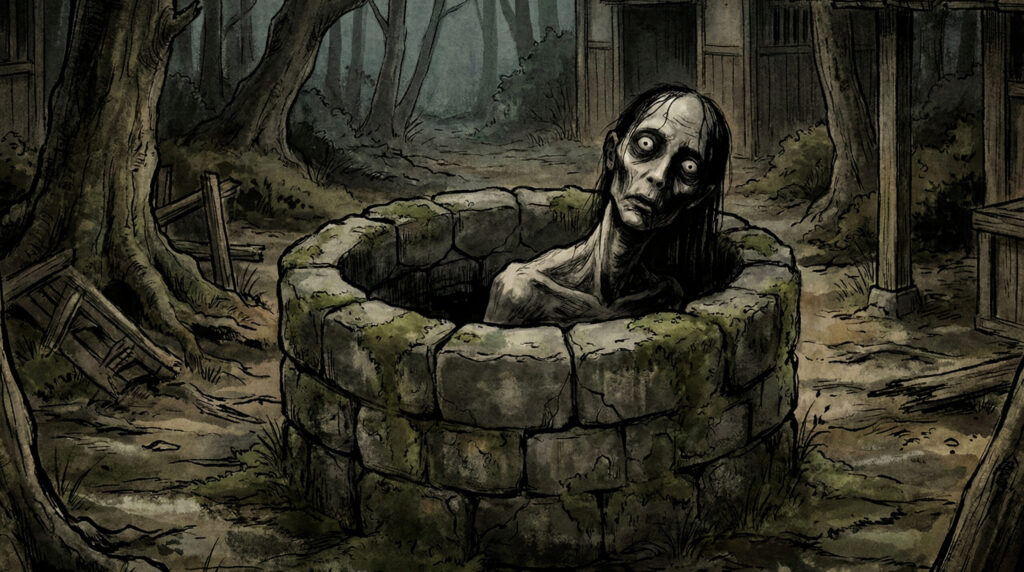
A hidden watcher spirit that peers from within abandoned wells.
It represents unseen observation, water-bound fear, and boundary haunting.
Primary Sources
Classical & Mythological Records
Edo-period well-ghost and well-bound spirit accounts
Setsuwa collections describing well-haunting apparitions
井戸霊・井戸怪談に関する江戸期説話資料
Modern Folklore References
Yanagita Kunio — well spirits and water-bound apparitions
Komatsu Kazuhiko — yōkai of wells and hidden watchers
Idonozoki – The Presence That Watches from the Depth of the Well in Japanese Folklore
Idonozoki is a yōkai associated with wells—confined, vertical spaces where water meets darkness. Unlike river spirits that invite approach, Idonozoki waits below, observing those who lean too far over the edge.
It does not call.
It does not reach.
It watches until you look back.
Idonozoki embodies the danger of curiosity turned inward.
Origins in Wells as Domestic Boundaries
In traditional Japan, wells were essential and intimate. They stood within villages and homes, supplying life while concealing depth. Unlike rivers or seas, wells were contained unknowns—dark, still, and unreachable.
Idonozoki emerged to explain unease around these spaces: the feeling that something within the well was aware of those above it.
The danger is not outside the village.
It is beneath it.
From Water Essence to Localized Gaze
Where Suisei represents water as essence and Kawahime represents water as allure, Idonozoki represents water as attention—focused, narrow, and vertical.
The well does not flow.
It stares upward.
Appearance as Partial Revelation
Idonozoki is rarely seen fully. Accounts describe fragments:
Eyes reflecting faint light
A face distorted by water and stone
A shadow that aligns with the viewer’s position
Movement only when watched
Its form adapts to perception. The clearer one tries to see, the less certain the shape becomes.
The well reveals nothing all at once.
Behavior: The Trap of Looking
Idonozoki’s power lies in the act of gazing:
Those who peer too long feel compelled to lean closer
Balance weakens without clear cause
A sense of being counted or measured arises
In some tales, the watcher becomes the watched
The well does not pull violently. The danger unfolds through fixation.
The fall is voluntary.
Relationship with Humans
Historically, people avoided unnecessary attention to wells:
Children were warned not to look inside
Lids were kept closed
Offerings were made after accidents
These customs were not superstition alone—they enforced restraint.
The well must be respected as a boundary.
Idonozoki Among Water Beings
Idonozoki occupies a precise niche:
- Suisei – water as essence
- Kawahime – water as invitation
- Idonozoki – water as gaze
- Mizushinin – water as result
It is the moment before consequence.
Symbolism and Themes
Curiosity as Risk
Attention invites danger.
Vertical Fear
Threats rise from below.
Domestic Uncanny
The familiar becomes unsafe.
Reflection and Reversal
To look is to be seen.
Related Concepts
Onryō (怨霊)
Vengeful spirits.
→ Onryō
Marebito (稀人)
Otherworldly visitors.
→ Marebito
Kage-onna (影女)
Shadow-bound apparitions.
→ Kage_onna
Mizu no Kami (水の神)
Water deities.
Idonozoki in Folklore Memory
Idonozoki appears in regional accounts explaining falls, drownings, or sudden fear near wells. Survivors describe moments of hesitation—an instant when the world narrowed.
Nothing grabbed them.
Something waited.
Modern Cultural Interpretations

This blade symbolizes unseen watching and well-bound fear.
It visualizes hidden observation condensed into weapon form.
Modern interpretations often read Idonozoki as a metaphor for fixation — obsession that pulls one deeper the longer it is indulged.
Psychologically, it represents intrusive thought: attention that turns back on itself.
In some modern visual reinterpretations, Idonozoki manifests as a yōtō — a blade whose surface seems to recede inward, as if depth has replaced reflection. The sword embodies descent rather than attack.
Idonozoki persists because closed depths still unsettle.
Modern Reinterpretation – Idonozoki as the Condition of Descending Attention
Idonozoki is not a watcher. It is not a creature that waits, follows, or observes.
It is the condition in which attention has already begun to fall.
The “beautiful girl” form does not look. She does not threaten, warn, or pursue. She simply is.
Her distant, undefined expression represents the moment when perception tilts — when looking quietly becomes depth.
She does not pull. She does not speak. She does not move. She remains only while attention is still leaning inward.
In this visual form, Idonozoki becomes a contemporary yokai of descending awareness — a spirit that exists not as a presence in the well, but as the condition that looking has already become falling.
Musical Correspondence
The accompanying track transforms depth into sound. Descending tonal motion, narrow harmonic ranges, and enclosed reverberation evoke inward collapse rather than motion.
Silence acts not as rest, but as vertical pressure — framing sound as distance rather than space.
Together, image and sound form a unified reinterpretation layer — a modern folklore artifact of attention that fails downward, long before the body moves.
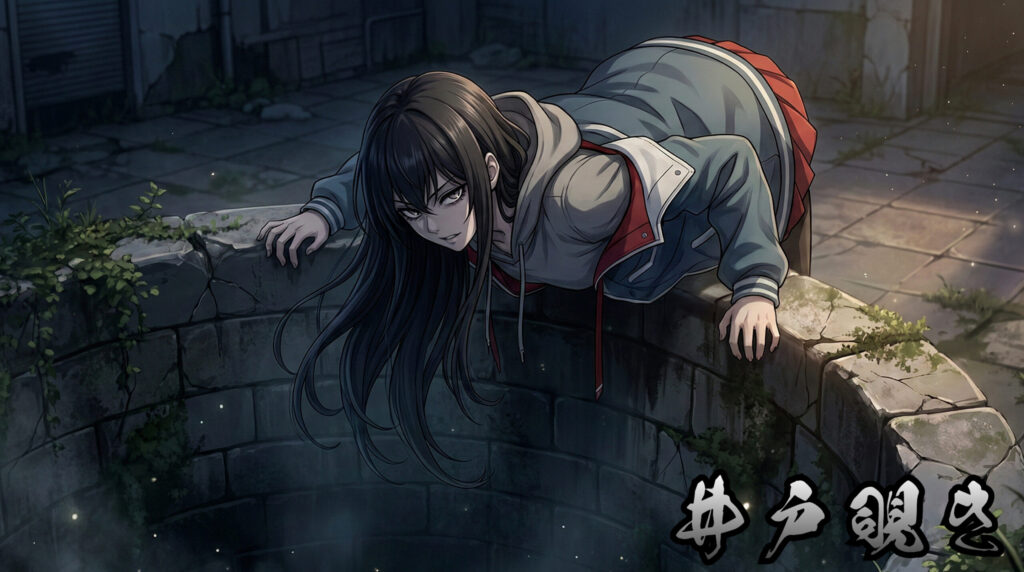
She embodies hidden watching and water-bound fear.
Her presence reflects unseen presence made visible.
Dreamy and stylish
Genre: Ritual Japanese HipHop / Darkwave Folklore Produced by: Phantom Tone | Suno AI | Kotetsu Co., Ltd. Tags: #JapaneseHipHop #AIgeneratedMusic #Yokai #Phant…