Ushi-oni – Monstrous Beasts of Japanese Folklore
Ushi-oni are among the most fearsome and grotesque creatures in Japanese folklore: monstrous beings combining features of cattle and demons, often dwelling near coasts, rivers, mountains, or remote villages. Their appearance alone inspires terror — massive bodies, horned heads, sharp fangs, and eyes filled with hostility.
Unlike ambiguous tricksters or silent spirits, ushi-oni are overtly dangerous. They attack humans directly, spreading fear, illness, or death. In many legends, merely encountering an ushi-oni is enough to bring misfortune.
Ushi-oni embody raw, physical horror — a manifestation of threat given tangible form.
Origins and Early Accounts
The name ushi-oni (牛鬼) literally means “ox demon,” reflecting its animalistic brutality and demonic nature. Early accounts vary widely by region, suggesting that the term encompasses multiple local monsters rather than a single unified being.
Stories of ushi-oni often emerged in areas where unexplained deaths, disease outbreaks, or disappearances occurred. The creature served as a narrative explanation for dangers lurking beyond the safety of the village — in forests, mountains, and along dangerous coastlines.
Unlike imported mythological figures, ushi-oni are strongly rooted in regional oral traditions.
From Local Monster to Folkloric Archetype
Over time, the ushi-oni evolved into a recognizable archetype: a monstrous guardian of forbidden spaces. In many tales, they prevent passage across bridges, guard caves or coastal inlets, or demand human victims.
This evolution reflects a broader folkloric pattern in which localized dangers are personified into monsters that mark boundaries — places where humans should not go lightly.
Ushi-oni are rarely negotiated with. They represent confrontation rather than deception.
Appearance and Variations
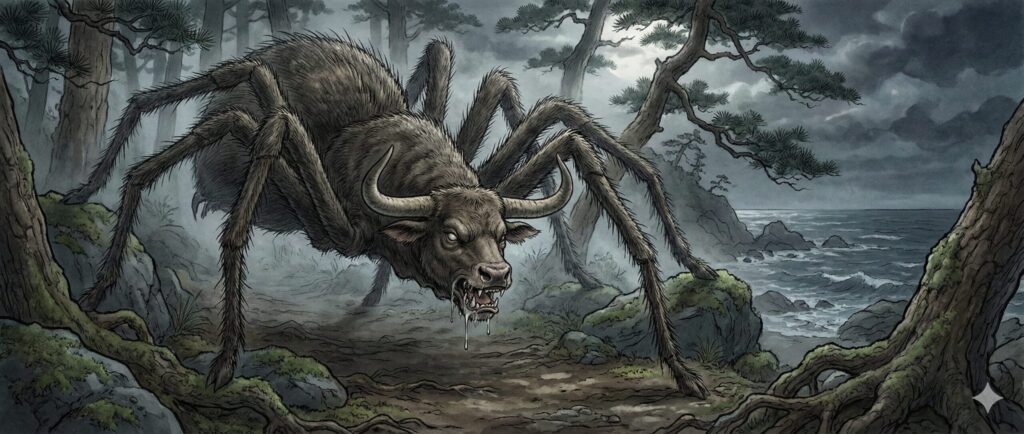
Descriptions of ushi-oni vary dramatically, but common traits include:
A bovine or horned head
Fanged mouth and fierce eyes
Large, muscular or spider-like bodies
Dark coloration, often black or deep red
An overwhelming physical presence
Some regions describe ushi-oni with crab-like or spider-like legs, while others portray them as giant ox-headed demons. This variability emphasizes function over form: ushi-oni are defined by menace, not anatomy.
Ushi-oni and Place
Ushi-oni are strongly tied to specific locations. They appear at:
Rocky coastlines and sea caves
Mountain passes and forest paths
River crossings and bridges
Village outskirts and abandoned areas
Their presence transforms geography into danger. These are not wandering monsters, but territorial entities — manifestations of places humans fear to tread.
Symbolism and Themes
Embodiment of Fear
Ushi-oni externalize collective anxiety, turning unseen threats into visible monsters.
Physical Violence
Unlike trick-based yokai, ushi-oni rely on brute force and intimidation.
Boundary Guardians
They mark forbidden zones, enforcing limits through terror rather than rules.
Chaos Without Ambiguity
Ushi-oni lack moral nuance. They are forces to be confronted, driven away, or destroyed.
Ushi-oni in Folklore and Art
Ushi-oni appear frequently in regional legends, warrior tales, and yokai compilations. Heroes or monks often confront them through bravery, ritual, or divine assistance.
In visual representations, ushi-oni are depicted:
Lurking in shadows near water or cliffs
Towering over human figures
With exaggerated horns and monstrous faces
As embodiments of nightmare rather than character
Their imagery prioritizes impact over subtlety.
Regional Variations and Local Legends
Ushi-oni legends are particularly prominent in western Japan, including Shikoku and parts of Chūgoku and Kyūshū.
Regional beliefs include:
Ushi-oni causing disease or curses
Protective rituals to ward them off
Heroes defeating ushi-oni to restore peace
Sacred objects used to repel them
These stories often serve as origin myths explaining local landmarks or rituals.
Modern Interpretations
In modern media, ushi-oni are often portrayed as boss-level monsters, emphasizing size, strength, and aggression. Games and anime favor their imposing silhouettes and brutal attacks.
Contemporary reinterpretations sometimes explore psychological aspects — ushi-oni as representations of overwhelming trauma or collective fear — but their core identity as monsters remains intact.
Conclusion – Ushi-oni as Manifestations of Brutal Fear
Ushi-oni represent the most direct form of folkloric terror. They do not deceive or test; they threaten and destroy. Their presence transforms space into danger and fear into survival instinct.
As monsters born from anxiety and danger, ushi-oni remind us that folklore does not always seek moral ambiguity. Sometimes, fear demands a face — and ushi-oni provide it.
They are the embodiment of what must be driven back to restore order.
Music Inspired by Ushi-oni
Music inspired by ushi-oni often emphasizes weight, aggression, and overwhelming force. Heavy low frequencies, pounding rhythms, and dense textures can evoke the creature’s massive presence.
Abrupt dynamic shifts and distorted timbres mirror sudden attacks, while relentless rhythmic patterns reflect inescapable threat. Sparse moments of silence heighten tension before impact.
Through these elements, music inspired by ushi-oni captures raw confrontation — the sound of fear made physical, advancing without subtlety or mercy.
Dreamy and stylish
Genre: Ritual Japanese HipHop / Darkwave Folklore Produced by: Phantom Tone | Suno AI | Kotetsu Co., Ltd. Tags: #JapaneseHipHop #AIgeneratedMusic #Yokai #Phant…
 Phantom Tone – Japanese Folklore Hip-Hop Project