Umi-bōzu – Abyssal Spirits of Japanese Folklore
Umi-bōzu are among the most ominous and mysterious figures in Japanese folklore: gigantic, shadowy beings that rise from the sea to confront sailors in the dead of night. Unlike coastal yokai that dwell near shorelines or reefs, umi-bōzu belong to the open water — places where the horizon dissolves, and human control fades.
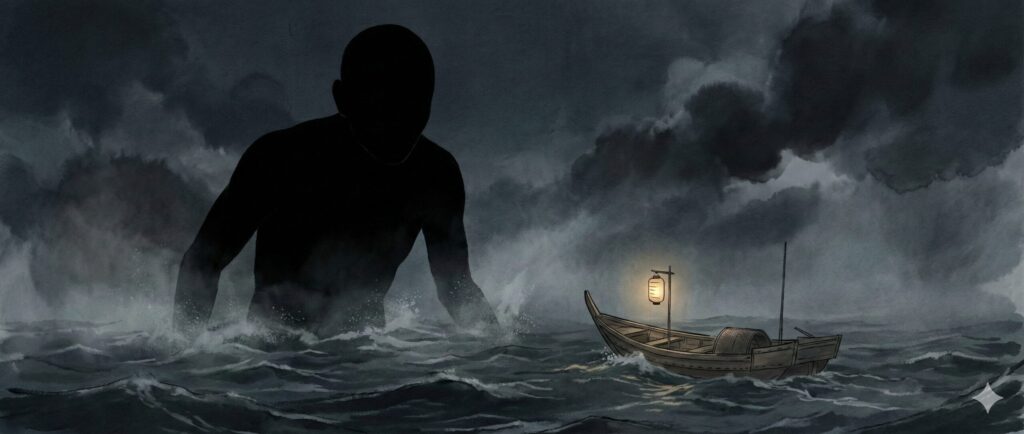
Typically described as enormous, black, monk-like figures with smooth, featureless heads, umi-bōzu appear suddenly from calm seas, overturning boats or demanding impossible tasks. Their presence transforms the ocean from a navigable space into an unknowable abyss.
Umi-bōzu embody the terror of the sea not as a place of storms, but as a place of silence — where destruction emerges without warning.
Origins and Early Accounts
Early references to umi-bōzu appear in sailor lore and regional coastal traditions rather than formal religious texts. Fishermen and travelers told of nights when the sea was unnaturally still, only for a massive dark shape to rise beside their vessel.
The name umi-bōzu (海坊主), meaning “sea monk,” reflects both their shaved-head appearance and their uncanny resemblance to Buddhist clergy. This association may stem from the perception of monks as liminal figures — removed from ordinary society — mirroring the ocean’s separation from the land-bound world.
These early accounts frame umi-bōzu not as moral judges, but as manifestations of the sea’s indifference to human intention.
From Sea Phenomenon to Yokai
Scholars often interpret umi-bōzu as folkloric explanations for sudden shipwrecks, rogue waves, or encounters with large sea creatures under poor visibility. In a world without modern navigation or meteorology, unexplained maritime disasters demanded narrative form.
Over time, repeated experiences and retellings solidified umi-bōzu into a yokai identity. Unlike dragons or sea gods, however, umi-bōzu remained formless and unpredictable. They did not rule the sea; they emerged from it.
This distinction reinforces their role as embodiments of sudden negation rather than cosmic order.
Appearance and Presence
Descriptions of umi-bōzu vary, but several traits recur:
Towering, humanoid silhouettes rising from the sea
Smooth, bald, monk-like heads
Pitch-black or shadowy bodies without clear features
Massive scale relative to human vessels
Umi-bōzu are often said to appear only at night, under moonlight or complete darkness. Their lack of detailed features heightens fear, emphasizing size and proximity rather than identity.
Like the sea itself, they resist precise description.
Umi-bōzu and the Open Ocean
Umi-bōzu are inseparable from the open sea. They do not haunt harbors or coastal villages, but confront those who venture far from land — fishermen, traders, and travelers who cross invisible boundaries.
In some legends, umi-bōzu demand a barrel or ladle from sailors, only to use it to flood the ship. Clever sailors sometimes escape by offering a bottomless barrel, frustrating the spirit and allowing retreat.
These stories emphasize wit and preparation over strength, reflecting the realities of maritime survival.
Symbolism and Themes
The Terror of Scale
Umi-bōzu dwarf human vessels, emphasizing human insignificance against the vastness of the sea.
Silence Before Destruction
They often appear during calm conditions, subverting the expectation that danger comes with storms or noise.
The Sea as Indifferent
Umi-bōzu do not punish wrongdoing or reward virtue. They act without discernible motive, embodying the ocean’s neutrality toward human fate.
Liminal Existence
Neither gods nor animals, umi-bōzu occupy the boundary between myth and natural phenomenon — just as the sea exists between known and unknown.
Umi-bōzu in Literature and Art
Umi-bōzu appear sporadically in folklore collections and yokai encyclopedias, often in brief, chilling anecdotes rather than extended narratives.
In visual art, they are typically depicted:
Rising beside small boats at night
Appearing as massive black forms against moonlit waves
Looming silently rather than attacking directly
Blending into the darkness of the sea and sky
These images reinforce their function as manifestations of dread rather than characters with personality.
Regional Variations and Maritime Beliefs
Different coastal regions describe similar beings under different names, suggesting a shared maritime anxiety rather than a single localized myth.
Common beliefs include:
Avoiding unnecessary speech at sea at night
Refraining from arrogance or mockery on the water
Carrying specific tools or charms for protection
Respecting unexplained calm as a warning sign
These practices reveal how folklore shaped behavioral codes for survival in dangerous environments.
Modern Interpretations
In modern media, umi-bōzu are often portrayed as deep-sea monsters or ancient entities awakened by human intrusion. Some interpretations lean toward cosmic horror, emphasizing their incomprehensible scale and origin.
Contemporary creators frequently highlight the contrast between advanced technology and primal fear — suggesting that, despite progress, the ocean remains fundamentally uncontrollable.
Conclusion – Umi-bōzu as Spirits of the Silent Abyss
Umi-bōzu represent one of the purest expressions of maritime fear in Japanese folklore. They are not embodiments of wrath or judgment, but of negation — the sudden erasure of safety in a place that appeared calm moments before.
Rising without warning and vanishing without explanation, umi-bōzu remind us that the sea does not announce its dangers. It simply opens — and swallows.
They are the shadow beneath still water.
Music Inspired by Umi-bōzu
Music inspired by umi-bōzu often emphasizes depth, restraint, and looming presence. Low-frequency drones, slow-moving harmonies, and vast reverberant spaces can evoke the weight and silence of the open ocean at night.
Gradual swells that rise without rhythmic urgency mirror the spirit’s sudden emergence, while sparse textures and minimal melodic motion suggest isolation and scale. Subtle dissonances and submerged timbres reflect unseen movement beneath the surface.
Through these elements, music inspired by umi-bōzu captures not chaos, but inevitability — the quiet moment when the sea reveals its abyss.
Dreamy and stylish
Genre: Ritual Japanese HipHop / Darkwave Folklore Produced by: Phantom Tone | Suno AI | Kotetsu Co., Ltd. Tags: #JapaneseHipHop #AIgeneratedMusic #Yokai #Phant…
 Phantom Tone – Japanese Folklore Hip-Hop Project