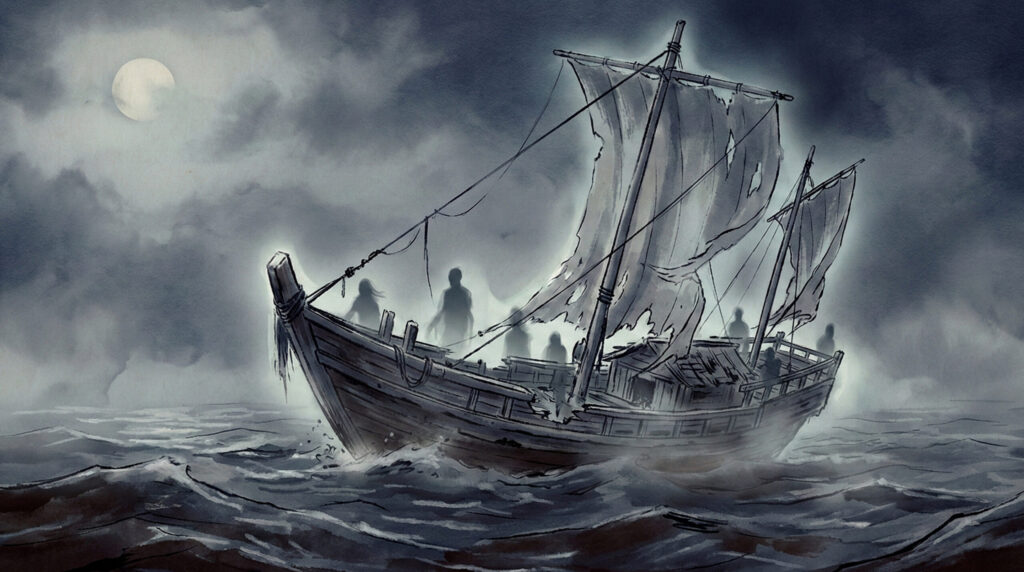
A phantom vessel carrying the spirits of those lost at sea.
It represents maritime disaster, lingering death, and drifting souls.
Primary Sources
Classical & Mythological Records
Edo period maritime ghost-ship accounts and coastal disaster lore
Setsuwa collections describing phantom ships and sea-death omens
海難・幽霊船・漂流霊に関する沿岸説話資料
Modern Folklore References
Yanagita Kunio — maritime ghost beliefs
Komatsu Kazuhiko — yōkai of sea death and phantom vessels
Yūrei-bune – Ghost Ships as Literary and Conceptual Anomalies in Japanese Tradition
Yūrei-bune(幽霊船) refers to ghostly ships that appear in Japanese texts and later narratives as apparitional vessels without living crews, drifting, appearing suddenly, or vanishing without trace. Although often conflated with Funayūrei(船幽霊), yūrei-bune belong to a distinct conceptual lineage, rooted primarily in literary description, recorded anecdotes, and interpretive tradition rather than in folk encounters at sea.
Where funayūrei are interactive, hostile, and clearly yokai-like, yūrei-bune are defined by appearance without engagement. They are seen, recognized, and remembered—but rarely confronted.
Separation from Funayūrei
A clear conceptual distinction is necessary.
- Funayūrei
- Appear as spirits of drowned sailors
- Directly interact with living crews
- Demand ladles, attack ships, or cause sinking
- Firmly rooted in maritime folk belief
- Yūrei-bune
- Appear as intact or semi-intact ships
- Lack visible crew or show indistinct figures
- Do not communicate or attack
- Function as apparitional signs rather than agents
Yūrei-bune are thus observational anomalies, not antagonistic beings.
Textual and Documentary Origins
References to yūrei-bune appear sporadically in travel accounts, anecdotal writings, and later compilations of strange phenomena. These descriptions often emphasize:
- Silent movement across water
- Ships appearing where none should be
- Vessels that vanish when approached
The tone of these accounts is notably restrained. Rather than dramatizing danger, they frame yūrei-bune as unsettling irregularities within otherwise familiar seascapes.
This textual restraint suggests that yūrei-bune were understood less as threats and more as disturbances in perception or order.
Yūrei-bune as Event-Based Anomaly
Yūrei-bune are best categorized as event-based anomalies(事象怪異), similar to shide no tabi or shiranui. Their defining features are:
- Sudden appearance
- Lack of causal explanation
- Absence of narrative resolution
They do not persist as entities. Each sighting stands alone, resisting accumulation into a coherent myth cycle.
Symbolic Role of the Ship
In Japanese cultural imagination, the ship represents:
- Passage between worlds
- Human control over hostile nature
- Collective effort and survival
A ship without crew destabilizes this symbolism. Yūrei-bune invert the ship’s meaning, transforming it from a vehicle of intention into a hollow sign of abandonment.
Unlike wreckage, yūrei-bune appear intact—suggesting loss without visible cause.
Related Concepts
Funayūrei (船幽霊)
Ghosts of drowned sailors.
→ Funayūrei
Umibōzu (海坊主)
Colossal sea spirits.
→ Umibōzu
Muen-botoke (無縁仏)
Unclaimed spirits.
→ Muen_botoke
Chinkon (鎮魂)
Ritual pacification.
Relationship to Death and Transition
While yūrei-bune are not explicitly funerary, they resonate strongly with beliefs about death and passage.
They may be interpreted as:
- Vessels that failed to complete their journey
- Signs of souls unable to disembark
- Echoes of journeys suspended between departure and arrival
In this sense, yūrei-bune align conceptually with shide no tabi, occupying the maritime version of the failed or frozen transition.
Absence of Agency and Moral Neutrality
Unlike many yokai, yūrei-bune display no intent. They do not punish hubris, test morality, or demand appeasement. Their neutrality is unsettling precisely because it offers no response.
This lack of agency marks yūrei-bune as phenomena to be witnessed, not addressed.
Modern Cultural Interpretations

This blade symbolizes drifting death and maritime loss.
It visualizes sea-bound souls condensed into weapon form.
In modern retellings, yūrei-bune are sometimes dramatized as haunted ships or cursed vessels. Such portrayals often borrow traits from funayūrei or Western ghost-ship lore.
A stricter folkloric reading resists this fusion, preserving yūrei-bune as minimalist anomalies — events that disturb expectation without supplying explanation.
In some modern visual reinterpretations, yūrei-bune manifest as a yōtō — a blade whose reflection never matches its form. The sword distorts light rather than cutting, embodying anomaly over aggression.
They endure because not every disturbance seeks a story.
Modern Reinterpretation – Yūrei-bune as Ships That Appear Without Purpose
Yūrei-bune are not ghosts that hunt. They do not demand. They do not answer.
They are vessels without destination.
The “beautiful girl” form does not explain. She does not warn. She does not guide.
Her distant, unmoving gaze represents anomaly without narrative — a ship that exists without crew, intent, or passage.
She does not approach. She does not depart. She does not follow.
She appears fully formed — and vanishes without residue.
In this visual form, Yūrei-bune becomes a contemporary yokai of directionless presence — a spirit that exists only as long as expectation has no answer.
Musical Correspondence
The accompanying track transforms drift into sound. Suspended drones, distant harmonics, and unresolved tonal motion evoke vessels moving without coordination.
Silence acts not as rest, but as open water — framing sound as movement without shore.
Together, image and sound form a unified reinterpretation layer — a modern folklore artifact of anomaly that appears intact, then dissolves into sea memory.
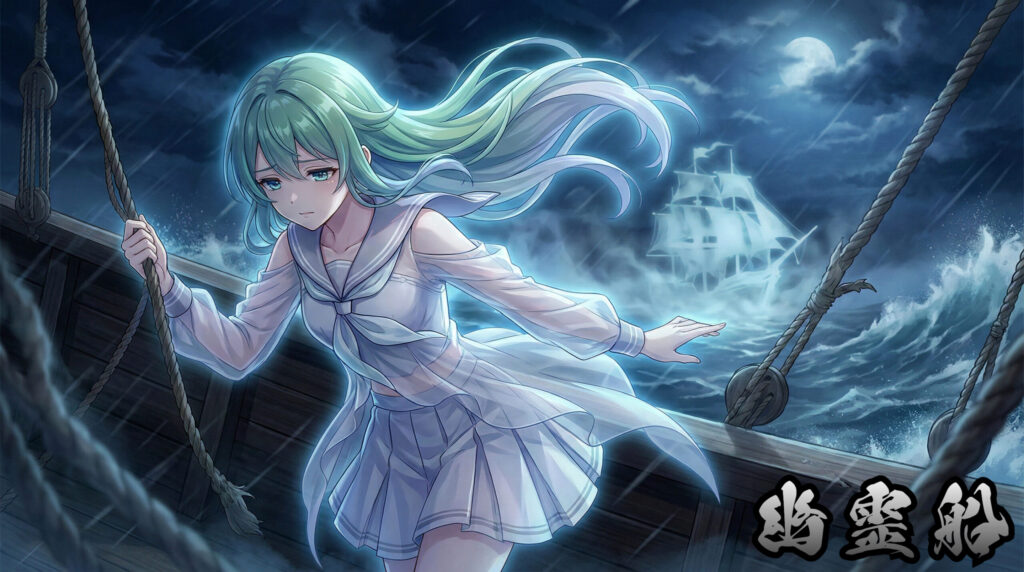
She embodies drifting sorrow and ocean-bound memory.
Her presence reflects maritime loss made visible.
Dreamy and stylish
Genre: Ritual Japanese HipHop / Darkwave Folklore Produced by: Phantom Tone | Suno AI | Kotetsu Co., Ltd. Tags: #JapaneseHipHop #AIgeneratedMusic #Yokai #Phant…