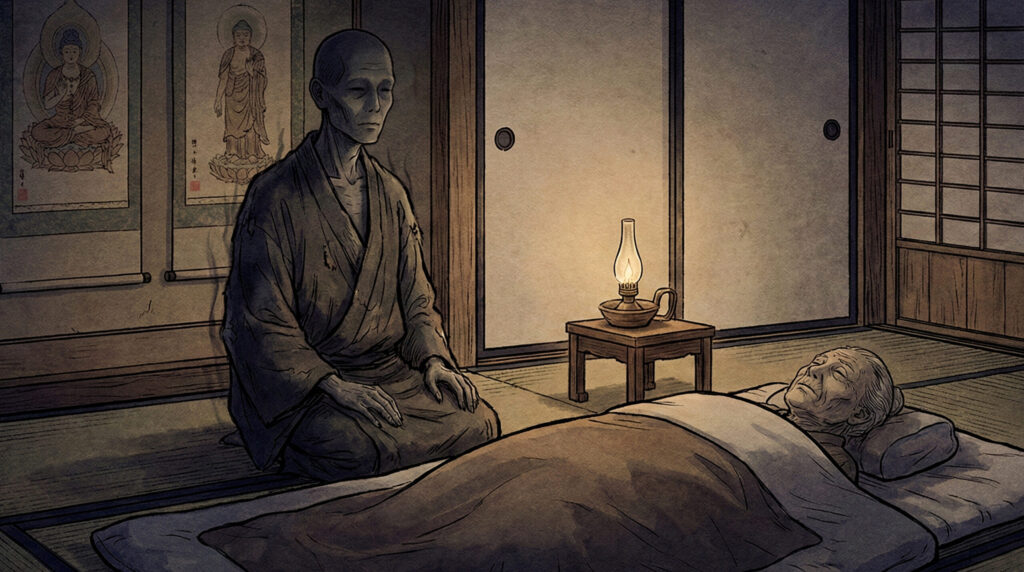
A personified spirit of death that oversees mortal endings.
It represents inevitability, boundary crossing, and soul retrieval.
Primary Sources
Classical & Mythological Records
Medieval death-spirit lore and Buddhist personifications of death
Setsuwa collections describing death-dealing entities and soul guides
死神・冥界使者・死霊管理に関する中世仏教説話資料
Modern Folklore References
Yanagita Kunio — death spirits and boundary beings
Komatsu Kazuhiko — yōkai of death and soul retrieval
Shinigami – Spirits of Death and Silent Invitation in Japanese Folklore
Shinigami are among the most abstract and unsettling figures in Japanese folklore: beings associated with death, the moment of dying, and the quiet pull toward the end of life. Unlike Western depictions of a singular Grim Reaper, Japanese shinigami are not always fixed in form, identity, or intent. They are presences rather than characters—forces that guide, invite, or pressure humans toward death.
They do not necessarily kill. Instead, shinigami influence choice, circumstance, and timing. Their horror lies not in violence, but in inevitability. They stand at the threshold where life falters, offering no judgment, no comfort, only direction.
Shinigami embody death as a process rather than an act.
Origins and Historical Formation
Unlike many yōkai with ancient mythological roots, shinigami as a defined concept emerged relatively late, shaped by Buddhist views of impermanence and the afterlife, as well as by literary influence. Edo-period literature and later translations of Western works contributed to consolidating the image of death-associated spirits.
Earlier Japanese belief systems focused more on ancestral spirits, vengeful ghosts (onryō), and the polluted state of death itself. The shinigami concept developed as a personification of the moment when life ends—less a god, more a function.
This makes shinigami uniquely liminal: they exist between doctrine and story, abstraction and figure.
Appearance and Formlessness
Shinigami lack a single canonical appearance. Descriptions vary widely:
Shadowy human-like figures
Invisible presences sensed rather than seen
Monk-like or official-looking silhouettes
Beings without faces or clear features
Often, they are described only through effect. A person feels an inexplicable urge, a sudden calm, or a loss of will. The shinigami’s presence is inferred from outcome rather than sight.
This ambiguity reinforces their role as inevitability rather than monster.
Shinigami and Human Vulnerability
In many tales, shinigami appear when humans are already weakened—by grief, illness, despair, or exhaustion. They do not create suffering; they capitalize on it.
Some stories describe shinigami whispering encouragement toward suicide or resignation. Others portray them as escorts who appear once death is already certain. In either case, resistance is possible, but difficult.
Importantly, shinigami are rarely depicted as evil. They are indifferent. Their function is cosmic, not moral.
Death Without Judgment
Unlike Buddhist judges or hell wardens, shinigami do not weigh sins or virtues. They do not punish or reward. Their arrival does not imply guilt.
This neutrality makes them more unsettling than moral enforcers. Death, in this framing, is not deserved or condemned—it simply arrives.
Shinigami thus reflect a worldview in which death is a transition governed by timing rather than ethics.
Symbolism and Themes
Inevitability Over Violence
Shinigami represent death as an unavoidable flow, not an attack.
Loss of Agency
Their influence often coincides with moments when human will weakens.
Silence and Absence
They are defined by what they do not say or explain.
Death as Passage
Shinigami guide rather than destroy.
Related Concepts
Kasha (火車)
Funerary corpse-stealing spirits.
→ Kasha
Muen-botoke (無縁仏)
Unclaimed spirits.
→ Muen_botoke
Onryō (怨霊)
Vengeful spirits.
→ Onryō
Chinkon (鎮魂)
Ritual pacification.
Shinigami in Literature and Folklore
Shinigami appear in Edo-period ghost stories and later literary works, often as quiet figures present at decisive moments. They may sit beside a dying person, stand unseen nearby, or simply be mentioned as the cause of a sudden turn toward death.
These appearances are brief and understated. The focus remains on the human experience—fear, resignation, or calm—rather than the shinigami themselves.
This narrative restraint emphasizes their role as background forces shaping fate.
Modern Cultural Interpretations

This blade symbolizes inevitable death and soul retrieval.
It visualizes terminal passage condensed into weapon form.
Modern media has greatly expanded the visual identity of shinigami, often portraying them as humanoid reapers, bureaucratic figures, or supernatural overseers. While these interpretations add personality, they diverge from the traditional emphasis on abstraction.
Contemporary reinterpretations sometimes humanize shinigami, giving them emotion or conflict. Traditional folklore, however, derives its power from their emotional absence.
In some modern visual reinterpretations, shinigami manifest as a yōtō — a blade stripped of ornament. The sword bears no decoration, embodying function without feeling.
They are frightening because they do not care.
Modern Reinterpretation – Shinigami as the Shape of the End
Shinigami do not judge. They do not punish. They do not explain.
They indicate.
The “beautiful girl” form does not comfort. She does not threaten. She does not persuade.
Her distant, quiet presence represents death as transition — not as rupture, but as withdrawal.
She does not arrive loudly. She does not remain after being seen. She only appears when departure has already begun.
In this visual form, Shinigami becomes a contemporary yokai of terminal presence — a spirit that exists only to mark the moment when life has begun to leave.
Musical Correspondence
The accompanying track transforms withdrawal into sound. Sparse drones, long pauses, and fading motifs evoke inevitability without drama.
Silence acts not as rest, but as gravity — framing sound as something that slowly releases.
Together, image and sound form a unified reinterpretation layer — a modern folklore artifact of death as quiet certainty.
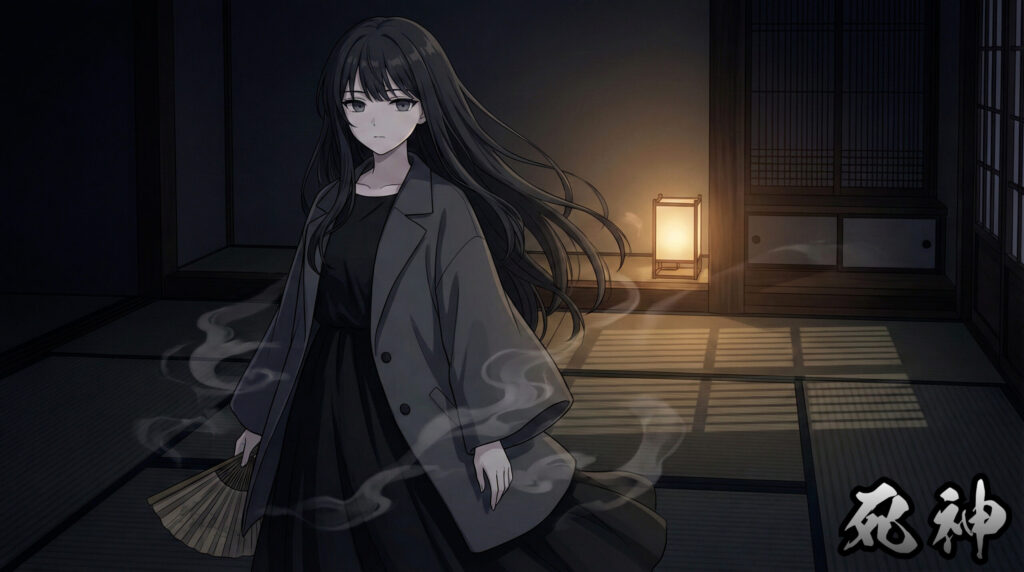
She embodies inevitability and boundary guardianship.
Her presence reflects terminal passage made visible.
Dreamy and stylish
Genre: Ritual Japanese HipHop / Darkwave Folklore Produced by: Phantom Tone | Suno AI | Kotetsu Co., Ltd. Tags: #JapaneseHipHop #AIgeneratedMusic #Yokai #Phant…