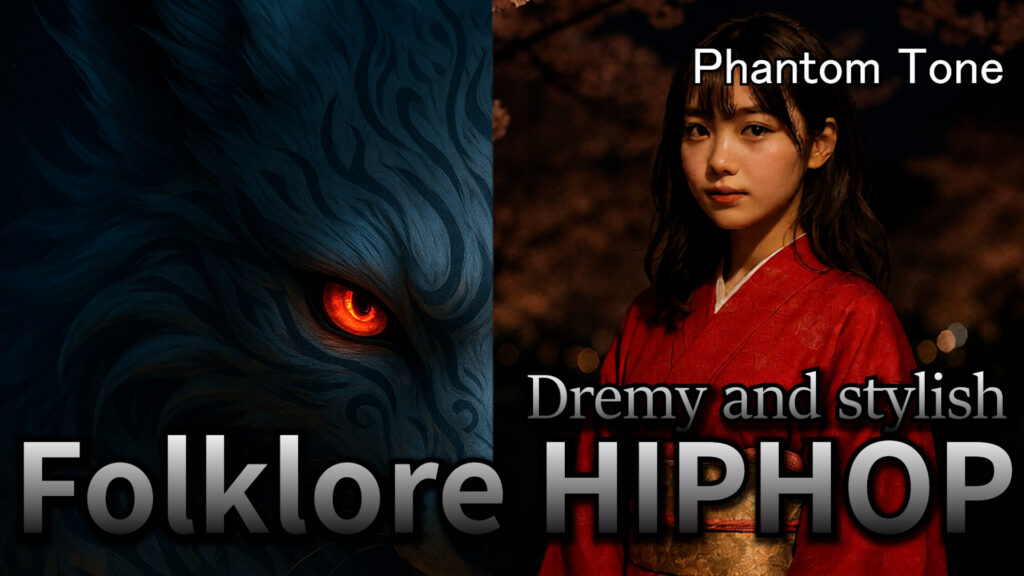

A flame-born apparition associated with graveyards and boundary spaces.
It represents funerary fire, liminal wandering, and spirit-bound light.
Primary Sources
Classical & Mythological Records
Heian–Edo period onibi (will-o’-the-wisp) accounts in setsuwa collections
Funerary and boundary-spirit lore tied to graveyards, marshes, and crossroads
鬼火・火霊・境界火に関する中世説話・民間信仰資料
Modern Folklore References
Yanagita Kunio — boundary spirits and funeral fire beliefs
Komatsu Kazuhiko — yōkai of liminal flames
Onibi no Musume – The Child Born from Wandering Flame in Japanese Folklore
Onibi no Musume, the “Daughter of the Ghost Flame,” is a liminal folkloric figure imagined as the feminine embodiment of onibi—mysterious blue or pale flames said to drift through graveyards, marshes, and abandoned places. Unlike destructive fire spirits, she does not burn. She drifts, watches, and lures.
She is not a flame given shape.
She is flame given lineage.
Onibi no Musume embodies fire that learned to linger.
Origins in Onibi and Deathly Landscapes
Onibi are traditionally associated with death, decay, and transitional spaces—cemeteries, wetlands, battlefields, and crossroads. Folklore explains them as manifestations of lingering spirits, resentment, or unspent life force.
From these drifting lights emerged the idea of descent: if fire can wander, it can also remain. Onibi no Musume arises as a personification of flame that has stayed long enough to acquire awareness and form.
She is not born once.
She appears wherever onibi endure.
Appearance and Gentle Illusion
Descriptions of Onibi no Musume emphasize beauty paired with fragility:
A young girl illuminated by faint blue or white flame
Hair and garments glowing softly, never catching fire
Bare feet that leave no trace
Eyes reflecting flickering light rather than emotion
Her form appears incomplete, as if sustained by light rather than flesh. She often manifests at night, at the edge of vision.
She invites approach without command.
Behavior and Silent Guidance
Onibi no Musume does not chase or attack. She appears briefly, moving slowly ahead of travelers, then vanishing. Those who follow may be led astray—into marshes, toward graves, or deeper into darkness.
In some tales, she guides lost souls rather than the living, appearing only to those close to death or despair.
She does not decide outcomes.
She reveals direction.
Fire Without Heat
A defining feature of Onibi no Musume is that her flame does not burn. Touching her does not cause pain, yet proximity brings unease—cold rather than warmth.
This inversion reinforces her role as a boundary figure: fire divorced from life, light separated from safety.
Illumination becomes warning.
Symbolism and Themes
Fire as Memory
Light persists after life ends.
Beauty Without Safety
Attraction masks danger.
Guidance Without Mercy
Paths are shown, not judged.
The Childlike Form of Death
Innocence tied to impermanence.
Related Concepts
Onibi (鬼火)
Will-o’-the-wisp spirits.
→ Onibi
Hotoke (仏)
Buddhist spirits.
Chinkon (鎮魂)
Ritual pacification.
Marebito (稀人)
Otherworldly visitors.
→ Marebito
Onibi no Musume in Folklore Imagination
Unlike named yōkai with fixed stories, Onibi no Musume exists as a composite figure across ghost tales, kaidan, and later creative interpretations. She explains why flames sometimes feel intentional—why they seem to watch, wait, or move just ahead.
She is remembered as presence rather than character.
A light that almost feels personal.
Modern Cultural Interpretations
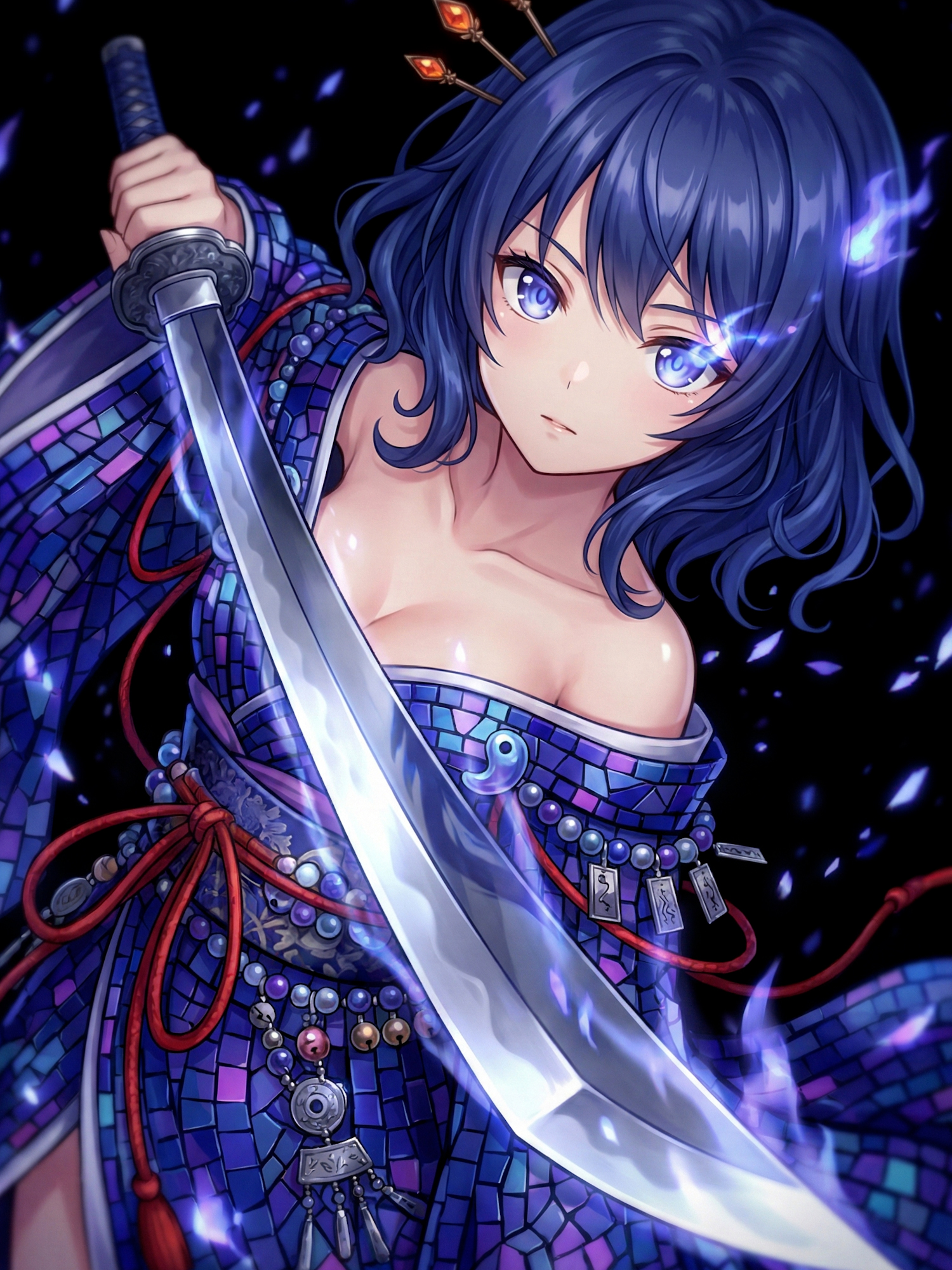
This blade symbolizes funerary flame and boundary wandering.
It visualizes spirit-bound fire condensed into weapon form.
Modern readings often interpret Onibi no Musume as a metaphor for grief, lingering attachment, and the allure of surrender. In visual media, she is frequently portrayed as melancholic rather than threatening.
She may also symbolize unresolved death — spirits that cannot depart and instead soften into something quiet and watchful.
In some modern visual reinterpretations, Onibi no Musume manifests as a yōtō — a blade that glows with cool blue fire. The sword does not burn; it beckons, embodying invitation rather than force.
Her relevance persists because people still follow lights they should not.
Modern Reinterpretation – Onibi no Musume as the Flame That Chose to Stay
In modern reinterpretation, Onibi no Musume—the “Daughter of the Ghost Flame”—has evolved from a minor folkloric phenomenon into a poignant symbol of lingering emotion and quiet loss. Rather than embodying malevolence, she is reimagined as the gentle persistence of memory itself: a light that hovers between realms, neither extinguished nor consuming.
Modern creators, from illustrators to filmmakers, often depict her not as a threat, but as a melancholic guide. The blue fire she carries becomes a metaphor for grief transformed—pain that no longer harms, but cannot let go. Through her, the boundary between mourning and devotion softens: she is not the fire that ends, but the warmth that remains.
In visual reinterpretations, this evolution takes form in the yōtō known as the “Azure Lantern Blade.” Its surface shimmers with a pale, internal glow—more like reflection than flame. When unsheathed, it does not scorch or blind; instead, it illuminates hesitation. The sword embodies invitation, not aggression—an echo of voices that never quite faded. It waits, humming faintly, as if remembering light itself.
Through this modern frame, Onibi no Musume emerges as an emblem of graceful haunting—an afterimage of love that endures past death, past speech, past recognition. Her story reveals a distinctly Japanese conception of death: not a rupture, but a continuation of presence, dimmed but not erased. Her flame is not warning, but remembrance—a light for those who still look back.
Musical Correspondence
Music inspired by Onibi no Musume moves with fragility and restraint, balancing melancholy with calm. High, translucent timbres—such as celesta, koto harmonics, or glass-like synths—evoke the shimmer of ghostly light over still water. Slow tempos and sparse melodic phrasing create a sensation of hovering rather than advancing.
Echoed notes fade into silence, forming a rhythmic absence that mirrors her gradual retreat from the world of the living. Harmonic motion remains circular and unresolved, reflecting a flame that neither grows nor dies. The result is music that feels barely there—intimate, weightless, and eternal.
Through these elements, compositions inspired by Onibi no Musume capture her essence: a light that endures without consuming—a melody heard as one steps into fog, unsure whether it comes from the living or the dead.

She embodies liminal flame and funerary wandering.
Her presence reflects spirit-bound light made visible.
Dreamy and stylish
Genre: Ritual Japanese HipHop / Darkwave Folklore Produced by: Phantom Tone | Suno AI | Kotetsu Co., Ltd. Tags: #JapaneseHipHop #AIgeneratedMusic #Yokai #Phant…