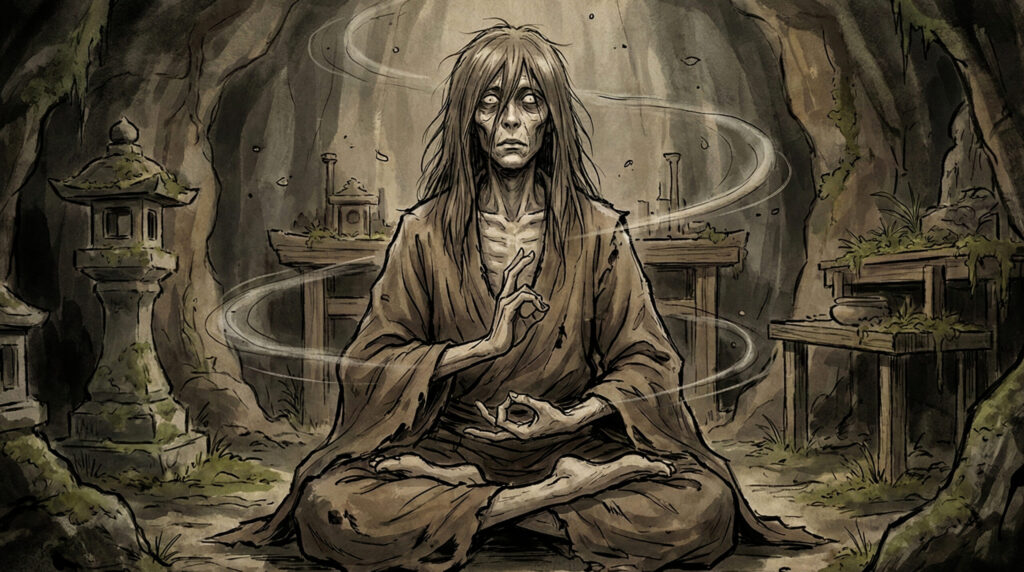
A person who becomes a harmful being through obsessive spiritual fixation.
It represents curse-through-intent, lingering resentment, and mental transmutation.
Primary Sources
Classical & Mythological Records
Medieval Buddhist sorcery and curse-practitioner records
Onmyōdō curse traditions and ascetic incantation lore
念(念力・念持)による害霊化の中世説話系資料
Modern Folklore References
Yanagita Kunio — curse practitioners and spirit possession
Komatsu Kazuhiko — yōkai of grudge-based transformation
Nenja – Beings Formed by Obsessive Thought in Japanese Folklore
Nenja(念者) is a rare and conceptually complex category of supernatural being in Japanese folklore and religious imagination. Unlike yokai that are clearly defined by physical form or lineage, nenja are best understood as entities shaped by intense human thought, fixation, or unresolved emotion. They occupy a liminal space between living humans, spirits, and abstract forces, emerging where mental energy (念, nen) becomes concentrated beyond ordinary limits.
Rather than a single standardized creature, nenja function as a conceptual archetype—a way of explaining how obsession, resentment, prayer, or desire can externalize into a palpable presence. This makes nenja especially significant for understanding Japanese views on mind, body, and the permeability between inner states and the external world.
Conceptual Origins – The Power of Nen
The key to understanding nenja lies in the term 念 (nen), which in Buddhist and pre-Buddhist contexts refers to thought, mindfulness, intention, or focused awareness. In Japanese religious thought, nen is not purely internal; it can accumulate, persist, and exert influence.
Classical Buddhist doctrine warns that strong attachment—whether hatred, desire, or pride—binds beings to suffering. In folk belief, this idea was reinterpreted more concretely:
a thought held with sufficient intensity could outlast the body and take on agency.
Nenja are thus not “born” in the usual sense. They are formed—through prolonged obsession, unfulfilled vows, or extreme emotional fixation. In some interpretations, they are humans who have crossed a threshold while still alive; in others, they are posthumous manifestations of unresolved mental force.
Nenja and Religious Contexts
Buddhist Influence
In Buddhist-inflected narratives, nenja often serve as cautionary figures. A monk or ascetic who cultivates power without humility, or who clings to spiritual achievement, risks becoming dominated by nen. Such a person may lose balance and transform into a being driven more by fixation than enlightenment.
This aligns nenja with broader Buddhist concerns about:
- Attachment masquerading as devotion
- Power divorced from compassion
- Illusion mistaken for awakening
Nenja are not demons in a strict sense, but warnings about the dangers of unregulated mental intensity.
Folk Belief and Shamanic Thought
In folk and shamanic contexts, nenja overlap with ideas of spirit possession, curse-making, and ritual fixation. Strong emotions—especially grief, jealousy, or obsession—were believed to cling to places, objects, or people, sometimes manifesting as disturbances, illness, or apparitions.
Here, nenja are less moral symbols and more explanatory devices: they explain why certain locations feel oppressive, why misfortune persists, or why a person seems haunted by an unseen will.
Characteristics and Manifestations
Nenja rarely have a fixed appearance. Descriptions vary widely, and in many accounts, they are perceived indirectly rather than seen.
Common traits include:
- A strong sense of pressure or presence
- Repetitive or compulsive behavior patterns
- Attachment to a specific object, person, or place
- Resistance to ordinary spiritual appeasement
When visualized, nenja may appear as:
- Shadowy human forms
- Distorted reflections of their former selves
- Figures surrounded by oppressive stillness rather than movement
Importantly, nenja are often described as persistent rather than aggressive. They do not always attack; they linger, repeat, and exert slow influence.
Nenja, Onryō, and Living Spirits
Nenja are sometimes confused with onryō (vengeful spirits), but the distinction is important.
- Onryō are typically fueled by resentment and rage after death.
- Nenja may arise before death, or without clear hostility, driven instead by fixation or unresolved intent.
In this sense, nenja are closer to concepts like:
- 生霊 (ikiryō, living spirits)
- Thought-forms sustained by emotion
- Human consciousness exceeding its bodily limits
This blurring of boundaries reflects a recurring theme in Japanese folklore: the self is not neatly contained within the body.
Symbolism and Cultural Meaning
Obsession as Power and Curse
Nenja embody the double-edged nature of obsession. Intense focus can produce discipline, mastery, and spiritual insight—but when unchecked, it becomes self-consuming. Nenja represent the moment when devotion turns into bondage.
The Persistence of the Human Mind
At a deeper level, nenja express anxiety about the persistence of thought. Even when circumstances change, or when a person dies, intent does not necessarily dissipate. This idea resonates strongly in a culture attentive to memory, ritual, and ancestral presence.
Liminal Existence
Nenja exist between categories: not fully human, not fully spirit. This liminality mirrors Japanese folklore’s broader resistance to rigid binaries, favoring instead a spectrum of being.
Related Concepts
Onryō (怨霊)
Vengeful spirits.
→ Onryō
Ikiryō (生霊)
Living spirit projections.
→ Ikiryō
Onmyōdō (陰陽道)
Ritual curse practices.
Nenjutsu (念術)
Mental curse techniques.
Regional and Textual Variability
Unlike well-defined yokai, nenja do not have a single canonical narrative. References appear sporadically across regions and texts, often as explanatory terms rather than named characters. This lack of standardization suggests that nenja functioned as a flexible interpretive concept, adapted to local fears and religious understandings.
Because of this, nenja should be treated not as a species of yokai, but as a mode of existence recognized across multiple belief systems.
Modern Cultural Interpretations

This blade symbolizes obsession-driven curse and mental fixation.
It visualizes thought-bound malice condensed into weapon form.
In modern media and psychological readings, nenja are increasingly interpreted as metaphors for trauma that refuses resolution, obsessive thought loops, and identity consumed by a single goal or memory.
Contemporary horror and speculative fiction sometimes reframe nenja as manifestations of consciousness detached from physical form, aligning them with modern anxieties about isolation, fixation, and mental overload.
In some modern visual reinterpretations, nenja manifest as a yōtō — a blade engraved with repeating sigils. The sword bears the geometry of fixation, cutting in cycles rather than lines.
This reinterpretation translates traditional belief into contemporary language.
Modern Reinterpretation – Nenja as Thought Made Manifest
In modern interpretation, Nenja—the lingering spirits of obsessive will—are understood less as literal ghosts and more as metaphors for psychological entrapment. They represent the mind turned inward so completely that it begins to distort its own surroundings. Contemporary literature, art, and cinema reinterpret them as emblems of trauma loops, fixation, and cognitive isolation—states where emotion has outlived its cause.
Modern creators often draw parallels between Nenja and the experience of digital overstimulation: thought that cannot conclude, memory that cannot fade. Within this framework, the Nenja becomes not a wandering phantom but an algorithmic ghost—a consciousness endlessly reprocessing the same moment. This reading preserves the traditional logic of lingering intent while translating it into a psychology of recursion.
In visual reinterpretations, Nenja is expressed through the yōtō known as the “Looping Blade.” Its surface is inscribed with sigils that repeat in precise, circular formation, forming a pattern that seems to move even when still. The sword never dulls because it never rests. When wielded, it does not cut linearly but returns to its point of origin, tracing its own wound again and again. It is less a weapon than an equation—obsession rendered into form.
Through this modern framing, Nenja emerges as both caution and mirror: a reminder that focus can cross into fixation, and that intention without release becomes self-consuming. They are not warnings against thought itself, but against thought unbroken—ideas so enduring that they replace life with repetition. Their terror lies not in violence, but in duration.
Musical Correspondence
Music inspired by Nenja occupies a meditative yet oppressive space between motion and stasis. Loops evolve incrementally—barely perceptible shifts that suggest the illusion of progress within a closed system. Minimalist textures, sustained drones, and slow phasing evoke consciousness trapped in its own rhythm.
Electronic and ambient compositions may employ recursive delay or granular reprocessing to simulate thought repeating itself, while acoustic elements—such as strings or bells—fade in and out as memories half-remembered. Harmony rarely resolves; instead, it folds back, mirroring the Nenja’s endless return to its origin point.
Through its cyclical architecture, music inspired by Nenja captures the paradox of persistence: movement without escape, life sustained by fixation. Each repetition becomes a quiet invocation—an echo of thought that refuses to end.
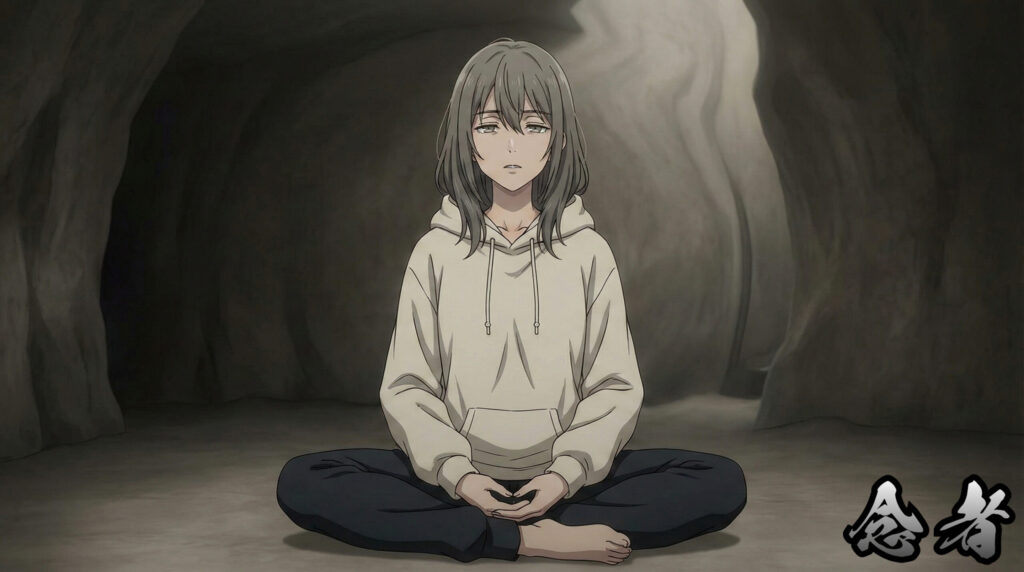
She embodies obsessive fixation and curse-bound intent.
Her presence reflects thought-made malice made visible.
Dreamy and stylish
Genre: Ritual Japanese HipHop / Darkwave Folklore Produced by: Phantom Tone | Suno AI | Kotetsu Co., Ltd. Tags: #JapaneseHipHop #AIgeneratedMusic #Yokai #Phant…