
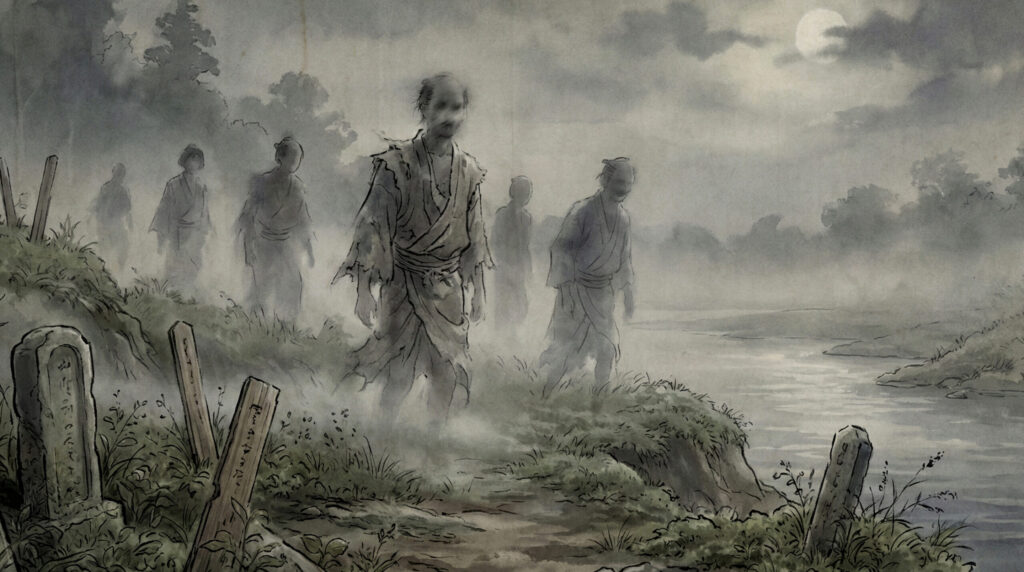
A spectral being formed from abandoned and socially unconnected dead.
It represents social exclusion, spiritual neglect, and unclaimed existence.
Primary Sources
Classical & Mythological Records
Heian–Kamakura period mortuary and boundary beliefs
Mu’en / Mu’en-botoke traditions in medieval temple records (無縁・無縁仏系文書)
Roadside, boundary, and outcast-associated spirit traditions
Modern Folklore References
Yanagita Kunio — studies on mu’en / outcast spirits
Komatsu Kazuhiko — yōkai of social exclusion and unclaimed dead
Muen-sha – Anomalies of the Socially Dead in Japanese Folk Thought
Muen-sha(無縁者の怪) refers to a category of folk anomaly centered on people who are socially dead while still biologically alive. Unlike muen-botoke(無縁仏), which concern the dead who lack ritual and remembrance, muen-sha occupy a separate axis: they are living humans who have lost all meaningful social ties and thus exist in a liminal, destabilizing state.
Muen-sha are not ghosts, yokai, or spirits in the conventional sense. They are anomalies produced by social erasure, where exclusion itself generates unease, fear, and supernatural interpretation.
The Concept of Muen Applied to the Living
The term muen(無縁) originally described the absence of relational bonds—family, village, temple, or patronage. In medieval Japanese society, where identity was inseparable from social placement, losing these bonds meant more than poverty or solitude. It meant loss of ontological status.
Muen-sha are those who still walk, speak, and work, yet are no longer fully recognized as members of the social order. This condition transforms them into figures of anomaly rather than individuals with narrative agency.
Social Death Versus Physical Death
Muen-sha represent social death, a condition distinct from biological death.
- A dead person may remain socially alive through memory and ritual
- A living person may become socially dead through exclusion
This inversion explains why muen-sha provoke discomfort. They violate the expected alignment between life and belonging. Their existence exposes the fragility of social inclusion itself.
Historical Context – Margins of Medieval Society
References to muen-sha emerge indirectly through descriptions of:
- Itinerants and permanent wanderers
- People expelled from kinship networks
- Those barred from temple affiliation or village residence
Such individuals often lived near borders—roads, riverbanks, mountain edges—spaces already associated with anomaly. Their presence was tolerated yet feared, producing a perception of human figures who exist outside moral accounting.
Muen-sha as Folk Anomaly
Unlike onryō or yūrei, muen-sha are not driven by emotion or postmortem fixation. Their anomaly lies in absence of accountability.
They are often described as:
- People who appear and disappear without trace
- Individuals whose past cannot be verified
- Figures who leave no social consequences behind
This lack of narrative continuity destabilizes communal trust, inviting supernatural explanation even without overt transgression.
Distinction from Related Concepts
Clarifying muen-sha requires firm separation from adjacent categories.
- Muen-botoke: dead without ritual or remembrance
- Hinin / outcast categories: legally defined social status
- Yokai: non-human entities with symbolic roles
Muen-sha differ in that they are human, alive, and undefined. Their threat is structural rather than intentional.
Symbolism and Cultural Meaning
Fear of Erasure
Muen-sha embody anxiety that one can cease to exist socially without dying. This fear is especially potent in collectivist structures.
Boundary of Responsibility
If no one is responsible for someone, who bears the consequences of their actions—or their suffering? Muen-sha force this question without offering an answer.
Humanity Without Recognition
Their existence challenges the assumption that humanity guarantees belonging. In folk logic, recognition precedes safety.
Related Concepts
Muen-botoke (無縁仏)
Unclaimed spirits.
→ Muen_botoke
Onryō (怨霊)
Vengeful spirits.
→ Onryō
Chinkon (鎮魂)
Ritual pacification.
Marebito (稀人)
Otherworldly visitors.
→ Marebito
Modern Cultural Interpretations

This blade symbolizes unclaimed existence and social erasure.
It visualizes abandoned identity condensed into weapon form.
In modern contexts, muen-sha resonate strongly with extreme social isolation, unnoticed lives, and individuals erased by bureaucratic or economic systems.
While modern language reframes the phenomenon sociologically, the underlying structure remains unchanged: a person without ties becomes anomalous.
In some modern visual reinterpretations, muen-sha manifest as a yōtō — a blade that carries no scabbard and no owner. The sword appears where connection has failed, embodying absence rather than aggression.
Muen-sha persist because disconnection still produces shadows.
Modern Reinterpretation – Muen-sha as the Living Unaccounted For
In modern interpretation, Muen-sha—literally “the unconnected living”—extend the concept of muen-botoke into the realm of the still-breathing. Once the term for the socially or spiritually unattached dead, its logic has quietly migrated into contemporary sociology, describing individuals who drift outside systems of family, employment, or recognition. These are not spirits, but people rendered invisible by structure: alive, yet absent within the machinery of society.
Modern readings frame Muen-sha as symptoms of hyper-modern isolation—lives emptied of narrative but filled with repetition. In literature and media, they appear as quiet neighbors, nameless workers, or the anonymous deceased found weeks later in apartments filled with still-running televisions. Their existence reframes the supernatural as social critique, suggesting that haunting now originates not from the dead, but from the overlooked living.
In visual reinterpretations, this condition finds form in the yōtō known as the “Orphaned Blade.” The weapon bears neither sheath nor master, suspended perpetually between function and abandonment. Its edge is polished yet untouched, a reflection of utility without purpose. When placed among others, it vanishes into background light—present, yet unacknowledged. The sword embodies presence without relationship, existence stripped of consequence.
Through this modern frame, Muen-sha are not tragic anomalies, but the logical outcomes of a culture that rewards detachment while mourning its effects. They reveal that invisibility no longer requires death—only disconnection. Their condition is a quiet indictment: when all ties dissolve, what remains human becomes administrative residue.
Musical Correspondence
Music inspired by Muen-sha inhabits the border between structure and absence. Repetitive electronic pulses or mechanical rhythms evoke habitual movement devoid of meaning—walking, working, existing without witness. The harmonic field often remains static, suggesting continuity without progression.
Subtle noise layers—air vents, distant trains, clock ticks—blur with minimal melodic lines, transforming background into the only voice left. The result is sound that feels observed but never heard, mechanical yet fragile. Each repetition hints at the exhaustion of identity through routine.
Through these choices, compositions inspired by Muen-sha capture their essence: motion without narrative, presence without connection. It is not silence that defines them, but the dull persistence of sound that no one names—a rhythm continuing long after its listener has stopped caring.
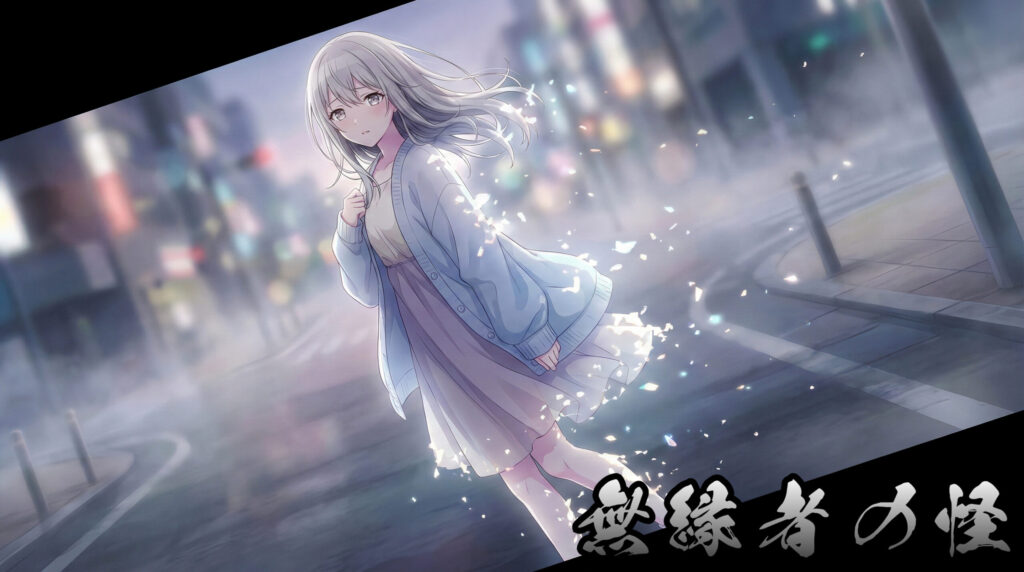
She embodies social erasure and abandoned presence.
Her presence reflects unclaimed existence made visible.
Dreamy and stylish
Genre: Ritual Japanese HipHop / Darkwave Folklore Produced by: Phantom Tone | Suno AI | Kotetsu Co., Ltd. Tags: #JapaneseHipHop #AIgeneratedMusic #Yokai #Phant…