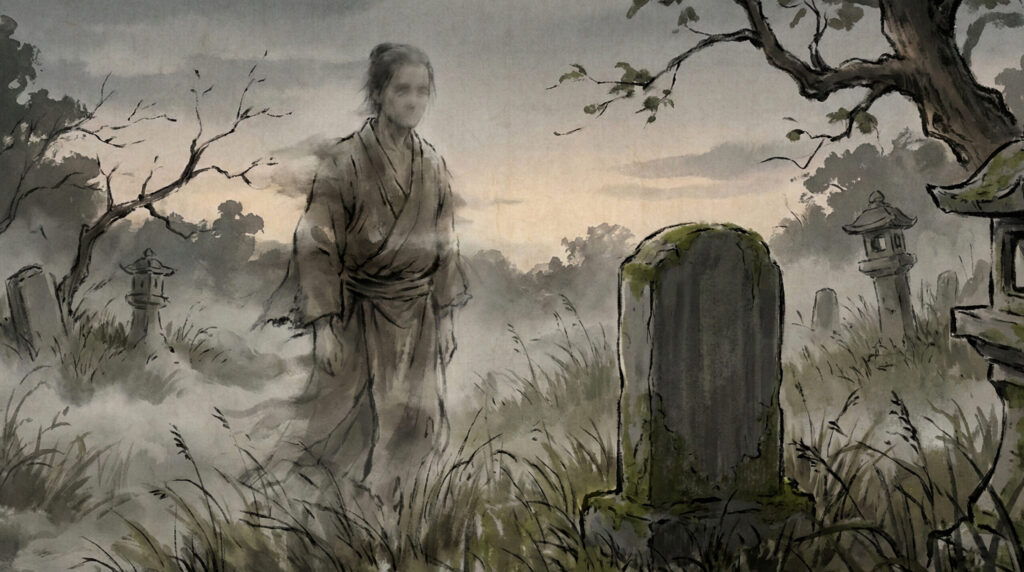
A spirit of the dead without descendants or memorial rites.
It represents abandonment, spiritual neglect, and unclaimed death.
Primary Sources
Classical & Mythological Records
Nihon Shoki (日本書紀)
Bizen Fudoki (備前国風土記)
Kibi region mythological traditions
Modern Folklore References
Yanagita Kunio — Kibi demon folklore
Komatsu Kazuhiko — Yōkai Encyclopedia
Muen-botoke – Spirits of the Unremembered Dead in Japanese Belief
Muen-botoke(無縁仏) are spirits of the dead who have lost all social, familial, and ritual ties. In Japanese religious belief and folklore, the term does not simply refer to an unclaimed body or neglected grave; it describes a condition in which the deceased has become spiritually disconnected from the living world.
Unlike vengeful ghosts or monstrous yokai, muen-botoke are defined by absence rather than aggression. They linger not because of hatred or unfinished business, but because no one remains to remember, mourn, or pray for them. Their presence embodies the quiet unease produced by forgotten lives.
The Meaning of Muen – Life and Death Without Ties
The concept of muen (無縁, “without connection”) originated as a social term. In medieval Japan, it described those outside established networks of family, village, or temple—wanderers, the impoverished, and the socially isolated.
Applied to the dead, muen became a spiritual condition. Japanese funerary culture emphasized ongoing relationships between the living and the deceased through memorial rites and ancestral remembrance. A death without these connections was understood as incomplete, leaving the spirit without orientation or stability.
Muen-botoke thus represent the continuation of social isolation beyond death.
Religious and Historical Background
Buddhist Views on Postmortem Care
In Japanese Buddhism as practiced at the communal level, death is a process rather than a moment. The dead pass through ritual stages guided by funerary rites, memorial services, and periodic offerings. These acts stabilize the spirit and integrate it into ancestral continuity.
Muen-botoke emerge when this process fails. They are not condemned as sinners, but understood as unattended souls—spirits left without guidance rather than punished by doctrine.
War, Disaster, and Anonymous Death
Periods of warfare, famine, and epidemic produced countless unclaimed bodies and anonymous burials. Roadsides, riverbanks, and mass graves became sites of anxiety, believed to harbor spirits without names or mourners.
Communities responded with collective memorials, reflecting the belief that neglecting the dead could destabilize both spiritual and social order.
Characteristics of Muen-botoke
Muen-botoke rarely appear in dramatic or violent forms. They are more often sensed than seen.
Commonly attributed traits include:
- Lingering presence near liminal spaces such as roads, boundaries, and abandoned land
- Feelings of heaviness, stagnation, or quiet unease
- Absence of personal narrative, name, or grievance
When visualized, muen-botoke are described as indistinct or incomplete figures, emphasizing erosion of identity rather than transformation.
Distinction from Yūrei and Onryō
Muen-botoke differ fundamentally from more familiar ghost types.
- Yūrei often retain memories, emotions, and personal stories.
- Onryō are driven by intense resentment and directed vengeance.
- Muen-botoke lack both strong emotion and clear intent.
They do not seek revenge. They persist simply because nothing remains to release them.
Symbolism and Cultural Meaning
Fear of Being Forgotten
At the core of the muen-botoke belief lies a deep cultural anxiety: death without remembrance. In a society structured around ancestral continuity, to be forgotten was to vanish completely.
Collective Responsibility for the Dead
Muen-botoke imply that care for the dead is not solely a family obligation but a communal one. Rituals for them reaffirm compassion and social responsibility.
Impermanence Without Resolution
While Buddhism teaches impermanence as a path toward liberation, muen-botoke represent impermanence stripped of release—dissolution without transcendence.
Related Concepts
Hotoke (仏)
Buddhist spirits.
Onryō (怨霊)
Vengeful spirits.
→ Onryō
Chinkon (鎮魂)
Ritual pacification.
Marebito (稀人)
Otherworldly visitors.
→ Marebito
Regional Practices and Local Beliefs
Across Japan, communities developed practices to address muen-botoke:
- Stone markers and roadside statues
- Annual collective memorial services
- Offerings placed at boundary spaces
These acts were meant not to banish the spirits, but to restore minimal connection by acknowledging their existence.
Modern Cultural Interpretations
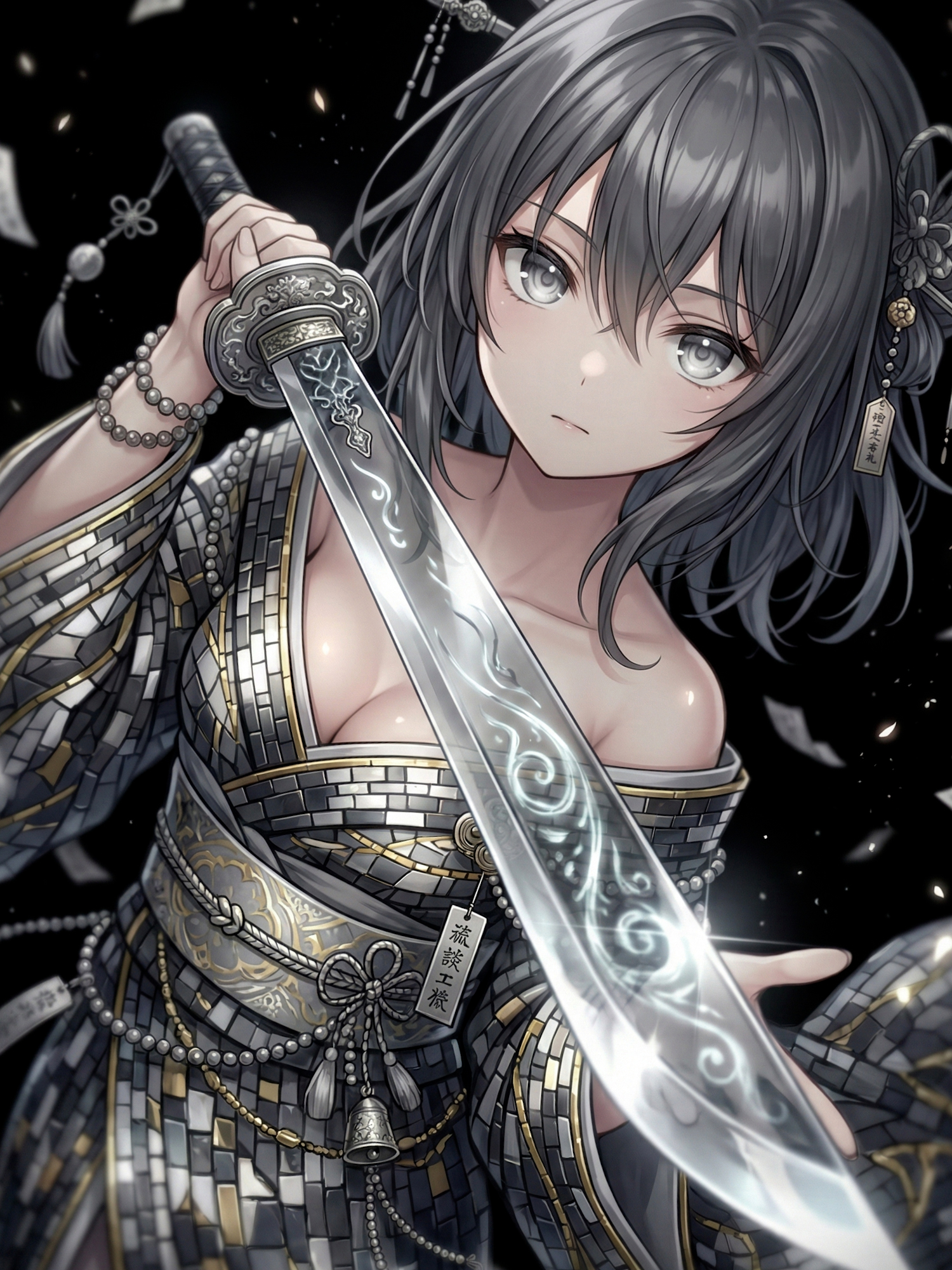
This blade symbolizes unclaimed death and ritual neglect.
It visualizes abandoned souls condensed into weapon form.
In modern contexts, muen-botoke are often reinterpreted as symbols of social isolation, unnoticed deaths, and lives erased by urban anonymity.
Such readings do not distort the traditional concept but instead reveal its continued relevance in contemporary society.
In some modern visual reinterpretations, muen-botoke manifest as a yōtō — a blade left unclaimed. The sword bears no crest and no lineage, embodying existence without witness.
They persist because anonymity still erases.
Modern Reinterpretation – Muen-botoke as Spirits Defined by Absence
In modern interpretation, Muen-botoke—the “unconnected dead”—stand as haunting reflections of disconnection within contemporary life. Once referring to souls without family, grave, or ritual remembrance, their meaning has quietly expanded to encompass the socially invisible: those who die alone, unnoticed, or unclaimed in the vast machinery of urban existence. They are not the wrathful dead of legend, but the forgotten—spiritual echoes of bureaucratic silence and neglected humanity.
Modern writers, filmmakers, and sociologists invoke Muen-botoke as metaphors for anonymity, alienation, and the quiet cost of disconnection. In these readings, the supernatural merges with the statistical—death without witness becomes both tragedy and critique. Their presence lingers not in haunted temples, but in unmarked apartments, deserted stations, or storage facilities of unclaimed remains. They are the folklore of the unacknowledged, reborn through the architecture of indifference.
In visual reinterpretations, their essence is embodied through the yōtō known as the “Nameless Blade.” Forged without crest or inscription, its steel bears no owner’s reflection. When drawn, it emits no sound—only the absence of it. The sword is a weapon that refuses purpose, a symbol of identity erased before history could record it. It does not cut the living; it divides the seen from the unseen.
Through this lens, Muen-botoke become the purest mirror of neglect. Their sorrow is systemic, not personal. They haunt not to frighten, but to remind: remembrance is the final form of connection. Their silence speaks for those whose names have been reduced to paperwork and whose final prayers were unheard. In a world crowded with sound, their quiet endurance becomes its own indictment.
Musical Correspondence
Music inspired by Muen-botoke operates on the threshold between sound and disappearance. Sparse drones, long reverberations, and fading harmonics define its structure. Each note arrives softly, lingers briefly, and vanishes without closure—mirroring the fragile trace of a life unremembered. Silence itself becomes a compositional tool, shaping the contour of what remains unsaid.
Composers may use distant ambient tones, decaying piano chords, or field recordings of urban emptiness—wind through corridors, mechanical hum, rain against concrete—to evoke the quiet persistence of absence. Rhythms are minimal, often dissolving into nothingness, while melodic motifs reappear faintly altered, as though memory is eroding in real time.
Through this restrained design, music inspired by Muen-botoke captures their essence: existence without witness. It is not elegy, nor lament, but continuation—sound as trace, presence as residue. In the space between notes, one might hear what remains of those the world has already forgotten.
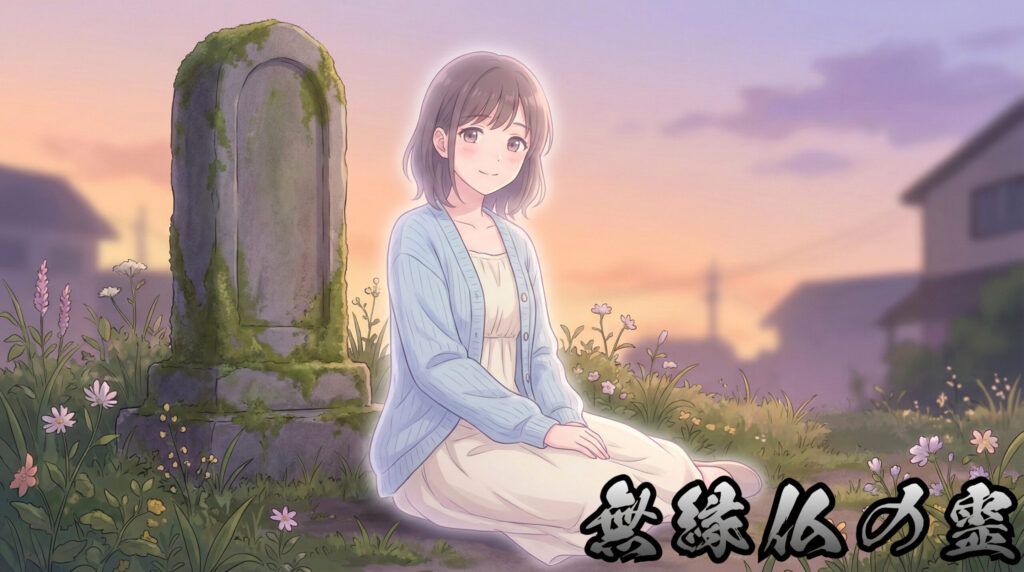
She embodies abandonment and spiritual neglect.
Her presence reflects unclaimed death made visible.
Dreamy and stylish
Genre: Ritual Japanese HipHop / Darkwave Folklore Produced by: Phantom Tone | Suno AI | Kotetsu Co., Ltd. Tags: #JapaneseHipHop #AIgeneratedMusic #Yokai #Phant…