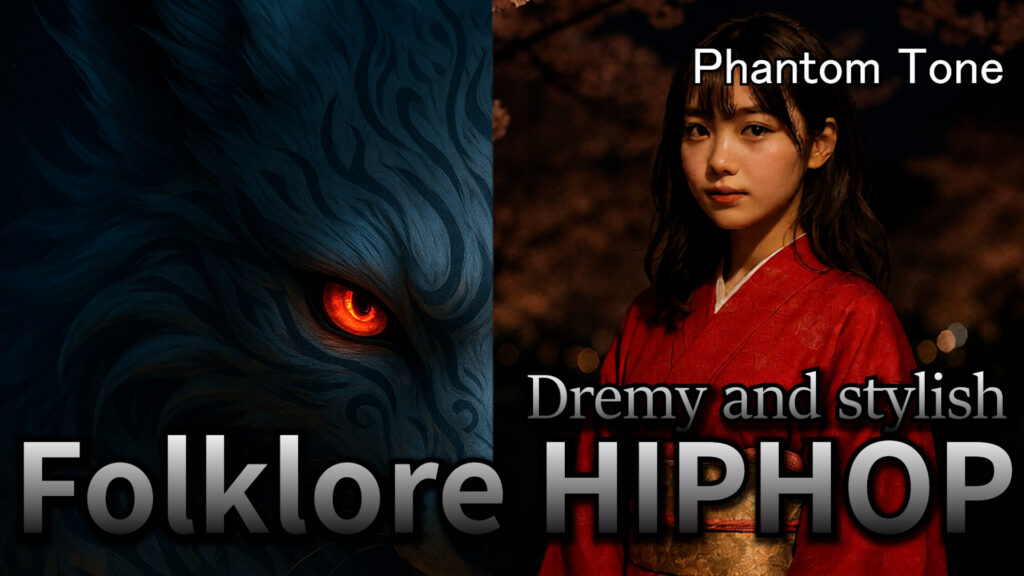
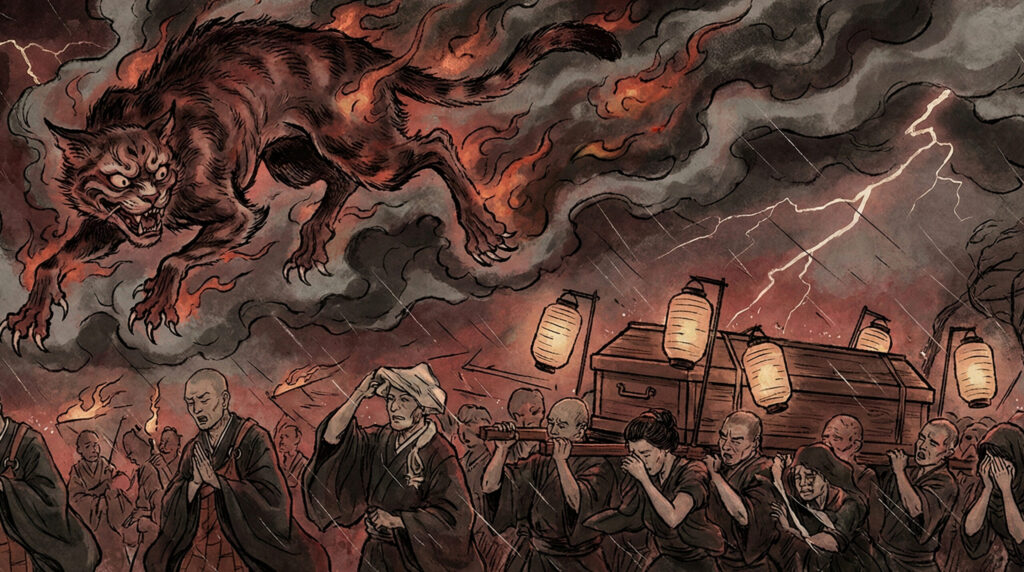
A fiery cart-like yokai that steals corpses from funerals.
It represents death, desecration, and posthumous punishment.
Primary Sources
Classical & Mythological Records
Nihon Shoki (日本書紀)
Bizen Fudoki (備前国風土記)
Kibi region mythological traditions
Modern Folklore References
Yanagita Kunio — Kibi demon folklore
Komatsu Kazuhiko — Yōkai Encyclopedia
Kasha – Corpse-Stealing Fire Spirits of Japanese Folklore
Kasha are among the most ominous and morally charged yōkai in Japanese folklore: supernatural beings associated with fire, death, and the stealing of corpses. Appearing at funerals or during storms, kasha snatch the bodies of the dead—often those who lived sinful or impure lives—and carry them away in flames, wind, or shadow.
Unlike playful or ambiguous yōkai, kasha are deeply entangled with fear of death, religious transgression, and social judgment. They operate at the boundary between this world and the next, enforcing an unsettling form of cosmic consequence. Their presence transforms funeral rites—normally acts of closure—into moments of vulnerability and terror.
Kasha embody the anxiety that even death does not guarantee peace.
Origins and Early Depictions
The origins of kasha can be traced to medieval Buddhist-influenced folklore, where moral conduct in life directly affected one’s fate after death. Early stories describe fiery creatures descending from the sky during funerals, especially those of individuals known for greed, cruelty, or spiritual neglect.
In some accounts, the kasha appears as a monstrous, flaming cat or demon; in others, as a burning wheel or chariot rolling through the night sky. Regardless of form, its function is consistent: to seize corpses deemed unworthy and remove them from proper burial.
These tales served as cautionary narratives, reinforcing religious discipline and social morality. Death was not the end of judgment—it was only another threshold.
Forms and Manifestations
Kasha are notable for their variable appearance, which shifts across regions and eras. Common depictions include:
A massive flaming cat with sharp claws and burning eyes
A fiery cart or wheel rolling through the sky
A demonic figure engulfed in smoke and flame
A whirlwind of fire and wind accompanying its arrival
Despite visual differences, kasha are always associated with heat, motion, and violent disruption. Their arrival is often heralded by sudden storms, thunder, or unnatural winds, signaling the breakdown of normal ritual order.
Kasha and Funeral Rituals
One of the most distinctive aspects of kasha lore is its close connection to funerary practice. Stories describe monks and villagers taking elaborate precautions to protect corpses: chanting sutras, sealing coffins with talismans, or performing decoy funerals.
In some legends, a monk substitutes a bundle of stones or straw for the corpse, tricking the kasha into stealing the wrong object. In others, intense prayer or ritual purity repels the creature entirely.
These stories reflect deep cultural concern about proper death rites and the fear that spiritual failure could invite supernatural intervention even after life has ended.
Moral Judgment and Social Fear
Kasha are not indiscriminate predators. They target specific individuals—often those portrayed as sinners, criminals, or people who rejected religious practice. This selective behavior reinforces their role as enforcers of moral consequence rather than random monsters.
At the same time, the terror they inspire reveals anxiety about communal judgment. A kasha’s appearance does not only condemn the dead; it brings shame and fear upon the living. Funerals become public tests of moral reputation.
In this way, kasha function as instruments of social discipline as much as supernatural horror.
Symbolism and Themes
Death Without Rest
Kasha embody the fear that improper living leads to unrest even after death.
Fire as Judgment
Flame represents purification, punishment, and irreversible consequence.
Ritual Vulnerability
Their presence highlights moments when humans are spiritually exposed.
Moral Surveillance
Kasha serve as reminders that behavior is observed beyond human society.
Related Concepts
Onryō (怨霊)
Vengeful spirits.
→ Onryō
Oni (鬼)
Demonic beings.
→ Oni
Shinigami (死神)
Death-related spirits.
→ Shinigami
Aramitama (荒御魂)
Violent divine aspects.
→ Aramitama
Kasha in Art and Literature
Kasha appear frequently in Buddhist sermons, medieval tales, and Edo-period yōkai collections. Artists often depict them mid-descent, engulfed in flame, reaching toward a coffin or funeral procession.
Unlike humorous yōkai, kasha imagery emphasizes motion, violence, and inevitability. Their design leaves little room for ambiguity: they are agents of dread.
Over time, feline features became more prominent, linking kasha to broader Japanese beliefs about cats as liminal, spiritually dangerous animals—especially around death.
Modern Cultural Interpretations
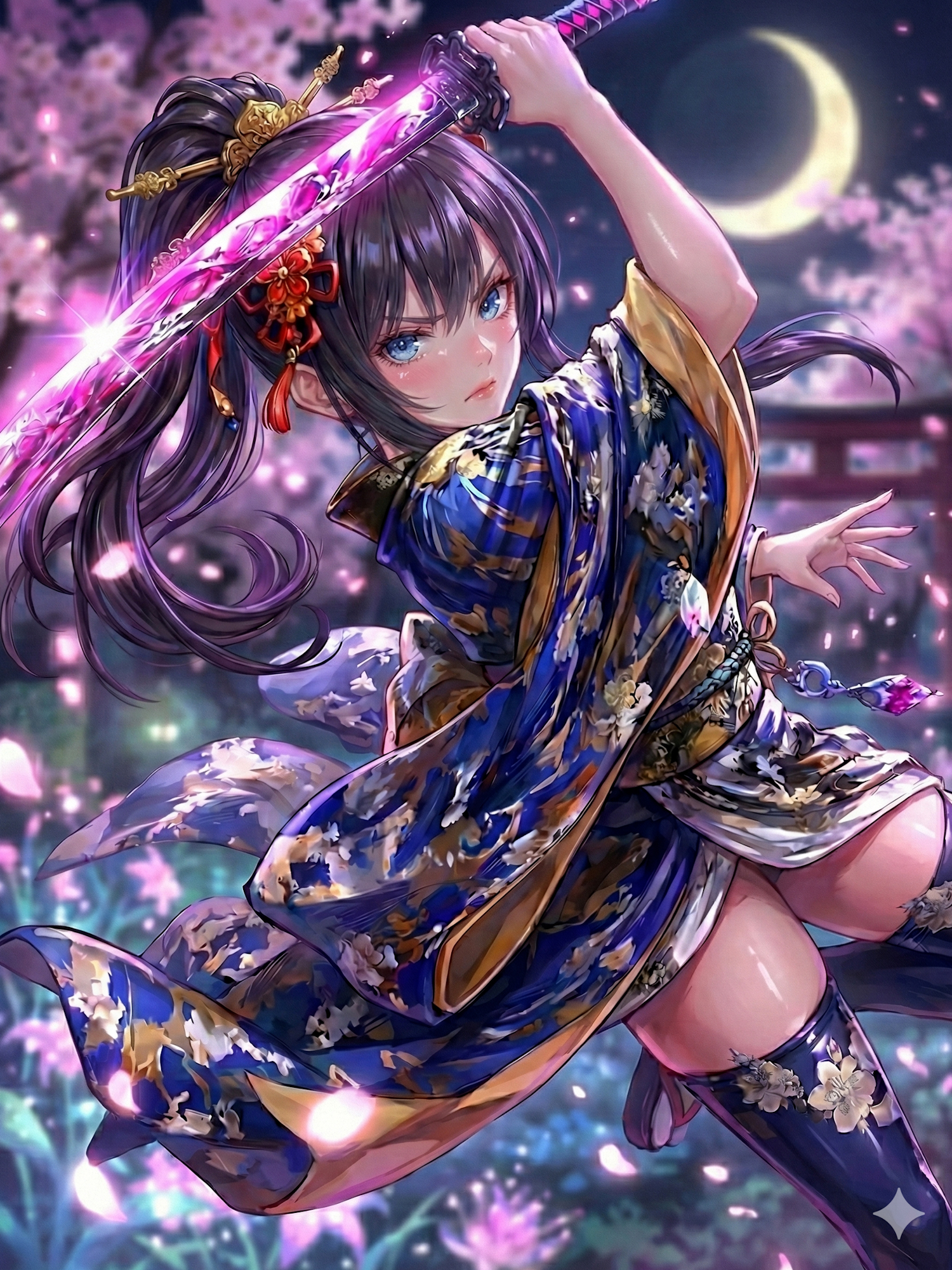
This blade symbolizes corpse theft and posthumous punishment.
It visualizes funerary desecration condensed into weapon form.
In modern reinterpretations, Kasha is no longer framed merely as a monstrous beast or a fiery cart of the dead. It is reimagined as a yōtō — a blade forged from funerary judgment itself. Rather than dragging corpses through flame, this incarnation of Kasha exists as a weapon that enforces posthumous accountability. Its edge does not burn bodies; it cuts ownership of the dead, severing the boundary between those who are permitted burial and those who are denied rest. The Kasha yōtō does not punish out of malice. It operates as a mechanism of reclamation — a blade that retrieves the dead when ritual legitimacy collapses. Where traditional imagery presented Kasha as a visible horror, its yōtō form reveals a colder truth: death is not only an end — it is an audited transition. Kasha endures because judgment does not stop at the grave.
Modern Reinterpretation – Kasha as Enforcers of Unsettled Death
In modern interpretation, Kasha—the corpse-thieving cat demon—stands as one of the most uncompromising figures in Japanese folklore. No longer limited to temple grounds or moral parables, she has become a symbol of unresolved consequence: the idea that even in death, accountability remains. Modern portrayals across manga, games, and film often amplify her physical terror—fiery descent, taloned limbs, winds that twist like screams—but beneath the spectacle lies something far older: the dread that one’s past cannot be buried.
Contemporary creators reinterpret Kasha as an avatar of corrupted passage—the moment when death itself malfunctions. Where funerary rites are meant to ensure safe transition, her arrival reverses the process. She turns closure into confrontation, dragging forth what was meant to stay still. In this way, she becomes a manifestation of spiritual entropy: a force born from neglected guilt, forgotten rituals, and the moral debris of the living.
In visual reinterpretations, the yōtō associated with her legend is known as the “Infernal Retrieval Blade.” The sword burns not with heat but with memory, its edge wreathed in spectral flame that devours absence itself. When drawn, it howls like torn sutras carried on storm wind. To wield it is to invite reckoning—the flame does not cleanse, it reveals. Under its light, nothing can remain hidden, not even the dead.
Through this lens, Kasha emerges not as mere predator but as the metaphysical consequence of avoidance. Her existence interrogates the human desire to forget. Every culture invents rituals to seal the past, but folklore such as hers insists: some acts remain unsealed. She is the embodiment of return—the sound of the gate reopening, the reminder that even the grave keeps its accounts.
Musical Correspondence
Music inspired by Kasha transforms her fiery descent into sonic motion. Compositions often begin with low drones or ritual percussion, evoking distant thunder before erupting into chaotic force. Layered rhythms mirror the storm of wings and claws, while overdriven bass tones simulate the pressure of burning air. Melodic fragments descend chromatically, collapsing like collapsing structures of order.
Between each surge, silence intrudes—not as calm, but as suspension before the next fall. Metallic textures, reverse reverbs, and choral undertones evoke the collision of sacred and profane. Traditional taiko or gong resonance may be buried within electronic distortion, blurring ritual with violence.
Through these contrasts, music inspired by Kasha captures her essence: judgment in motion. It is sound as descent—a reminder that some reckonings do not wait for the living to finish speaking. Beneath the roar and flame, her presence whispers one truth: nothing buried stays buried forever.
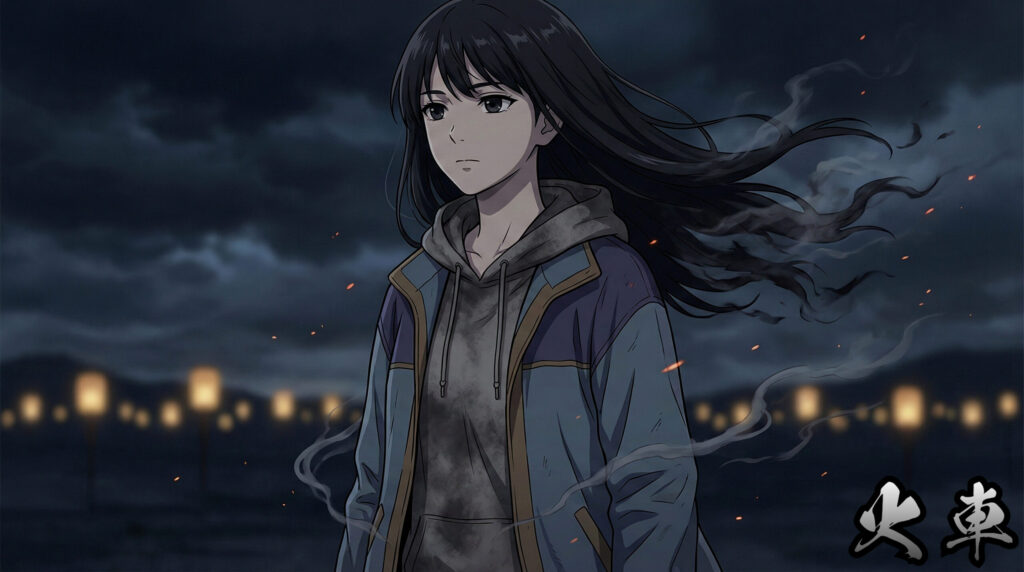
She embodies funerary punishment and corpse-bound curse.
Her presence reflects death desecration made visible.
Dreamy and stylish
Genre: Ritual Japanese HipHop / Darkwave Folklore Produced by: Phantom Tone | Suno AI | Kotetsu Co., Ltd. Tags: #JapaneseHipHop #AIgeneratedMusic #Yokai #Phant…