Ryū – Divine Serpents of Japanese Folklore
Ryū, the dragons of Japanese folklore, are among the most powerful and revered beings in the mythological landscape of Japan. Unlike Western dragons associated with hoards and destruction, Japanese ryū are primarily water deities — serpentine spirits governing rain, rivers, seas, and the life-sustaining cycles of nature.
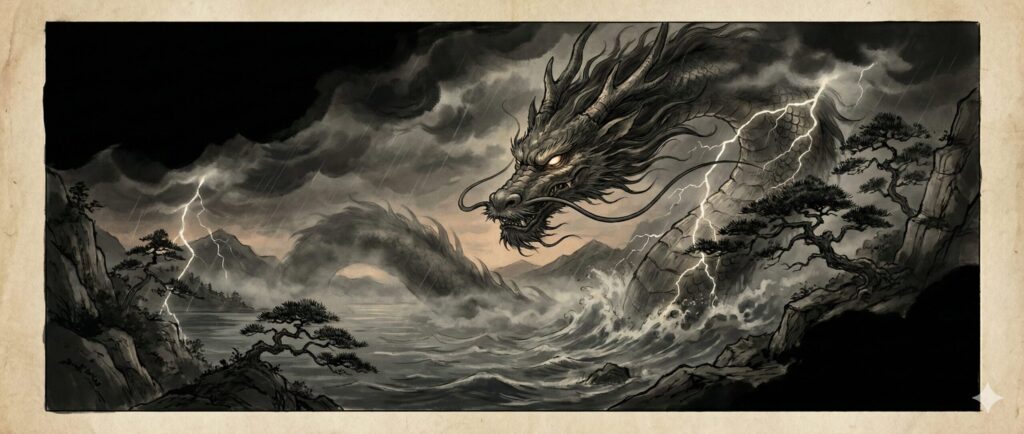
Typically depicted as long, sinuous creatures with clawed limbs, flowing whiskers, and jewel-like eyes, ryū move freely between sky and water. They are not merely monsters or animals, but divine forces whose presence shapes weather, fertility, and the fate of entire regions.
Ryū embody authority without cruelty and power without excess — symbols of natural order rather than domination.
Origins and Early Beliefs
The concept of the dragon entered Japan through continental influences from China and Korea, where dragons were already established as celestial and aquatic deities. However, in Japan, the dragon image merged seamlessly with older indigenous beliefs centered on water spirits, serpents, and sacred natural sites.
Ancient Japanese communities depended heavily on rainfall and river systems, making water a central concern of ritual and myth. As a result, ryū became objects of worship rather than fear. Shrines and legends portray them as guardians of springs, lakes, waterfalls, and coastal waters.
Early myths describe dragons dwelling beneath seas or within mountains, emerging only when balance is disrupted or divine intervention is required.
From Water Spirit to Divine Authority
Over time, ryū evolved from localized water spirits into figures of cosmic significance. In classical mythology, they appear as rulers of underwater realms, such as Ryūjin, the Dragon God of the Sea.
Unlike many yokai, ryū are often explicitly divine. They interact with gods, emperors, and heroes, granting boons or enforcing natural law. Their power is vast but measured — floods and storms occur not out of malice, but as consequences of imbalance or disrespect.
This transformation reflects a worldview in which nature itself possesses hierarchy and intention.
Appearance and Form
Japanese dragons are characterized by fluid, elongated bodies designed for movement rather than brute force. Common traits include:
Serpentine bodies without wings
Clawed limbs, usually three-toed
Flowing whiskers and mane-like hair
Horned heads with expressive eyes
Pearls or jewels symbolizing wisdom and power
Their ability to fly without wings underscores their supernatural nature — movement governed by spiritual force rather than physical mechanics.
Ryū and Water
Water defines the ryū’s domain. Dragons control rainfall, tides, currents, and storms, linking them directly to agriculture and survival.
Many legends describe villagers offering prayers and rituals to appease dragons during droughts or floods. Ryū respond not to individual desire, but to collective harmony — emphasizing balance between human activity and natural systems.
This relationship positions the dragon as mediator between humanity and the environment.
Symbolism and Themes
Authority Without Tyranny
Ryū represent rulership that maintains order rather than exploits power.
Fertility and Renewal
As bringers of rain, dragons symbolize growth, harvest, and the continuation of life.
Balance Between Heaven and Earth
Moving freely between sky, land, and water, ryū embody connection across realms.
Sacred Distance
Though benevolent, ryū remain fundamentally otherworldly — revered rather than approached casually.
Ryū in Mythology and Art
Ryū appear prominently in foundational texts such as the Kojiki and Nihon Shoki, as well as in shrine legends and temple iconography.
In art, dragons are commonly depicted:
Coiling through clouds and waves
Emerging from waterfalls or the sea
Encircling sacred jewels
Carved into temple ceilings and shrine gates
These images emphasize motion, flow, and restrained power, shaping the iconic Japanese dragon aesthetic still recognized today.
Regional Variations and Local Legends
Across Japan, specific lakes, rivers, and coastlines are associated with named dragon spirits. Local legends tell of:
Dragons inhabiting mountain lakes
Serpents transformed into divine ryū
Dragons marrying humans or interacting with heroes
Sacred sites protected by dragon guardians
These regional stories root cosmic dragons firmly in local geography, reinforcing their role as place-bound deities.
Modern Interpretations
In modern media, Japanese dragons often appear as wise, ancient beings rather than mindless beasts. Anime, games, and literature portray them as guardians, teachers, or embodiments of elemental power.
Contemporary interpretations frequently emphasize elegance and spiritual authority, preserving the dragon’s identity as a symbol of harmony rather than conquest.
Conclusion – Ryū as Guardians of Water and Balance
Ryū stand at the apex of Japanese mythological beings — not as conquerors, but as custodians of life-sustaining forces. Their power lies in control rather than chaos, restraint rather than destruction.
As dragons of water and sky, ryū remind humanity that survival depends not on mastery of nature, but on alignment with it. They are symbols of continuity, authority, and the unseen currents that shape existence.
Music Inspired by Ryū
Music inspired by ryū often emphasizes flow, scale, and equilibrium. Long melodic lines, evolving harmonies, and gradual dynamic shifts can evoke the movement of water and clouds guided by unseen force.
Layered textures reflect the dragon’s passage between realms, while balanced rhythms and steady pacing convey authority without aggression. Resonant low tones paired with luminous upper harmonics suggest depth and transcendence.
Through these elements, music inspired by ryū captures not conflict, but harmony — the quiet majesty of a divine presence governing water, sky, and life itself.
Endless Sky
Genre: Japanese Ritual HipHop / AI Art Fusion Produced by: Phantom Tone | Suno AI | Kotetsu Co., Ltd. Tags: #JapaneseHipHop #AIgeneratedMusic #WafuHipHop #Phan…
 Phantom Tone – Japanese Folklore Hip-Hop Project