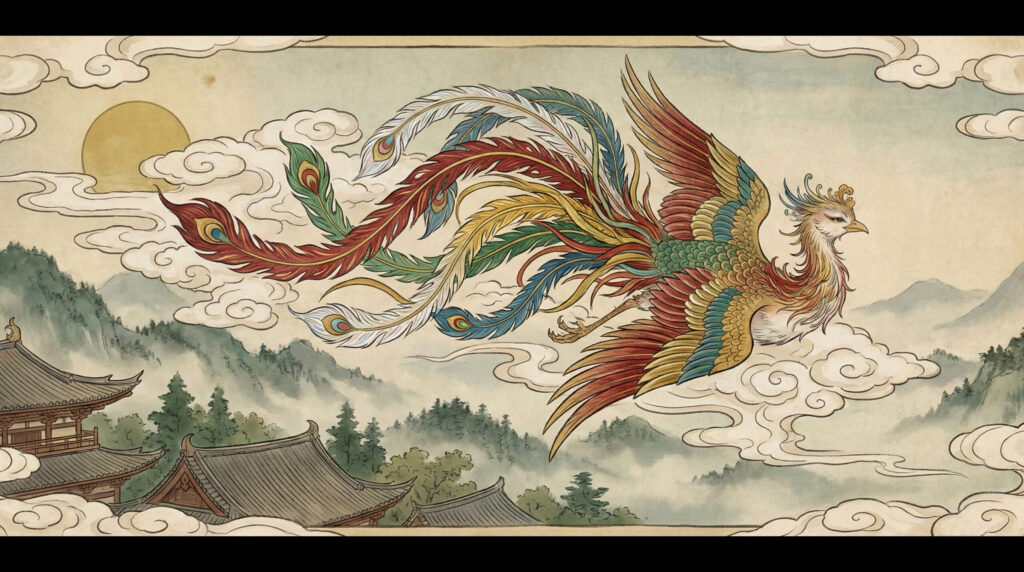
A sacred phoenix-like bird appearing in eras of peace and virtuous rule.
It represents harmony, imperial authority, and divine legitimacy.
Primary Sources
Classical & Mythological Records
Nihon Shoki (日本書紀)
Bizen Fudoki (備前国風土記)
Kibi region mythological traditions
Modern Folklore References
Yanagita Kunio — Kibi demon folklore
Komatsu Kazuhiko — Yōkai Encyclopedia
Hōō – Celestial Phoenix of Japanese Myth and Legend
The Hōō, often translated as the Japanese phoenix, is one of the most exalted and symbolic beings in Japanese mythology. Unlike destructive monsters or mischievous yōkai, the hōō represents harmony, virtue, renewal, and cosmic balance. It is not a creature of fear, but of omen—its appearance signaling an age of peace, just rule, and moral order.
Depicted as a magnificent, otherworldly bird adorned with radiant plumage, the hōō embodies an ideal rather than a threat. It is said to appear only in times of harmony and to vanish when disorder or corruption prevails. As such, the hōō exists less as an active agent and more as a cosmic barometer, reflecting the moral state of the world.
In Japanese culture, the hōō stands at the intersection of mythology, political symbolism, and spiritual aspiration.
Origins and Transmission to Japan
The hōō originates from the Chinese fenghuang, a mythological bird associated with imperial virtue and cosmic harmony. Introduced to Japan through early cultural exchange, particularly during the Asuka and Nara periods, the concept was absorbed into Japanese cosmology and adapted to local beliefs.
While rooted in continental mythology, the Japanese hōō developed its own distinct identity. Rather than being directly worshipped as a deity, it became a symbolic presence—appearing in art, architecture, and court ideology as a sign of divine approval and righteous governance.
In classical texts, the hōō is described as a composite creature, combining elements of multiple animals: the beak of a rooster, the neck of a snake, the back of a tortoise, and the tail of a fish. This hybrid form reinforces its role as a unifying being that transcends ordinary categories.
Appearance and Sacred Attributes
Descriptions of the hōō emphasize beauty, symmetry, and balance rather than aggression:
Brilliant, multicolored feathers often associated with fire and sunlight
Graceful wings capable of traversing heaven and earth
A noble, serene expression rather than ferocity
A presence accompanied by light, music, or auspicious clouds
The hōō is frequently depicted standing calmly rather than in flight, suggesting stability and restraint. It does not hunt, kill, or consume living beings, instead subsisting on bamboo seeds or sacred dew—an image reinforcing its purity and nonviolence.
Symbol of Peace and Virtuous Rule
A central theme of hōō mythology is its relationship to governance. The bird is said to appear only under the reign of a wise and benevolent ruler. Its arrival signifies harmony between heaven, earth, and humanity, while its absence or disappearance warns of moral decay.
Because of this association, the hōō became a powerful emblem in imperial symbolism. It appears on ceremonial objects, court decorations, and later architectural motifs, most famously atop the Phoenix Hall (Hōō-dō) at Byōdō-in Temple.
In this context, the hōō functions not as a supernatural actor, but as a judgment rendered by the cosmos itself.
Fire, Renewal, and Misconceptions
Unlike the Western phoenix, which is defined by death and rebirth through flame, the Japanese hōō is less focused on cyclical destruction. While fire and radiance are part of its imagery, they symbolize illumination and vitality rather than self-immolation.
Renewal in hōō mythology is moral and societal rather than physical. The world is “reborn” not through catastrophe, but through the restoration of harmony and virtue. This distinction reflects broader differences between Japanese and Western mythic structures.
Symbolism and Themes
Harmony Over Conflict
The hōō represents balance, coexistence, and the alignment of human conduct with cosmic order.
Moral Authority
Its appearance serves as an external validation of ethical leadership and righteous rule.
Transcendence of Duality
As a composite being, the hōō transcends simple categories of animal, spirit, or deity.
Idealized Power
Its strength lies in presence and symbolism, not action or domination.
Related Concepts
Fenghuang (鳳凰 / Chinese Phoenix)
Mythical auspicious bird of virtue and harmony.
Hōrai (蓬莱)
Immortal realms associated with divine beings.
Marebito (稀人)
Otherworldly visitors.
→Marebito
Shijin (四神)
Cosmic directional guardian beasts.
Hōō in Art and Cultural Memory
Throughout Japanese history, the hōō has been a favored motif in visual art, architecture, and decorative crafts. It appears in temple carvings, folding screens, kimono patterns, and imperial regalia.
Rather than dynamic action scenes, artists tend to depict the hōō in poised, symmetrical compositions, reinforcing its association with order and serenity. Its image became synonymous with refinement, prosperity, and spiritual legitimacy.
Even in modern Japan, the hōō remains a symbol of elegance and auspiciousness, frequently invoked in ceremonial or commemorative contexts.
Modern Interpretations
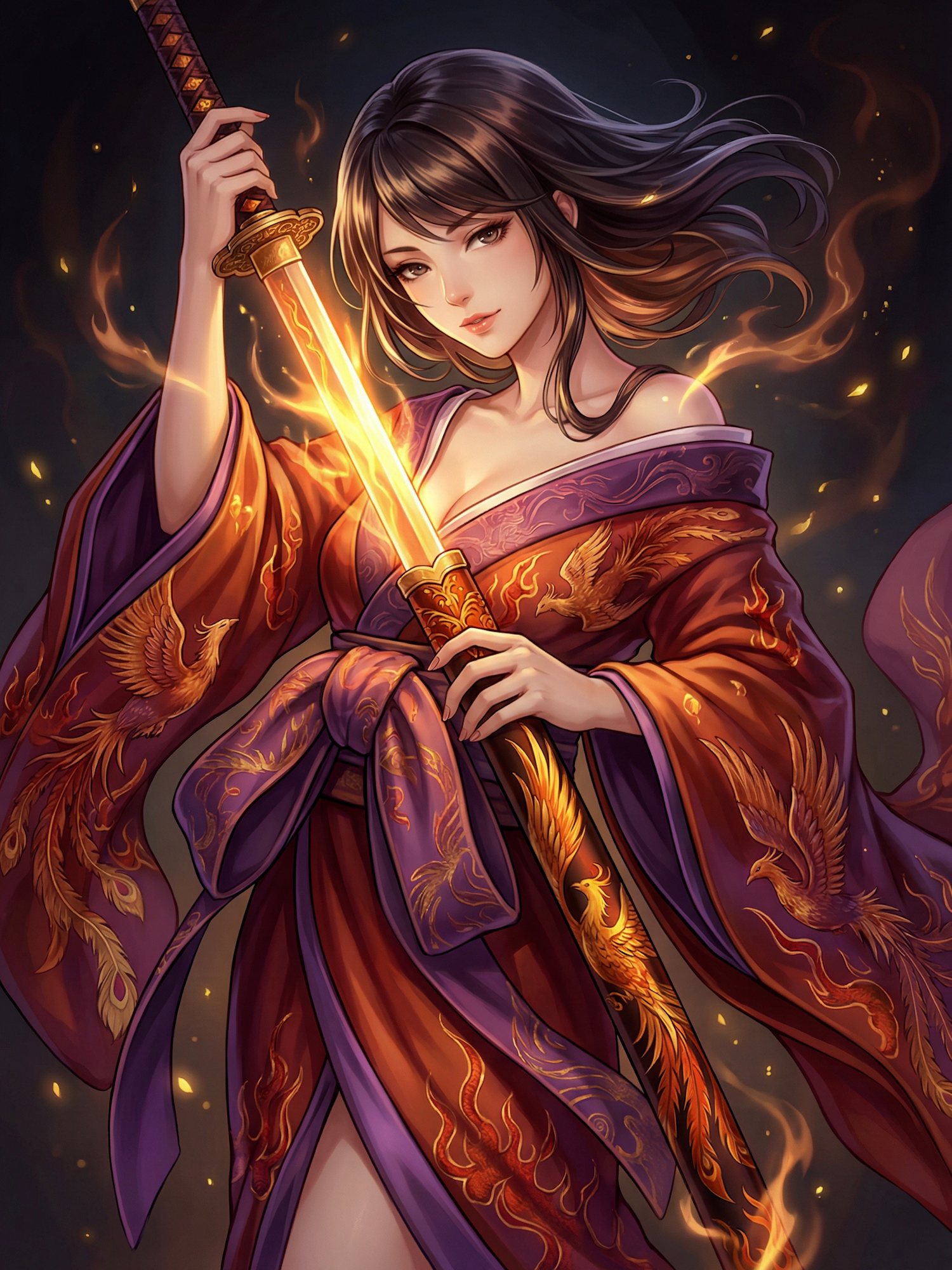
This blade symbolizes divine legitimacy and cosmic order.
It visualizes imperial harmony condensed into weapon form.
In modern reinterpretations, the hōō is no longer framed solely as a benevolent symbol of peace or imperial virtue. It is reimagined as a yōtō — a sacred blade forged from celestial authority itself. Rather than descending to bless, this incarnation of the hōō exists as a weapon that enforces harmony. Its edge does not punish through wrath, but through inevitability: a blade that cuts imbalance from the world, not out of anger, but out of cosmic necessity. The hōō yōtō is not a tool of conquest. It is a judicial instrument of order — a silent executor of celestial legitimacy. Its presence signifies not aspiration, but correction. Where traditional imagery celebrated the hōō as a sign of peace, its yōtō form reveals a harsher truth: peace is maintained not by mercy alone, but by the quiet existence of an absolute blade. The hōō endures because harmony itself requires enforcement.
Modern Reinterpretation – Hōō as the Bird of Cosmic Balance
In this modern reinterpretation, the Hōō (phoenix) transcends its traditional role as a royal omen to become a symbol of equilibrium between chaos and order — the aspiration for peace sustained through self-discipline. In a world increasingly defined by volatility, the hōō reappears not as a relic of myth, but as a luminous metaphor for moral poise and ecological harmony. Its wings no longer herald dynastic virtue alone; they reflect a universal yearning for restoration and clarity.
The “beautiful celestial” visualization presents the Hōō as a creature woven from light and time. Feathers shimmer in gradients of pearl, vermilion, and indigo — colors that shift like the horizon at dawn. Each plume trails fine motes of radiance that resemble falling petals rather than flame. The bird’s face is serene, almost human in expression, framed by crest feathers that resemble the sun’s corona. When it moves, the air bends slightly, as though gravity itself chooses to yield before balance.
In this vision, the yōtō appears as a ceremonial blade resting within the bird’s plumage — its edge polished to mirror the sky. The sword’s surface refracts halos of faint gold, its form more symbolic than lethal. It represents the equilibrium of forces — a weapon that exists not to divide, but to define. When drawn, it does not blaze, but hums — a resonance that quiets rather than commands. The act of wielding it is meditation, not conquest.
Through this interpretation, the Hōō becomes less a creature of resurrection and more a manifestation of perfected restraint. It embodies the rare synthesis of authority without arrogance, illumination without blindness. Its flight is not toward the heavens, but within them — tracing patterns that hold the world together for as long as humanity remembers to look up. The Hōō endures because harmony, though fragile, is the most desired form of power.
Musical Correspondence
The composition accompanying this vision unfolds like a sunrise in motion. Sustained string harmonics and airy choral layers evoke ascension through stillness, while distant bells shimmer with subtle dissonance that resolves into radiant consonance. The music does not rise in triumph; it expands in understanding.
Low drones anchor the celestial brightness, grounding transcendence in earthbound awareness. Every cadence feels deliberate, patient — a balance between breath and silence. Gentle flutes trace arcs of melody reminiscent of wings gliding through calm wind, while slow cymbal rolls mark the turn of invisible cycles.
In its closing passage, a single tone lingers as the harmonies dissolve, leaving a quiet void — the echo of the Hōō departing but not gone. Through grace, minimalism, and radiant balance, the music captures the creature’s essence: not rebirth through fire, but serenity born from perfect alignment between spirit, sound, and sky.
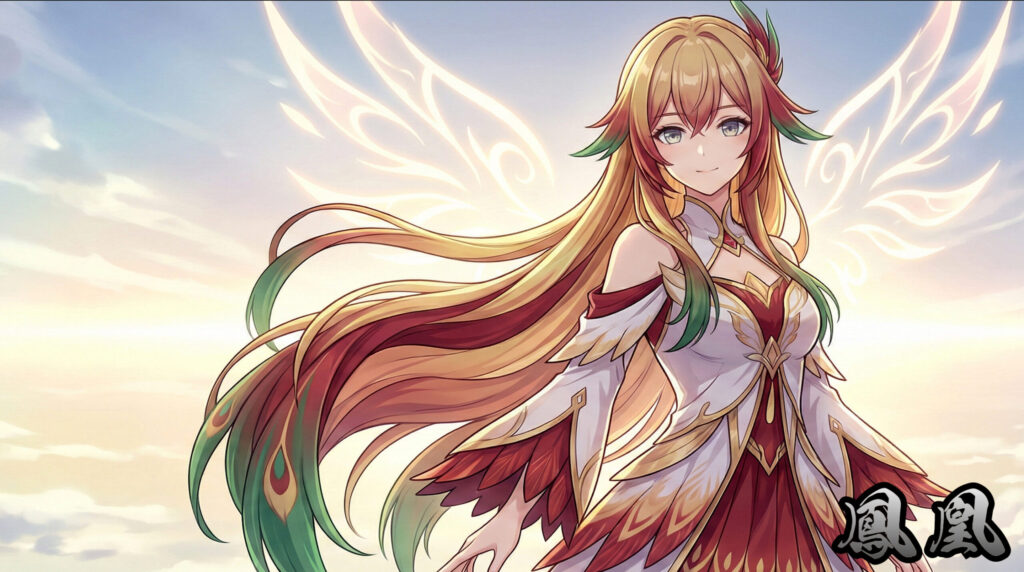
She embodies celestial harmony and sacred sovereignty.
Her presence reflects divine virtue made visible.
Dreamy and stylish
Genre: Ritual Japanese HipHop / Darkwave Folklore Produced by: Phantom Tone | Suno AI | Kotetsu Co., Ltd. Tags: #JapaneseHipHop #AIgeneratedMusic #Yokai #Phant…