
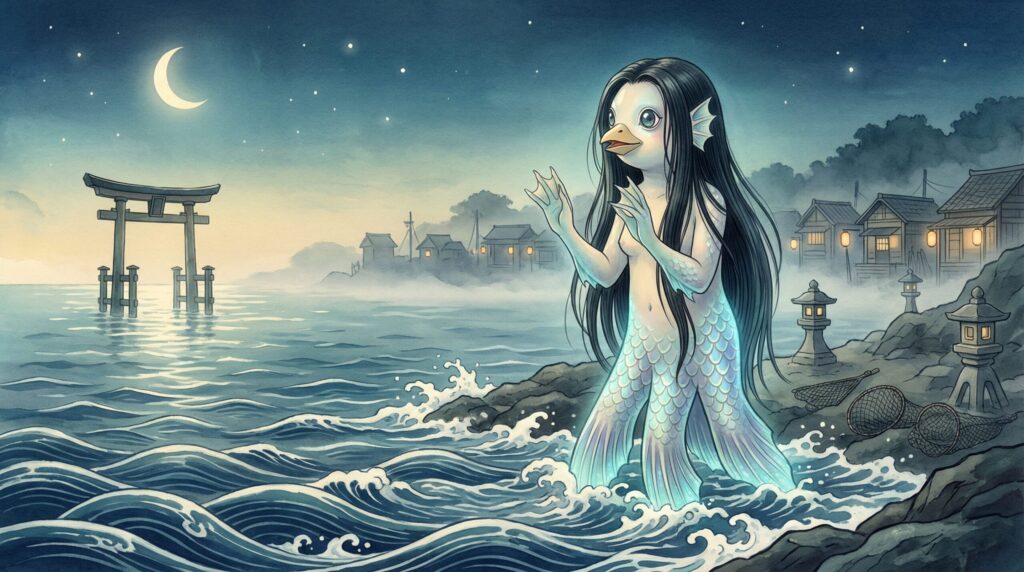
A prophetic sea yokai who appears to warn of epidemics.
It represents plague, prediction, and ritual prevention.
Primary Sources
Classical & Mythological Records
Nihon Shoki (日本書紀)
Bizen Fudoki (備前国風土記)
Kibi region mythological traditions
Modern Folklore References
Yanagita Kunio — Kibi demon folklore
Komatsu Kazuhiko — Yōkai Encyclopedia
Amabie – Prophecy, Plague, and the Shape of Preventive Fear in Japanese Folklore
Amabie occupies a singular and unsettling position in Japanese folklore: a prophetic being whose power does not lie in attack or pursuit, but in warning. Unlike aggressive yōkai that hunt, curse, or destroy, Amabie emerges only to announce calamity—specifically epidemic disease—before vanishing into the sea.
Amabie is not a monster of violence.
Amabie is a monster of anticipation.
Its presence transforms fear into preparation. In this way, Amabie embodies the tension between inevitability and prevention, fate and ritual response.
Origins in Late Edo Maritime Folklore
The earliest known record of Amabie appears in a Kawaraban broadsheet dated 1846, in the late Edo period. According to the account, a luminous, human-faced creature with long hair and three fin-like limbs emerged from the sea in Higo Province.
It declared:
“For the next six years, good harvests will continue.
But disease will spread.
Draw my likeness and show it to others.”
Amabie then returned to the sea.
This act establishes Amabie not as a destroyer, but as a messenger whose power is bound to reproduction of its image—an early form of protective viral transmission, long before modern epidemiology.
Appearance and the Logic of the Unsettling
Amabie’s form defies comfortable classification.
Human face
Long flowing hair
Beaked mouth or reptilian snout
Three tail-like limbs or fins
A scaly, luminous lower body
This hybrid structure destabilizes visual certainty. It is neither human nor fish, neither god nor beast. The strangeness itself functions as mnemonic technology: the more unsettling the image, the more likely it is to be remembered, reproduced, and circulated.
Amabie’s body is a visual carrier of warning.
Prophecy as Preventive Technology
Unlike yōkai that punish after transgression, Amabie intervenes before catastrophe fully unfolds. Its role is predictive rather than reactive.
The instruction to copy and distribute its image transforms folklore into a ritual information network. Protection is achieved not by prayer, sacrifice, or exorcism—but by replication.
In this sense, Amabie represents one of Japan’s earliest folkloric models of public-health logic.
Fear becomes data.
Image becomes medicine.
Disappearance and Return
After its Edo-period appearance, Amabie vanished from public memory—until its dramatic resurgence during the COVID-19 pandemic. Once again, its image spread rapidly across social media, art communities, and popular culture, reviving its ancient function in a modern informational ecosystem.
This return demonstrates that Amabie is not bound to period, belief, or religion. It is bound to condition:
the moment when invisible danger demands visible warning.
Symbolism and Themes
Fear as Prevention
Amabie turns dread into action.
Image as Medicine
Its likeness functions as a ritual tool.
Prophecy Without Control
It announces calamity, but does not prevent it—only prepares.
The Sea as Information Source
Danger emerges from unseen depths.
Related Concepts
Yogen no Tori (予言の鳥)
Prophetic creatures announcing calamity.
Umibōzu (海坊主)
Sea-based yokai.
→Umibōzu
Aramitama (荒御魂)
Violent divine aspects.
→Aramitama
Marebito (稀人)
Otherworldly visitors.
→Marebito
Historical Sources and Transmission
Only one primary Edo-period record of Amabie survives, found in a woodblock-printed kawaraban leaflet. This rarity contributes to both its mystery and its adaptability. During the time of its origin, such printed sheets were commonly used to distribute news, supernatural sightings, and protective rituals. Amabie’s instruction to circulate its portrait fits this media environment perfectly.
Over the following century and a half, Amabie remained obscure in popular culture until the 21st century, when its connection to epidemic protection brought unprecedented global recognition. The revival demonstrates how yokai evolve across time, reappearing when their symbolic function becomes relevant again.
Modern Cultural Interpretations

This blade symbolizes epidemic prophecy and ritual defense.
It visualizes protective divination turned into weapon.
In contemporary Japan and abroad, Amabie has transformed into a cultural icon of healing, positivity, and resilience. Artists reinterpret it in countless styles — cute, ethereal, surreal, or solemn — and it appears in merchandise, medical posters, municipal campaigns, and digital art.
This modern reimagining reflects the yōkai’s enduring relevance: a figure that blends beauty and eeriness, offering symbolic reassurance during moments of collective anxiety. Its emphasis on imagery makes Amabie naturally suited for the digital era, where protective symbols spread visually just as they once did through woodblock prints.
In some modern visual reinterpretations, Amabie manifests as a yōtō — a blade etched with wave-like scales and luminous fins. The sword does not threaten; it wards. Its presence turns protection into form.
Amabie endures because reassurance still needs symbols.
Modern Reinterpretation – Amabie as the Radiant Oracle of Renewal
In this modern reinterpretation, Amabie transcends its folkloric origins as a sea-born prophet to become a symbol of collective endurance — the embodiment of healing through imagination. Once a mysterious coastal omen whispered through Edo-period woodblock prints, it has resurfaced in digital form as an emblem of hope shared through screens and social networks. Its resurgence reveals how art, in any age, transforms fear into communication.
The “beautiful protector” visualization depicts Amabie not as creature or saint, but as a presence made of light and tide. Her form flows between human and aquatic: long hair drifts like seaweed in slow current, her scales shimmer in translucent layers of turquoise and pale gold, and her gaze — gentle yet unblinking — reflects both ocean depth and human empathy. Her voice is not a command but a resonance, felt rather than heard, as though prophecy itself were an undertone of the waves.
The yōtō she carries is unlike those of wrathful spirits or vengeful deities. Its blade ripples like liquid glass, each motion refracting faint blues and greens. Patterns of wave and fin are etched along its length, pulsing softly with bioluminescent glow. The weapon does not exist to strike; it exists to sanctify — to define the boundary where dread dissolves into faith. When drawn, its edge does not wound; it illuminates.
Through this reinterpretation, Amabie becomes a cultural prism — refracting crisis into beauty, isolation into solidarity. She is not a savior who removes hardship, but a mirror reminding humanity of its own capacity to endure. Her modern life in posters, art, and media reveals a truth embedded in Japanese folklore: that myth is not fixed. It transforms to meet the world’s needs. Amabie survives because hope always finds a new shape.
Musical Correspondence
The corresponding composition embodies calm radiance and oceanic depth. Flowing arpeggios shimmer like refracted light beneath the surface, while ethereal synth textures echo the undulating rhythm of waves. Soft bells and woodwind tones emerge like distant calls — half prayer, half lullaby.
Gradually, a luminous motif unfolds: rising intervals suggesting breath after submersion. Low-frequency drones provide grounding, like the sea’s pulse beneath its glittering skin. The harmonic language avoids resolution, maintaining suspension — a musical expression of balance between uncertainty and faith.
In its final moments, the melody dissipates into quiet, as though returning beneath the tide. Through restraint, light, and flow, the music captures Amabie’s essence: not power over fear, but beauty within it — the gentle glow that guides communities through shadowed waters.
le>
She embodies prophecy and protective ritual power.
Her presence reflects calamity prevention made visible.
Amabie
Genre: Japanese Folklore Hip-Hop, Ritual Lo-Fi Poetry Produced by: Phantom Tone | Suno AI | Kotetsu Co., Ltd. Tags: #AIgeneratedMusic #JapaneseHipHop #Folklore…