Onibi – Wandering Flames of the Japanese Night
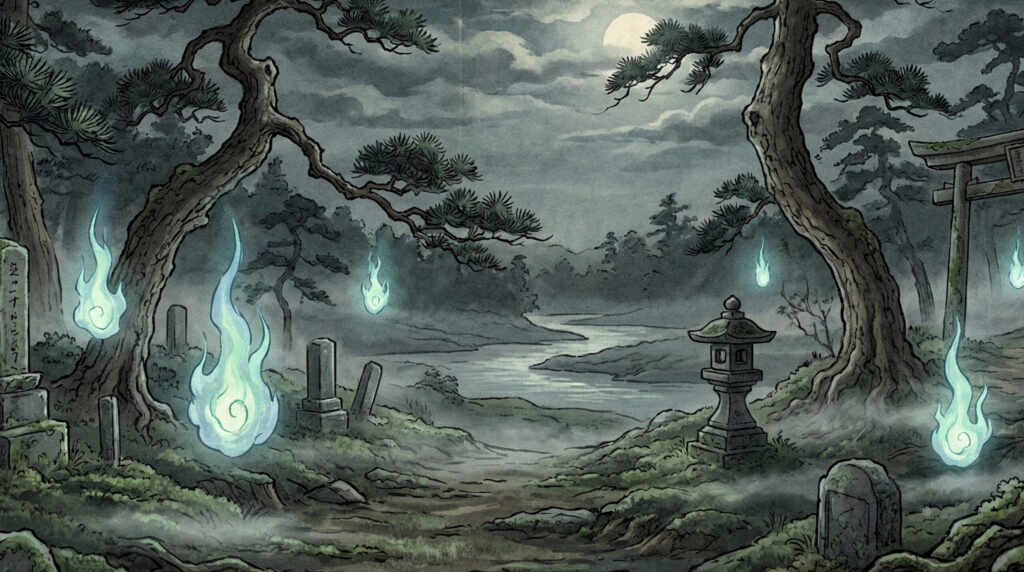
Onibi are among the most elusive and atmospheric phenomena in Japanese folklore: mysterious floating flames that appear in graveyards, marshes, forests, and lonely roads after dark. Neither fully creature nor simple fire, onibi exist as manifestations of lingering spirit energy—lights that drift, flicker, and vanish without warning.
Unlike aggressive yōkai, onibi rarely attack. Their power lies in misdirection and unease. Those who follow them may become lost, frightened, or emotionally unsettled. Onibi do not roar or strike; they simply glow, hover, and lead the unwary astray.
They represent a quiet, persistent fear—the fear of the unknown moving just ahead, always out of reach.
Origins and Early Beliefs
References to ghostly lights appear in Japan’s oldest folklore, often linked to death, burial grounds, and places of spiritual residue. Early explanations treated onibi as flames born from the souls of the dead, especially those who died violently, unjustly, or without proper rites.
In some traditions, onibi are the transformed spirits of humans or animals. In others, they are pure manifestations of spiritual energy leaking into the physical world. Rather than a single myth, onibi function as a category of phenomena, absorbing local beliefs and interpretations.
Their universality across regions suggests a shared human response to unexplained light in darkness—interpreted through the lens of spirit and memory.
Appearance and Behavior
Descriptions of onibi are simple yet vivid:
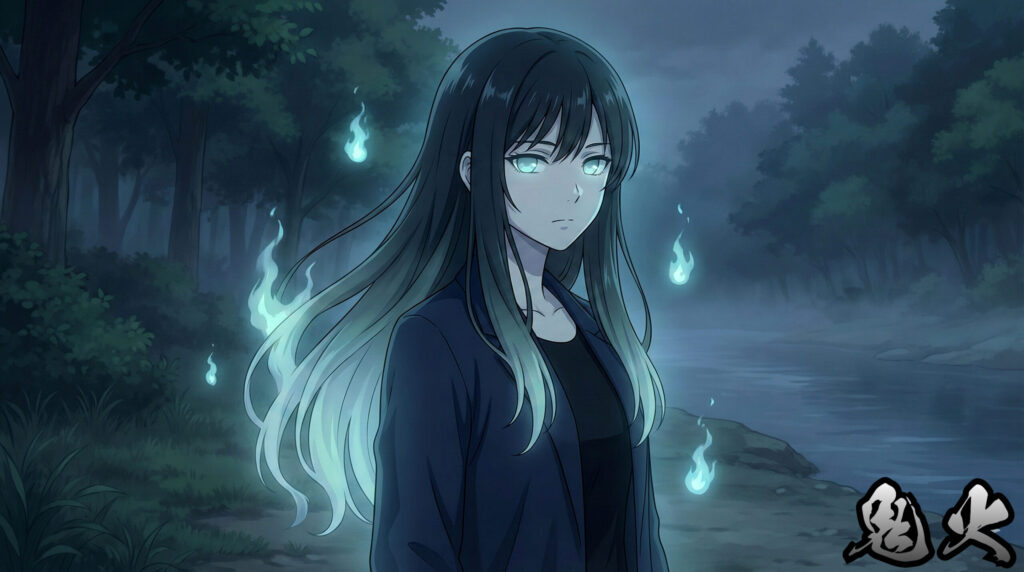
Small floating flames, often blue, green, or pale white
Gentle flickering rather than roaring fire
Silent movement through air or just above the ground
Sudden appearance and disappearance
Onibi are not hot in the conventional sense. Some legends claim they do not burn at all, while others warn that touching them can drain vitality or bring illness. Their physical ambiguity reinforces their supernatural nature.
They often appear in clusters, drifting like lanterns without bearers.
Onibi and the Dead
The strongest association of onibi is with death and lingering souls. Graveyards, execution sites, battlefields, and abandoned villages are frequent settings for encounters.
In some stories, onibi are the visible form of human resentment or sorrow that failed to dissipate after death. In others, they mark places where boundaries between worlds are thin.
Rather than punishing the living, onibi seem to repeat the presence of the past—unresolved, glowing faintly in the present.
Misdirection and Loss
A recurring motif in onibi folklore is misguidance. Travelers who follow the lights may wander into swamps, forests, or unfamiliar terrain. When they realize the danger, the onibi vanish, leaving silence behind.
Importantly, the onibi do not pursue. They drift forward, indifferent to whether they are followed. The danger lies in human curiosity and fear, not malicious intent.
This framing places responsibility subtly on the observer.
Symbolism and Themes
Residual Spirit Energy
Onibi symbolize emotions or souls that have not fully passed on.
The Boundary of Worlds
They appear where life and death intersect.
Quiet Misdirection
They lead astray without force, only presence.
Fear Without Form
Their lack of shape or intent amplifies unease.
Variations and Related Phenomena
Japanese folklore contains many named variations of ghostly fire—each reflecting regional nuance. Some are tied to specific animals, others to particular deaths or locations. Despite different names, their behavior remains similar: light without source, motion without explanation.
This flexibility allowed onibi belief to coexist with changing religious and scientific understanding, shifting from literal spirits to symbolic phenomena without losing cultural resonance.
Onibi in Art and Literature
Onibi appear frequently in classical paintings, yōkai scrolls, and later literature as small but powerful visual accents. Artists depict them hovering above graves, drifting through reeds, or glowing in distant darkness.
Rather than dominating the scene, onibi often serve as focal points of atmosphere—small lights anchoring vast darkness. Their visual restraint reinforces their thematic subtlety.
Modern Interpretations
In modern media, onibi are often stylized as ghostly flames or spirit lights, sometimes accompanying larger yōkai or serving as visual shorthand for haunted spaces.
Contemporary interpretations may frame onibi as metaphors for memory, trauma, or emotional residue—things that persist quietly rather than erupt violently.
Despite reinterpretation, their essential character remains unchanged: light without warmth, presence without voice.
Conclusion – Onibi as Flames of Lingering Absence
Onibi are not monsters to be fought or spirits to be appeased. They are signs—glimpses of something unresolved, glowing faintly at the edge of perception.
Their drifting flames remind us that not all fear comes from threat. Some fear comes from absence, from what remains after life has ended but meaning has not.
In their quiet motion and sudden disappearance, onibi embody the unease of night itself: beautiful, silent, and unknowable.
Music Inspired by Onibi (Will-o’-the-Wisp)
Music inspired by onibi often emphasizes lightness, suspension, and restraint. Sparse arrangements, sustained tones, and gentle oscillation can evoke floating flames in darkness.
High-register melodies, soft drones, and subtle electronic textures mirror their ethereal glow. Rhythms may be minimal or absent, creating a sense of drifting without direction.
By focusing on atmosphere over momentum, music inspired by onibi captures their essence: a presence that guides nothing, threatens nothing, yet lingers quietly—just long enough to be remembered.
Dreamy and stylish
Genre: Ritual Japanese HipHop / Darkwave Folklore Produced by: Phantom Tone | Suno AI | Kotetsu Co., Ltd. Tags: #JapaneseHipHop #AIgeneratedMusic #Yokai #Phant…
 Phantom Tone – Japanese Folklore Hip-Hop Project
konkon sama
Genre: Ritual Lo-Fi Japanese HipHop / Shinto Folklore Fusion Produced by: Phantom Tone | Suno AI | Kotetsu Co., Ltd. Tags: #JapaneseHipHop #AIgeneratedMusic #W…