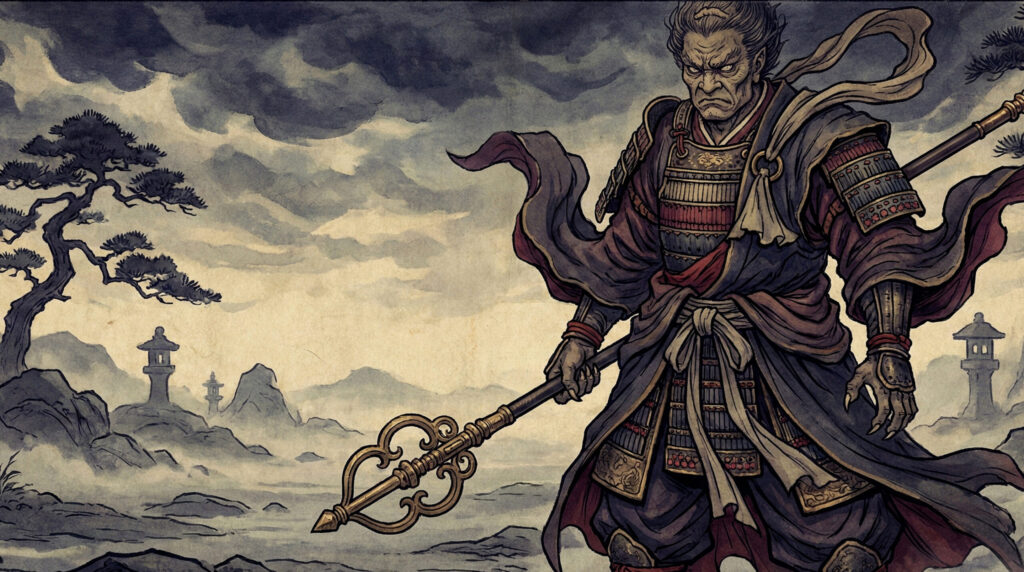
A wrathful guardian spirit adapted from Indian Yaksha mythology.
It represents divine punishment, violent protection, and sacred fury.
Primary Sources
Classical & Mythological Records
Nihon Shoki (日本書紀)
Bizen Fudoki (備前国風土記)
Kibi region mythological traditions
Modern Folklore References
Yanagita Kunio — Kibi demon folklore
Komatsu Kazuhiko — Yōkai Encyclopedia
Yasha – Wrathful Guardians and Fallen Spirits in Japanese Folklore
Yasha are among the most complex and emotionally charged figures in Japanese folklore: fierce, wrathful beings born from the intersection of Buddhist cosmology, warrior imagery, and human passion. Neither purely demonic nor purely divine, yasha occupy a volatile middle ground—figures of violent protection, obsession, and transformation.
Often portrayed with terrifying expressions, supernatural strength, and an aura of fury, yasha are driven by intense emotion. Unlike monsters that act out of instinct, yasha act out of purpose. Their violence is not random; it is directed, fueled by duty, love, hatred, or unresolved attachment.
Yasha embody the danger and necessity of wrath.
Origins in Buddhist Cosmology
The concept of yasha originates from the Indian yakṣa, a class of spirits associated with nature, wealth, and protection. Through Buddhism, yakṣa entered East Asian cosmology and were reinterpreted in Japan as yasha—beings often aligned with the protection of Buddhist law, sacred places, or cosmic order.
In this framework, yasha are not evil. They are guardians whose ferocity is justified by their role. Their terrifying appearance serves as deterrence, not cruelty.
However, as these ideas blended with local folklore, yasha began to absorb more human traits—emotion, obsession, and tragedy—expanding their narrative role beyond strict religious symbolism.
Appearance and Wrathful Form
Yasha are typically depicted with overwhelming physical presence:
Muscular or armored bodies
Sharp fangs, horns, or wild hair
Burning eyes filled with rage or sorrow
Weapons such as swords, spears, or claws
Dynamic, aggressive postures
Their appearance reflects inner state. A yasha’s body manifests emotion—anger made flesh. Unlike oni, whose brutality may be blunt, yasha convey controlled violence, disciplined yet explosive.
They look like warriors who have crossed a spiritual threshold.
From Guardian to Fallen Being
A recurring theme in yasha lore is transformation. Some yasha are born as protectors of the Buddhist law. Others are humans who become yasha through overwhelming emotion—grief, jealousy, or unfulfilled devotion.
In these stories, love turns into obsession, duty into fixation. The yasha’s strength increases as their humanity erodes. This transformation is often irreversible, trapping them in a role defined by what they protect or pursue.
Unlike simple corruption narratives, yasha stories emphasize inevitability. Emotion, once unleashed, cannot be recalled.
Yasha and the Warrior Ideal
Yasha frequently overlap with warrior imagery. Their discipline, loyalty, and readiness to kill echo the values—and dangers—of martial devotion. In some tales, fallen warriors become yasha, continuing to fight beyond death.
This association frames yasha as cautionary figures. Absolute commitment may produce strength, but it also risks dehumanization. The line between protector and destroyer grows thin.
Yasha thus reflect anxieties about violence justified by duty.
Symbolism and Themes
Wrath as Protection
Yasha represent anger wielded in defense rather than chaos.
Transformation Through Emotion
They show how intense feeling reshapes identity.
Duty Without Release
Their suffering often stems from unending obligation.
Power at the Cost of Humanity
Strength increases as personal peace disappears.
Related Concepts
Oni (鬼)
Demonic beings.
→Oni
Aramitama (荒御魂)
Violent divine aspects.
→Aramitama
Kishin (鬼神)
Wrathful divine oni spirits.
→Kishin
Yaksha (Skt.)
Indian guardian spirits adapted into Japanese cosmology.
Yasha in Folklore and Cultural Memory
Yasha appear in temple iconography, religious tales, and later folklore as both guardians and threats. Some are worshipped indirectly as protectors; others are feared as spirits unable to move on.
Their dual status—revered and feared—cements their ambiguity. They are not meant to be loved, but acknowledged.
In narrative, they often appear at moments of extreme tension, embodying forces unleashed when restraint collapses.
Modern Cultural Interpretations

This blade symbolizes sacred violence and guardian wrath.
It visualizes divine punishment condensed into weapon form.
In modern media, yasha are frequently portrayed as tragic anti-heroes or powerful antagonists — figures driven by loss or obsession rather than pure malice.
Contemporary interpretations highlight internal conflict, reframing yasha as victims of their own intensity.
In some modern visual reinterpretations, yasha manifest as a yōtō — a blade etched with unresolved lines. The sword carries traces of repeated motion, embodying what cannot be released.
They persist because emotional extremes remain recognizable.
Modern Reinterpretation – Yasha as the Shape of Unleashed Emotion
In this modern reinterpretation, Yasha embodies the threshold where devotion becomes destruction — emotion that has outlived its purpose yet refuses to fade. They are not monsters of appetite, but of intensity: spirits who burn too brightly to rest. Their strength is neither villainous nor virtuous; it is the byproduct of feeling left unchecked, emotion made structure. In Yasha, the sacred and the violent coexist — each breath an act of preservation that doubles as devastation.
The “beautiful warrior” visualization reimagines Yasha as an almost divine figure of exhaustion and grace. Their appearance is radiant yet frayed: crimson light courses through veins like heated metal, and the armor they wear appears half-melted, half-regenerated. Long hair, swept back by unseen wind, glows faintly at the edges like a dying flame that refuses to extinguish. Their gaze carries both fury and sorrow — the burden of those who fight long after reason has fled.
The yōtō in their hand is a weapon carved from emotion itself. Its blade is veined with restless energy, faint arcs of luminescence tracing patterns of movement that never cease. Each swing leaves behind a brief echo of light — not fire, but remembrance. The sword does not thirst for blood; it seeks release. Around them, the battlefield dissolves into abstraction — a landscape made of echoes, the residue of every emotion that could not find peace.
Through this reinterpretation, Yasha stands as a meditation on strength untempered by stillness. Their legend becomes a mirror for those consumed by purpose: protectors who cannot stop protecting, avengers who cannot stop remembering. They remind us that endurance without healing corrodes, and that passion without balance becomes an unending storm.
Musical Correspondence
The accompanying composition translates Yasha’s emotional paradox into sound — aggression sculpted with precision. Polyrhythmic percussion layers drive forward momentum, while distorted strings pulse beneath, creating the sensation of movement sustained past fatigue.
Amid the chaos, a restrained melody weaves through — a fragile human voice of harmony almost drowned by its own rhythm. The harmony never resolves; it circles, tightens, repeats. Metallic reverberations suggest the hum of the yōtō itself, resonating with the weight of countless strikes. Silence cuts through occasionally, like a breath drawn between screams.
The piece concludes with a gradual slowing, not in peace, but in exhaustion — rhythm dissolving into echo. Through this structure, the music captures Yasha’s essence: emotion as weapon, devotion as confinement, beauty forged through unending conflict.
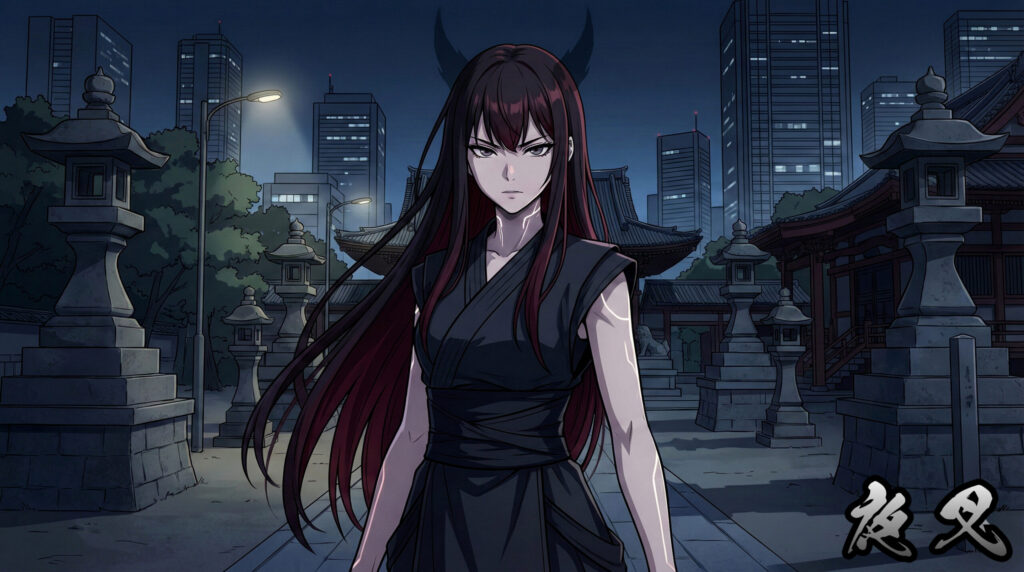
She embodies sacred fury and merciless guardianship.
Her presence reflects divine judgment given form.
Dreamy and stylish
Genre: Ritual Japanese HipHop / Darkwave Folklore Produced by: Phantom Tone | Suno AI | Kotetsu Co., Ltd. Tags: #JapaneseHipHop #AIgeneratedMusic #Yokai #Phant…