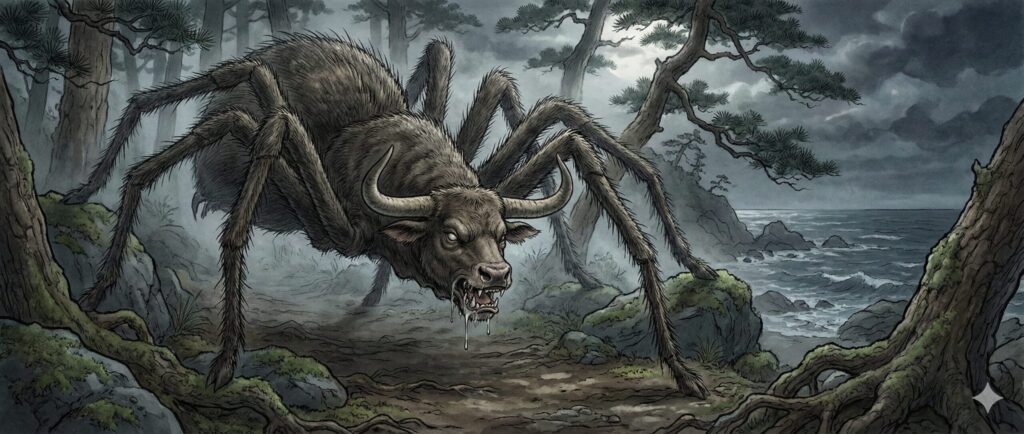
A monstrous yokai of coastal regions, bearing the head of an ox and the body of a demon or spider.
It represents maritime terror, plague, and sudden death.
Primary Sources
Classical & Mythological Records
Nihon Shoki (日本書紀)
Bizen Fudoki (備前国風土記)
Kibi region mythological traditions
Modern Folklore References
Yanagita Kunio — Kibi demon folklore
Komatsu Kazuhiko — Yōkai Encyclopedia
Ushi-oni – Monstrous Beasts of Japanese Folklore
Ushi-oni are among the most fearsome and grotesque creatures in Japanese folklore: monstrous beings combining features of cattle and demons, often dwelling near coasts, rivers, mountains, or remote villages. Their appearance alone inspires terror — massive bodies, horned heads, sharp fangs, and eyes filled with hostility.
Unlike ambiguous tricksters or silent spirits, ushi-oni are overtly dangerous. They attack humans directly, spreading fear, illness, or death. In many legends, merely encountering an ushi-oni is enough to bring misfortune.
Ushi-oni embody raw, physical horror — a manifestation of threat given tangible form.
Origins and Early Accounts
The name ushi-oni (牛鬼) literally means “ox demon,” reflecting its animalistic brutality and demonic nature. Early accounts vary widely by region, suggesting that the term encompasses multiple local monsters rather than a single unified being.
Stories of ushi-oni often emerged in areas where unexplained deaths, disease outbreaks, or disappearances occurred. The creature served as a narrative explanation for dangers lurking beyond the safety of the village — in forests, mountains, and along dangerous coastlines.
Unlike imported mythological figures, ushi-oni are strongly rooted in regional oral traditions.
From Local Monster to Folkloric Archetype
Over time, the ushi-oni evolved into a recognizable archetype: a monstrous guardian of forbidden spaces. In many tales, they prevent passage across bridges, guard caves or coastal inlets, or demand human victims.
This evolution reflects a broader folkloric pattern in which localized dangers are personified into monsters that mark boundaries — places where humans should not go lightly.
Ushi-oni are rarely negotiated with. They represent confrontation rather than deception.
Appearance and Variations
Descriptions of ushi-oni vary dramatically, but common traits include:
A bovine or horned head
Fanged mouth and fierce eyes
Large, muscular or spider-like bodies
Dark coloration, often black or deep red
An overwhelming physical presence
Some regions describe ushi-oni with crab-like or spider-like legs, while others portray them as giant ox-headed demons. This variability emphasizes function over form: ushi-oni are defined by menace, not anatomy.
Ushi-oni and Place
Ushi-oni are strongly tied to specific locations. They appear at:
Rocky coastlines and sea caves
Mountain passes and forest paths
River crossings and bridges
Village outskirts and abandoned areas
Their presence transforms geography into danger. These are not wandering monsters, but territorial entities — manifestations of places humans fear to tread.
Symbolism and Themes
Embodiment of Fear
Ushi-oni externalize collective anxiety, turning unseen threats into visible monsters.
Physical Violence
Unlike trick-based yokai, ushi-oni rely on brute force and intimidation.
Boundary Guardians
They mark forbidden zones, enforcing limits through terror rather than rules.
Chaos Without Ambiguity
Ushi-oni lack moral nuance. They are forces to be confronted, driven away, or destroyed.
Related Concepts
- Oni (鬼)
Demonic beings.
→Oni - Kishin (鬼神)
Wrathful divine oni spirits.
→Kishin - Aramitama (荒御魂)
Violent divine aspects.
→Aramitama - Umibōzu (海坊主)
Sea-based yokai related to maritime calamity.
→Umibōzu
Ushi-oni in Folklore and Art
Ushi-oni appear frequently in regional legends, warrior tales, and yokai compilations. Heroes or monks often confront them through bravery, ritual, or divine assistance.
In visual representations, ushi-oni are depicted:
Lurking in shadows near water or cliffs
Towering over human figures
With exaggerated horns and monstrous faces
As embodiments of nightmare rather than character
Their imagery prioritizes impact over subtlety.
Regional Variations and Local Legends
Ushi-oni legends are particularly prominent in western Japan, including Shikoku and parts of Chūgoku and Kyūshū.
Regional beliefs include:
Ushi-oni causing disease or curses
Protective rituals to ward them off
Heroes defeating ushi-oni to restore peace
Sacred objects used to repel them
These stories often serve as origin myths explaining local landmarks or rituals.
Modern Cultural Interpretations
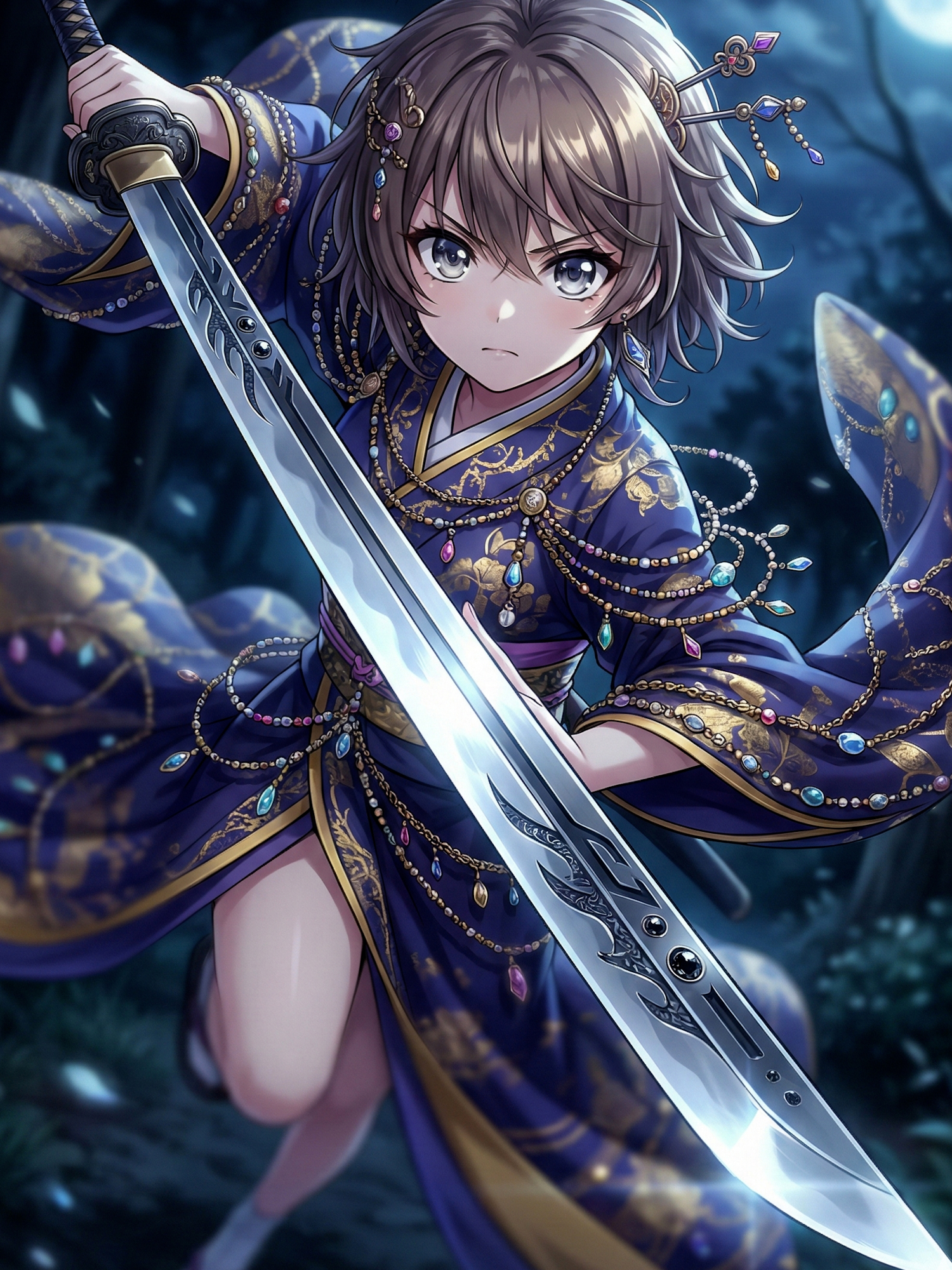
This blade symbolizes unstoppable maritime calamity and ritual death.
It visualizes coastal fear condensed into a weapon.
In modern media, ushi-oni are often portrayed as boss-level monsters, emphasizing size, strength, and aggression. Games and anime favor their imposing silhouettes and brutal attacks.
Contemporary reinterpretations sometimes explore psychological dimensions — framing ushi-oni as representations of overwhelming trauma or collective fear — yet their core identity as monsters remains intact.
In some modern visual reinterpretations, ushi-oni manifest as a yōtō — a blade that feels more like a battering ram than a sword. The weapon embodies mass and momentum, turning impact itself into its edge.
Ushi-oni endure because brute force still terrifies.
Modern Reinterpretation – Ushi-oni as Manifestations of Brutal Fear
In this modern reinterpretation, Ushi-oni becomes the embodiment of blunt terror — the primal violence that precedes morality, logic, or language. Unlike cunning yokai or spiritual tempters, it represents the world’s raw hostility: the crushing weight of something vast, unstoppable, and indifferent. Its horror lies not in mystery, but in immediacy. To encounter the ushi-oni is to face the realization that not all forces can be reasoned with — some must simply be endured or escaped.
The “beautiful monster” visualization renders Ushi-oni as a paradox of form — monstrous power expressed through terrible grace. The figure retains a faintly human silhouette, but her body is armored in shell-like plates resembling a fusion of bull and crustacean. Long strands of seaweed-like hair drift around her like tendrils, and her lower limbs blur into mist and shadow, suggesting movement both terrestrial and aquatic. Her eyes are molten amber — intelligent, but devoid of empathy. She looks less enraged than inevitable.
Her yōtō takes the form of an immense, blunt-edged weapon — more hammer than sword — its spine lined with fragments of bone and coral. When lifted, it seems to distort gravity itself. Every swing carries an echo of breaking structures and collapsing cliffs. Around her, the landscape bends under unseen pressure; air thickens, sound slows. The scene feels like the moment just before impact — an eternal, suspended heartbeat before annihilation.
Through this reinterpretation, Ushi-oni becomes a manifestation of magnitude itself — the violence of natural forces personified. She is not evil, but inevitable. Her form reminds us that not all fear is psychological; some arises from contact with power so immense it renders meaning irrelevant. She is terror purified of intent — the sound of the world exhaling through ruin.
Musical Correspondence
The accompanying composition channels physicality into sound. Sub-bass tremors simulate tectonic weight, while percussive strikes land like collapsing pillars. Drones and distortion layers form an unrelenting wall of resonance, evoking the density of impact itself.
Midway, a brief section of near-silence emerges — air displacement before another wave hits. Metallic reverberations and bowed low strings suggest struggle against inevitability, a futile attempt to stabilize rhythm as the structure crumbles again.
The final passage collapses into a single sustained tone — immense, suffocating, unresolving. Through its sheer weight and repetition, the music captures Ushi-oni’s essence: fear not as narrative, but as presence. A sound too large to oppose, reverberating long after form has been crushed.
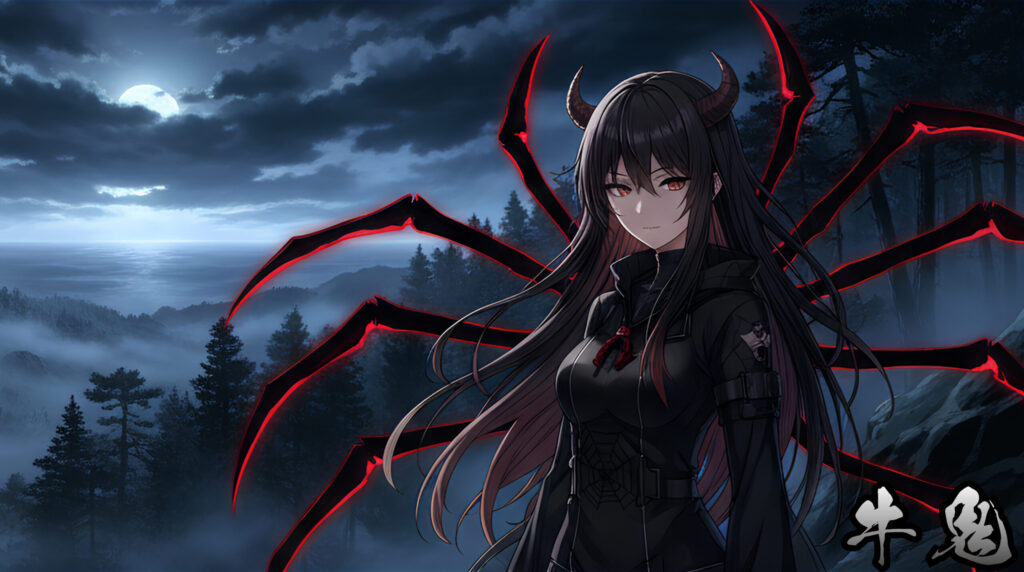
She embodies lurking coastal doom and ritualized fear.
Her presence reflects the sea’s silent hunger given form.
Dreamy and stylish
Genre: Ritual Japanese HipHop / Darkwave Folklore Produced by: Phantom Tone | Suno AI | Kotetsu Co., Ltd. Tags: #JapaneseHipHop #AIgeneratedMusic #Yokai #Phant…