
A pair of elongated-limb yokai working together near rivers and coasts.
They represent abnormal bodies and boundary danger.
Primary Sources
Classical Folklore & Myth Records
- Nihon Shoki (日本書紀)
- Konjaku Monogatari-shū (今昔物語集)
- Regional coastal and river folklore traditions
Modern Folklore References
- Yanagita Kunio — Body-anomaly spirit studies
- Komatsu Kazuhiko — Yōkai Encyclopedia
Tenaga & Ashinaga – The Unequal Pair That Hunts Together in Japanese Folklore
Tenaga and Ashinaga are a paired yōkai in Japanese folklore whose terror lies not in individual strength, but in cooperation born from imbalance. One has impossibly long arms. The other has impossibly long legs. Alone, each is incomplete. Together, they are lethal.
One reaches.
One carries.
Neither can succeed alone.
Tenaga and Ashinaga embody danger created through dependency.
Origins in Coastal and Riverine Landscapes
Legends of Tenaga and Ashinaga are often tied to shorelines, river mouths, and shallow coastal waters. These environments—neither fully land nor sea—mirror the yōkai’s nature: beings that function only at boundaries.
Fishermen and travelers told of strange figures emerging from water or reeds, their silhouettes distorted and unnatural. The pairing explained how such impossible bodies could move and hunt.
The threat was not speed.
It was reach.
Distorted Bodies and Complementary Forms
Descriptions emphasize exaggeration rather than monstrosity:
Tenaga possesses arms so long they drag across the ground or water
Ashinaga has legs towering above human height
Their torsos remain roughly human
Their faces are often indistinct or shadowed
Neither appears fully functional alone. Their bodies demand cooperation.
The horror lies in anatomy that requires partnership.
Method of Attack
Tenaga and Ashinaga are ambush predators. Their method is precise:
Ashinaga wades into water or terrain too deep for humans
Tenaga extends arms to seize prey from afar
Victims are pulled toward the pair
Escape becomes impossible once grabbed
The attack is silent and sudden. Distance offers no safety.
Reach replaces pursuit.
Dependence as Strength
Unlike solitary yōkai, Tenaga and Ashinaga rely entirely on each other. This dependence is not weakness—it is their advantage. Their coordination transforms individual limitation into collective dominance.
This inversion unsettles human logic: imbalance becomes efficiency.
They are not broken.
They are specialized.
Symbolism and Themes
Cooperation Through Imbalance
Flaws become function.
The Danger of Reach
Distance does not protect.
Boundary Predators
Threats thrive at edges.
Interdependence
Power emerges from pairing.
Related Concepts
Yama-otoko (山男)
Mountain humanoid spirits.
Kappa (河童)
River boundary yokai.
→Kappa
Nurikabe (塗壁)
Boundary obstruction yokai.
→Nurikabe
Namazu (鯰)
Disaster spirits.
Tenaga & Ashinaga in Folklore and Art
The pair appears in yōkai encyclopedias and illustrations, often depicted looming over water or grasping at humans from afar. Artists emphasize their asymmetry, reinforcing the idea that harmony is not required for effectiveness.
They are memorable because they defy symmetry.
Modern Cultural Interpretations
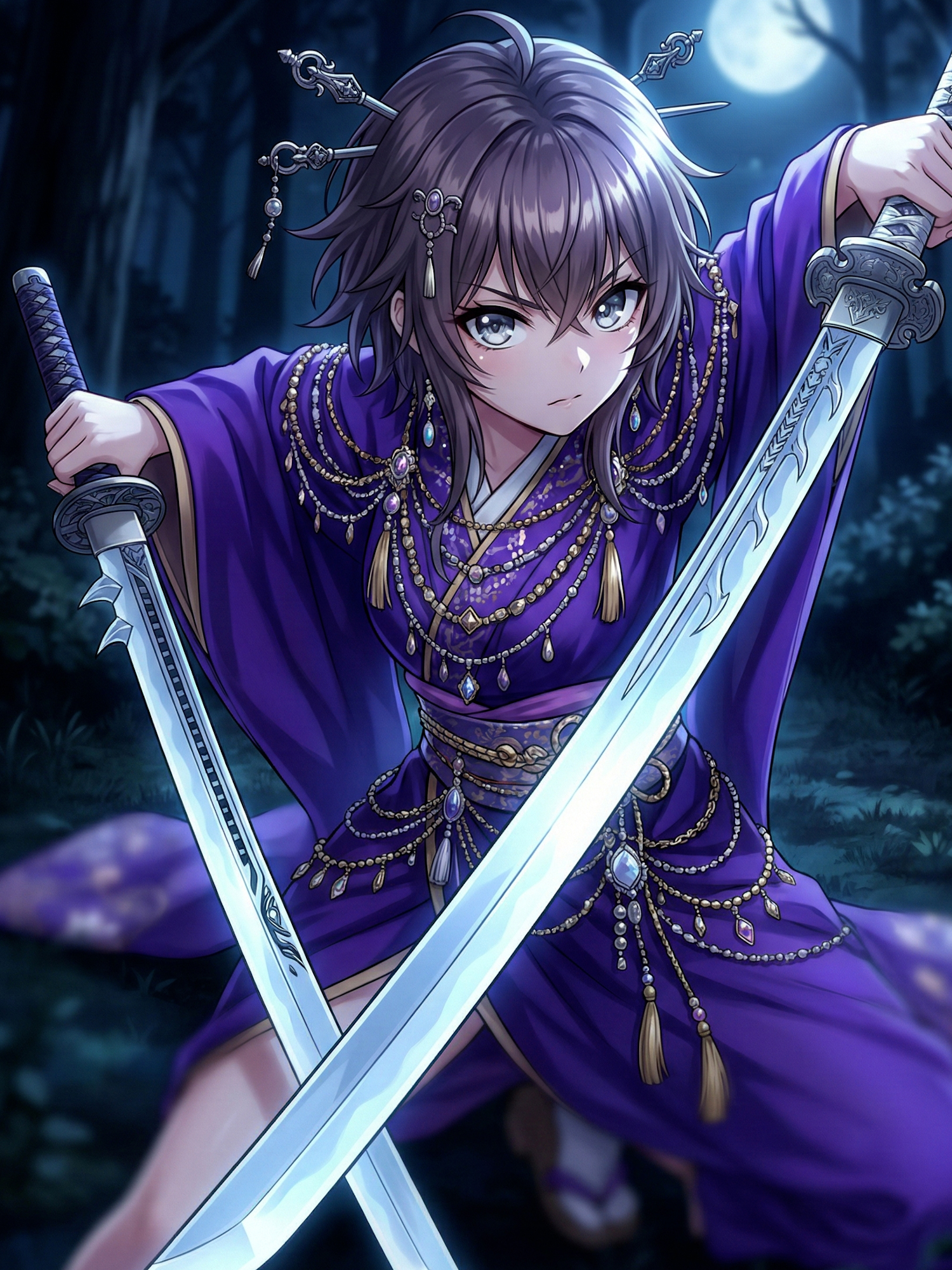
This blade symbolizes unreachable grasp and inescapable pursuit.
It visualizes danger that cannot be outrun.
Modern interpretations often view Tenaga and Ashinaga as metaphors for systems built on unequal roles — where imbalance is not corrected, but exploited.
Psychologically, they may represent fears of being overreached, controlled from afar, or caught by mechanisms larger than oneself.
In some modern visual reinterpretations, Tenaga and Ashinaga manifest as twin yōtō — one elongated, one grounded. The paired blades embody extension and anchoring, turning imbalance into form.
They persist because reach keeps expanding.
Modern Reinterpretation – Tenaga & Ashinaga as the Pair That Should Not Work
In modern reinterpretation, Tenaga and Ashinaga cease to be curiosities of anatomy and become metaphors for collaboration within dysfunction — the unnatural harmony of asymmetry. Their union represents systems that compensate rather than heal, mechanisms that continue not because they are just, but because they are efficient. They are a reminder that imbalance, when synchronized, can still achieve terrifying precision.
The “beautiful twin” visualization renders them as two figures bound by motion rather than form. One — Tenaga — is slender and serpentine, her arms elongated in graceful arcs that reach beyond the visible frame. The other — Ashinaga — stands firm, her legs monumental and rooted, carrying both their weight. Their attire mirrors this duality: one flows like water, the other grounded like stone. Between them, threads of luminous tension connect wrist to ankle, creating a silent geometry of dependence.
The paired yōtō mirror their anatomy — one blade impossibly long, its edge tapering into air; the other short and wide, a counterbalance of inertia. When crossed, they form a distorted circle — not perfect, but functional. Around them, ripples of distortion suggest unseen reach, as though space itself bends to their cooperation.
Through this reinterpretation, Tenaga and Ashinaga become embodiments of dangerous harmony — a system that persists not through balance, but through exploitation of extremes. Their beauty lies in the illusion of unity; their horror, in the realization that imperfection can be synchronized into power. They do not coexist by choice. They function because they must.
Musical Correspondence
The accompanying composition builds on interplay and asymmetry. Low percussion and heavy bass pulses mark Ashinaga’s stride — deliberate, grounding, cyclic — while extended strings and electronic echoes trace Tenaga’s reach, expanding beyond tempo. Each motif chases the other, overlapping in imperfect rhythm.
Midway, the two motifs begin to merge. The grounded rhythm accelerates; the higher lines fragment. What began as cooperation becomes entanglement — a rhythmic structure that feels functional but increasingly unstable. Sudden pauses reveal breathless silence, like mechanical parts misfiring before realigning again.
By merging tension and interdependence, the music captures Tenaga and Ashinaga’s essence: two incomplete entities that achieve motion only together — proof that even broken designs can endure when bound by necessity.

She embodies distorted reach and inevitable pursuit.
Her presence reflects boundary danger that closes in slowly.
Dreamy and stylish
Genre: Ritual Japanese HipHop / Darkwave Folklore Produced by: Phantom Tone | Suno AI | Kotetsu Co., Ltd. Tags: #JapaneseHipHop #AIgeneratedMusic #Yokai #Phant…