

A legendary oni leader dwelling in Ōeyama.
It represents excess, terror, and supernatural kingship.
Primary Sources
Classical and Medieval Records
- Ōeyama Engi (大江山縁起)
- Otogi-zōshi (御伽草子)
- Konjaku Monogatari-shū (今昔物語集)
Modern Folklore References
- Komatsu Kazuhiko — Yōkai Encyclopedia
- Yanagita Kunio — Oni folklore studies
Shuten Dōji – The Demon Who Drank Like a God and Ruled Like a King in Japanese Folklore
Shuten Dōji is one of the most infamous and complex oni in Japanese folklore. He is not a mindless monster, nor a simple villain. He is a ruler—charismatic, terrifying, and deeply human in his excess.
He drinks endlessly.
He commands loyalty.
He inspires fear and admiration in equal measure.
Shuten Dōji embodies power unleashed through indulgence.
Origins in Mountains and Margins
Legends place Shuten Dōji deep in the mountains—most famously Mount Ōe—far from imperial authority and human law. These remote spaces symbolized freedom, danger, and rejection of order.
In some traditions, Shuten Dōji is said to have once been human or even divine, cast out due to arrogance or transgression. In others, he is born an oni outright. The ambiguity is intentional.
His origin shifts because his role does.
Appearance and Regal Brutality
Descriptions of Shuten Dōji emphasize both monstrosity and nobility:
A towering oni with horns and fierce features
Long, unkempt hair and commanding posture
Rich garments or armor befitting a lord
A cup or gourd of sake always at hand
He is often depicted smiling—even while committing atrocities. His confidence is absolute.
He does not hide his nature.
He celebrates it.
Rule Through Excess
Unlike oni who terrorize indiscriminately, Shuten Dōji rules a domain. He commands other demons, hosts lavish feasts, and abducts humans—particularly noblewomen—to serve as captives or offerings.
His indulgence is ritualized. Drinking, feasting, and cruelty are not accidents; they are expressions of sovereignty.
Excess becomes authority.
Defeat by Deception
Shuten Dōji is ultimately defeated not by brute force, but by cunning. Disguised as monks, heroes led by Minamoto no Yorimitsu infiltrate his domain and offer enchanted sake.
Intoxicated beyond control, Shuten Dōji falls asleep. Only then is he slain.
Even in death, legends say his severed head continues to speak or attempt revenge—refusing silence.
Power does not yield easily.
Symbolism and Themes
Excess as Corruption
Indulgence replaces restraint.
Charismatic Tyranny
Cruelty wrapped in charm.
Civilization vs. Wilderness
Order confronts untamed power.
The Fall of the Mighty
Pride invites deception.
Related Concepts
Ibaraki Dōji (茨木童子)
Oni warrior.
→Ibaraki Dōji
Onidōmaru (鬼童丸)
Cursed oni youth.
→Onidōmaru
Oni (鬼)
Demonic beings.
→Oni
Aramitama (荒御魂)
Violent divine aspects.
→Aramitama
Shuten Dōji in Art and Literature
Shuten Dōji has been a favorite subject in emakimono, Noh plays, and later popular culture. Artists emphasize contrast: elegance and horror, laughter and bloodshed.
He is memorable because he enjoys what he is.
Not a curse—
a choice.
Modern Cultural Interpretations
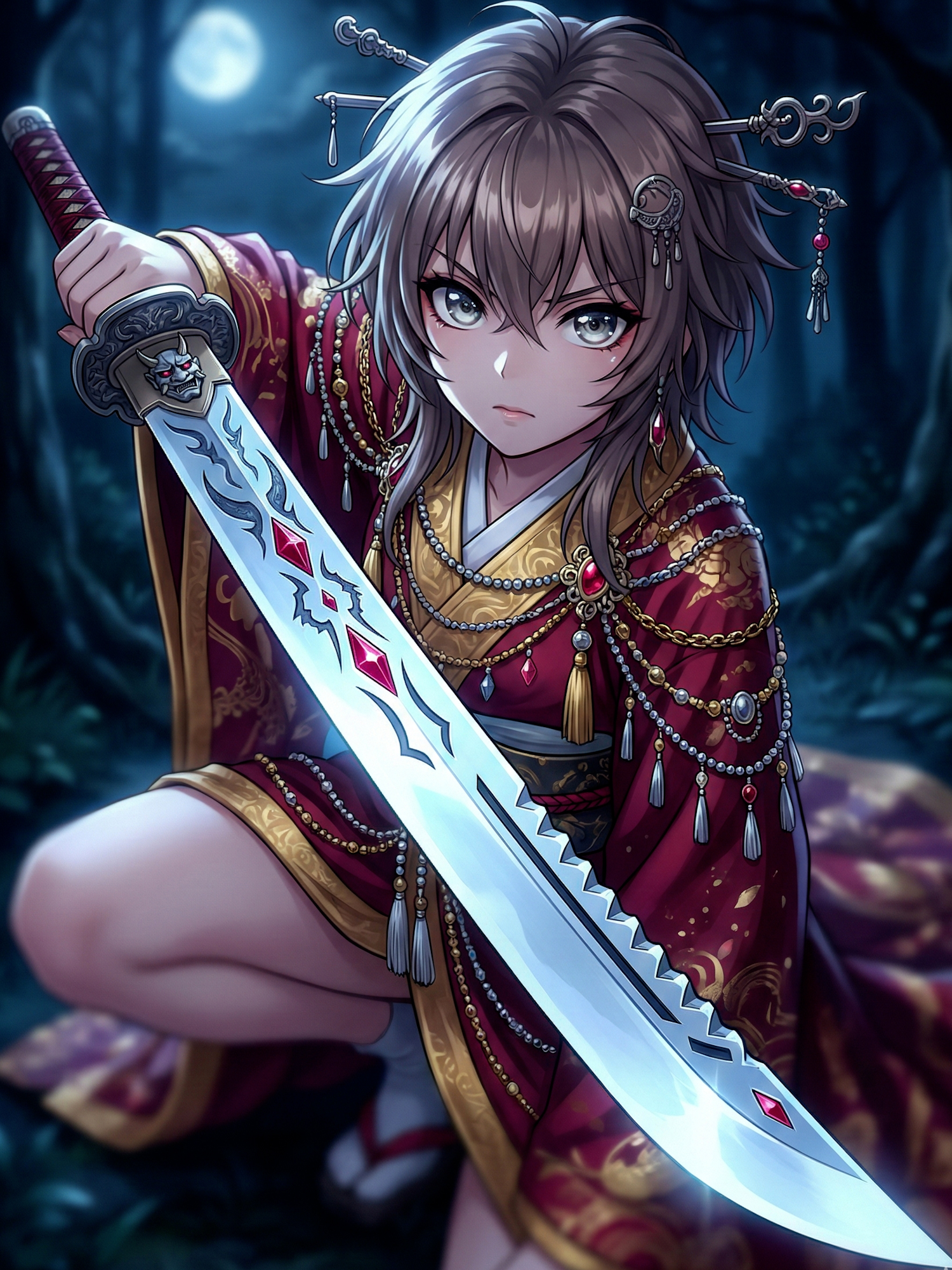
This blade symbolizes tyrannical authority and ritualized terror.
It visualizes sovereignty enforced through fear.
Modern readings often frame Shuten Dōji as a metaphor for destructive leadership, unchecked privilege, and systems built on excess. He can also be read as a tragic figure — powerful, exiled, and ultimately undone by his own appetites.
In contemporary media, Shuten Dōji frequently appears as an anti-hero or fallen king rather than a simple villain.
In some modern visual reinterpretations, Shuten Dōji manifests as a yōtō — a blade stained with ceremonial indulgence. The sword carries ornate engravings and traces of ritual luxury, embodying excess hardened into weapon.
Shuten Dōji endures because indulgence still rules.
Modern Reinterpretation – Shuten Dōji as the King Who Drank Himself Into Legend
In this modern reinterpretation, Shuten Dōji emerges not merely as a monstrous villain, but as a portrait of charismatic decay — the leader whose allure conceals corrosion. He is the figure of indulgence refined into ritual, a sovereign of appetite whose downfall was never accidental but inevitable. His legend endures because it feels familiar: excess disguised as majesty, corruption mistaken for charm.
The “beautiful boy” or androgynous demon king visualization captures this paradox with seductive menace. His appearance glows with refinement — crimson sake splashed across pale skin like ink, golden eyes half-lidded in intoxicated amusement. Horns curve elegantly, lacquered like fine ornament rather than instruments of fear. Silk robes shimmer with the colors of spilled wine and candlelight, a celebration of beauty on the verge of rot.
In his hand, the yōtō glints with ceremonial decadence. Its blade is etched with swirling motifs of flame and cloud — the same symbols once carved into the walls of his banquet hall. Dried traces of gold leaf and crimson lacquer cling to its surface, suggesting a weapon born not of necessity, but of luxury. Around him, empty sake cups litter a marble dais, and ghostly attendants dance on air heavy with perfume and death.
Through this reinterpretation, Shuten Dōji becomes an allegory of grandeur collapsing under its own gravity. He is not feared for what he takes, but for what he represents — a beauty that knows it is doomed and continues anyway. His laughter echoes as both charm and curse, the final sound before ruin. In his intoxication, he achieves a kind of immortality: desire remembered longer than virtue.
Musical Correspondence
The accompanying composition unfolds like a feast that turns to nightmare. It begins with ritual percussion and deep bass tones — stately, intoxicating — before horns and choral fragments weave in celebratory chaos. The rhythm swells with grandeur, then slips unpredictably into dissonance as indulgence consumes order.
Midway, the texture fractures: distorted strings and unstable tempos create a drunken waltz, echoing both the euphoria of power and the dizziness of collapse. Bells and low drums resurface, evoking the rhythm of ritual gone awry — devotion curdled into excess.
The final movement fades into slow, echoing chords that resemble the last notes of a banquet extinguished by dawn. The music captures Shuten Dōji’s essence not as horror, but as spectacle — the sound of magnificence devouring itself, and of a legend too beautiful to survive sobriety.

She embodies excess and dominant authority.
Her presence reflects fear given royal form.
Dreamy and stylish
Genre: Ritual Japanese HipHop / Darkwave Folklore Produced by: Phantom Tone | Suno AI | Kotetsu Co., Ltd. Tags: #JapaneseHipHop #AIgeneratedMusic #Yokai #Phant…