
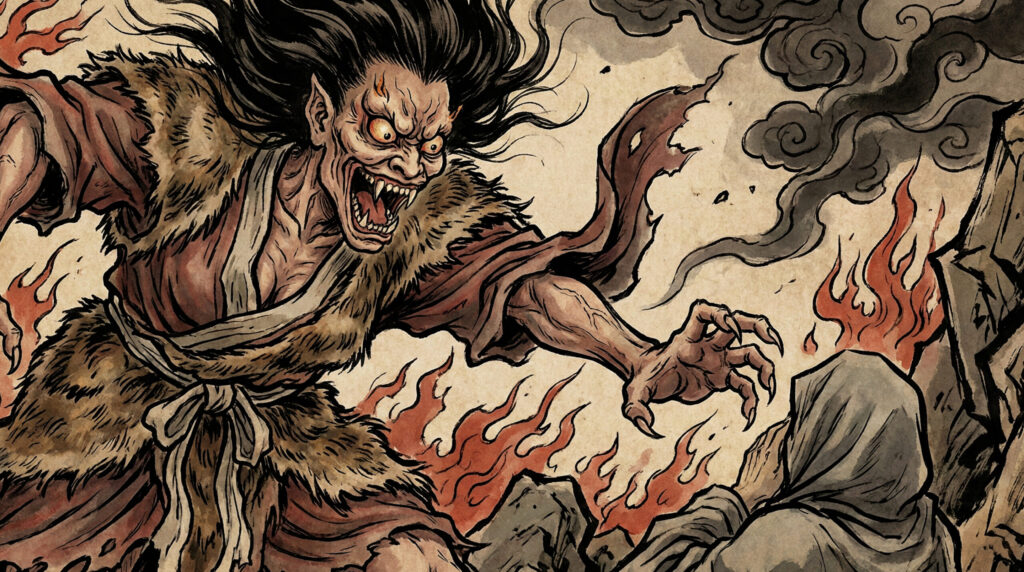
A ferocious demon derived from Buddhist cosmology.
It represents hunger, destruction, and moral punishment.
Primary Sources
Buddhist & Classical Religious Records
- Nihon Shoki (日本書紀)
- Buddhist sutra translations referencing Rākṣasa
- Temple doctrinal texts describing wrathful guardians
Modern Folklore References
- Yanagita Kunio — Religious folklore studies
- Komatsu Kazuhiko — Yōkai Encyclopedia
Rasetsu – The Devouring Being That Crossed from Buddhist Cosmology into Japanese Folklore
Rasetsu refers to a class of fearsome beings introduced to Japan through Buddhism, originating in Indian cosmology as Rākṣasa. In Japanese thought, Rasetsu came to embody a paradox: beings of extreme violence who also serve cosmic order.
They are not mere monsters.
They are not fallen gods.
They are necessary terror.
Rasetsu embody destruction permitted by doctrine.
Origins in Indian and Buddhist Cosmology
The concept of Rasetsu originates in ancient Indian mythology, where Rākṣasas appear as man-eating demons associated with chaos, illusion, and transgression. With the spread of Buddhism, these beings were absorbed into a broader cosmological system.
In Buddhist texts, Rasetsu are often positioned as:
Guardians of sacred realms
Punishers of karmic transgression
Embodiments of uncontrolled desire
Violence is not removed.
It is repurposed.
Transmission to Japan and Conceptual Shift
When Buddhism entered Japan, Rasetsu arrived not as folk monsters, but as doctrinal entities. Over time, they merged with indigenous oni imagery, but retained a distinctive feature: justification.
A Rasetsu devours not for hunger alone, but as function.
They are terrifying by design.
Appearance as Codified Ferocity
Japanese depictions of Rasetsu emphasize structured monstrosity:
Ferocious faces with bared fangs
Wild hair and exaggerated musculature
Weapons or claws rather than crude force
Postures of attack frozen in purpose
Their form signals inevitability rather than chaos.
This is violence with rules.
Behavior: Punishment, Not Chaos
Unlike many yōkai or oni, Rasetsu do not act randomly:
They punish moral failure
They enforce karmic consequence
They guard thresholds to hellish realms
They consume as judgment
Their cruelty is procedural.
Mercy is not their role.
Relationship with Humans
Humans do not encounter Rasetsu accidentally. In narrative, they appear when moral boundaries are crossed—either as warning or consequence.
Fear of Rasetsu is instructional.
Avoidance is ethical.
They teach by terror.
Rasetsu Among Oni and Demonic Beings
Within the hierarchy of fearsome entities, Rasetsu occupy a unique position:
- Oni – localized or moralized monsters
- Rasetsu – doctrinal enforcers
- Kishin (鬼神) – deified violence
Rasetsu represent violence sanctioned by cosmic law.
Symbolism and Themes
Devouring as Judgment
Consumption equals consequence.
Fear as Teaching Tool
Terror instructs morality.
Imported Cosmology
Foreign demons recontextualized.
Order Through Destruction
Chaos contained by function.
Related Concepts
Kishin (鬼神)
Wrathful divine spirits.
→Kishin
Oni (鬼)
Demonic beings.
→Oni
Niō (仁王)
Temple guardian figures.
Aramitama (荒御魂)
Violent divine aspects.
→Aramitama
Rasetsu in Texts and Iconography
Rasetsu appear in sutras, temple art, and hell scrolls (jigoku-e), often as attendants of greater judges rather than independent villains.
They are not protagonists.
They are mechanisms.
Their presence signals inevitability.
Modern Cultural Interpretations

This blade symbolizes insatiable destruction and karmic consumption.
It visualizes punishment without satiation.
Modern interpretations often read Rasetsu as representations of systemic violence — punishment embedded in ideology rather than individual malice. In this framing, cruelty is not a flaw of character, but a function of structure.
Psychologically, Rasetsu externalize the fear of absolute judgment: consequence without explanation, appeal, or mercy. They embody the terror of being processed rather than confronted.
In some modern visual reinterpretations, Rasetsu manifest as a yōtō — a blade designed not for battle, but for enforcement. The sword carries no emotion, no rage; it exists solely to enact verdict. To face it is to realize that resistance has already been accounted for.
Rasetsu persist because systems still punish impersonally.
Modern Reinterpretation – Rasetsu as Violence That Serves Order
In modern reinterpretation, Rasetsu no longer appear as demons of chaos, but as agents of structure — embodiments of punishment divorced from feeling. They are not monsters of passion; they are instruments of principle. In this sense, the terror they evoke is bureaucratic rather than bestial: precision without empathy, judgment without hesitation.
The “beautiful girl” visualization frames this paradox in haunting form. Her attire recalls a ceremonial executioner rather than a warrior — black and ivory robes folded with immaculate precision, a veil of thin metal chains draping across her face. Her expression is tranquil, almost reverent, the serenity of one who believes herself to be nothing more than an extension of purpose. In her hand rests the yōtō: an austere, featureless blade that reflects no light, forged to erase rather than to glorify.
Around her, the air is devoid of chaos. There are no flames, no cries — only stillness. This quiet makes her more unsettling than any roaring god of destruction. She represents not wrath, but function: the moment when morality has been converted into machinery. Her beauty, immaculate and distant, is inseparable from the horror of what she enacts.
Through this interpretation, Rasetsu becomes an icon of impersonal cruelty — the face that systems wear when they convince themselves they are only doing what must be done. She is both priest and punishment, the calm center of an act that erases individuality. Her perfection is the proof that something human has been subtracted.
Musical Correspondence
The accompanying track constructs sound as inevitability. Heavy taiko drums strike in even, ritual patterns — not aggressive, but absolute. A choir murmurs in unison beneath the percussion, each voice indistinguishable from the next, creating a texture of collective obedience. Metallic overtones shimmer like distant machinery engaging.
Midway, harmonic content begins to collapse. Notes merge into drones, rhythm tightens into pulse, and the composition becomes procedural — more process than performance. When silence arrives, it feels less like relief and more like execution complete.
Through this sonic design, the music mirrors Rasetsu’s essence: violence stripped of emotion, ritual refined into enforcement. It is not fury, but function — beauty rendered unbearable by its precision.

She embodies hunger and karmic violence.
Her presence reflects punishment that never rests.
Between Oni and Wolf
Genre: Japanese Folklore Hip-Hop, Ritual Lo-Fi Poetry Produced by: Phantom Tone | Suno AI | Kotetsu Co., Ltd. Tags: #AIgeneratedMusic #JapaneseHipHop #Folklore…

Scarlet Oni
Genre: Japanese Folklore HipHop / Darkwave Enka Trap Produced by: Phantom Tone | Suno AI | Kotetsu Co., Ltd. Tags: #JapaneseFolkloreHipHop #AIGeneratedMusic #P…

Echoes of Sorrow
Genre: Japanese Folklore HipHop / Darkwave Lo-Fi Produced by: Phantom Tone | Suno AI | Kotetsu Co., Ltd. Tags: #JapaneseFolklore #OniMyth #AIgeneratedMusic #Ph…