

A fierce oni warrior associated with Ōeyama legends.
It represents loyalty, rage, and supernatural retribution.
Primary Sources
Classical and Medieval Records
- Ōeyama Engi (大江山縁起)
- Otogi-zōshi (御伽草子)
- Konjaku Monogatari-shū (今昔物語集)
Modern Folklore References
- Komatsu Kazuhiko — Yōkai Encyclopedia
- Yanagita Kunio — Oni folklore studies
Ibaraki Dōji – The Fierce Oni of Defiance in Japanese Folklore
Ibaraki Dōji is one of the most formidable and enigmatic oni in Japanese folklore: a demon warrior known for ferocity, cunning, and unwavering defiance. Often remembered as the most dangerous companion of Shuten Dōji, Ibaraki Dōji stands apart not merely as a subordinate, but as an embodiment of resistance against authority and fate.
Unlike oni who represent chaos alone, Ibaraki Dōji is defined by will. Even in defeat, the spirit does not submit. Survival, persistence, and refusal to be erased form the core of the legend.
Ibaraki Dōji embodies strength that does not bow.
Origins and Legendary Context
Ibaraki Dōji appears most prominently in medieval legends surrounding Shuten Dōji, the infamous oni lord of Mount Ōe. While Shuten Dōji symbolizes excess and tyranny, Ibaraki Dōji represents the sharp edge of rebellion—swift, intelligent, and relentless.
The name “Ibaraki” is associated with thorns (ibara), suggesting danger, pain, and entanglement. This imagery reinforces the idea of an oni who wounds not through brute force alone, but through proximity and resolve.
Ibaraki Dōji is the blade beside the throne.
Appearance and Shifting Form
Descriptions of Ibaraki Dōji vary, reflecting the oni’s adaptability:
A powerful oni with horns and wild hair
A fierce warrior clad in armor
A disguised noblewoman or human figure
A shadowy presence revealed only in combat
This fluidity underscores a key trait: Ibaraki Dōji survives by transformation. Unlike oni bound to monstrous form, this figure crosses boundaries between demon and human, battlefield and court.
Identity is a weapon.
The Severed Arm and Unbroken Will
One of the most famous episodes tells of Ibaraki Dōji losing an arm in battle against Minamoto no Raikō (Raikō) and his retainers. Yet this defeat is not an ending. Through deception and patience, Ibaraki Dōji later retrieves the severed arm, restoring wholeness.
This act defines the legend. Loss does not equal defeat. Retreat is not surrender.
The arm becomes a symbol of continuity—proof that power can be reclaimed.
Relationship with Authority
Unlike many oni who are destroyed by heroes, Ibaraki Dōji exists in tension with authority rather than opposition alone. The demon challenges not just warriors, but systems: order, hierarchy, and moral certainty.
By surviving encounters that should end the story, Ibaraki Dōji disrupts the narrative of absolute victory. The hero may win the battle, but not the erasure.
This makes Ibaraki Dōji uniquely unsettling.
Symbolism and Themes
Defiance Over Destruction
Strength lies in refusal to vanish.
Adaptability as Power
Survival through transformation.
Loss Without Submission
Damage does not end resistance.
Oni as Counter-Hero
Villainy complicated by resolve.
Related Concepts
Shuten Dōji (酒呑童子)
Leader of the Ōeyama oni.
→Shuten Dōji
Oni (鬼)
Demonic beings.
→Oni
Yagyō-babaa
Aged oni folklore.
→Yagyō-babaa
Aramitama (荒御魂)
Violent divine spirit aspect.
→Aramitama
Ibaraki Dōji in Art and Performance
Ibaraki Dōji appears frequently in Noh plays, emakimono, and later ukiyo-e prints. Artists emphasize tension and posture—moments just before violence or revelation.
In Noh theater, the figure is often portrayed with restrained movement and controlled intensity, highlighting intelligence rather than brute rage.
The oni becomes a presence of pressure rather than spectacle.
Modern Cultural Interpretations
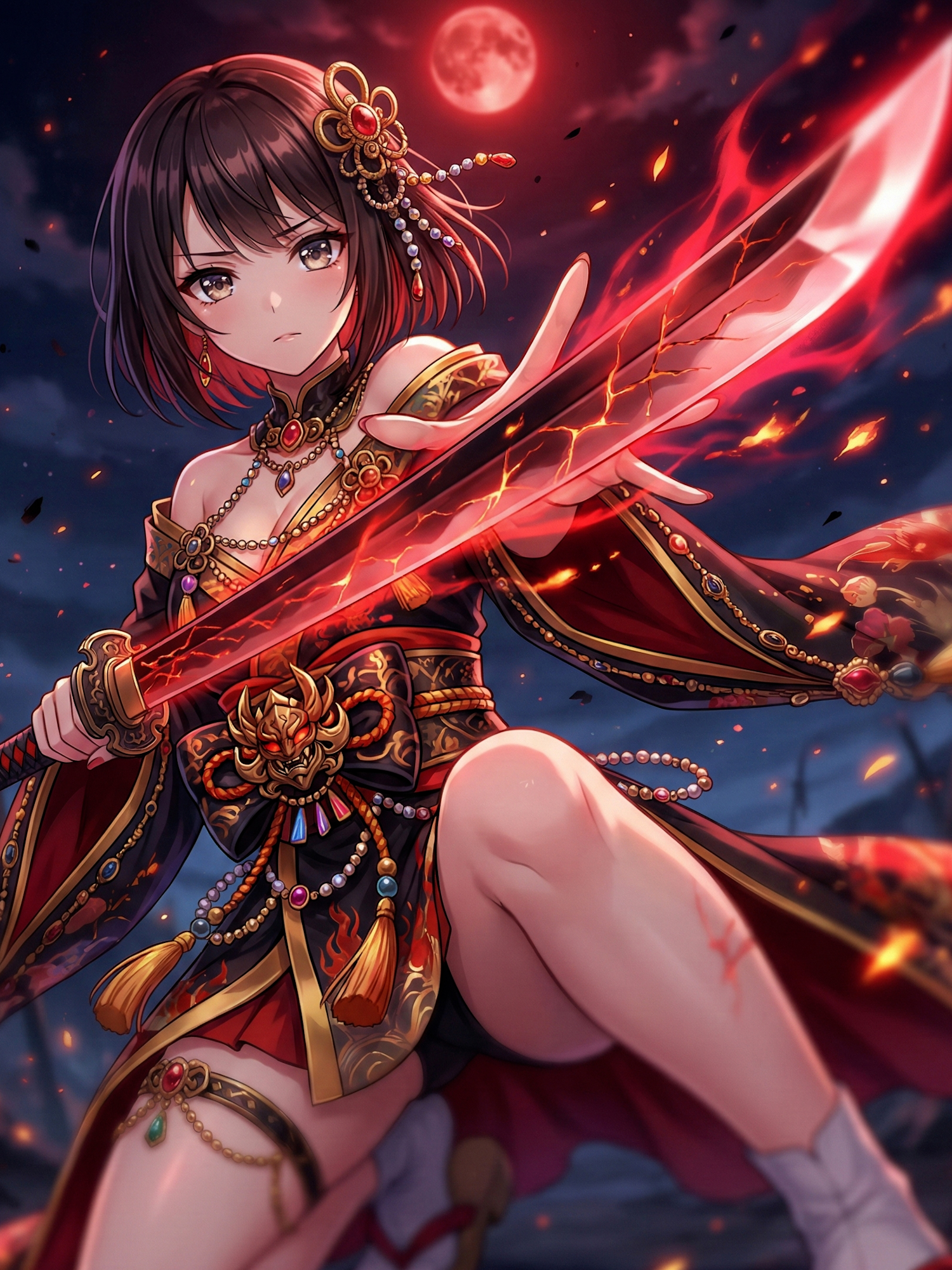
This blade symbolizes violent loyalty and severed vengeance.
It visualizes wrath that survives destruction.
Modern reinterpretations often frame Ibaraki Dōji as an anti-hero or tragic figure — one who resists domination rather than embodying pure evil. Gender-fluid portrayals and added psychological depth emphasize adaptability, survival, and persistence.
In contemporary media, Ibaraki Dōji frequently symbolizes rebellion against imposed order, authority, and fixed identity. The legend is thus recontextualized as a narrative of resistance rather than monstrosity.
In some modern visual interpretations, Ibaraki Dōji is reimagined as a yōtō — a cursed blade that refuses submission. The sword carries defiance rather than malice, existing not to serve power, but to challenge it.
The myth endures because defiance endures.
Modern Reinterpretation – Ibaraki Dōji as the Oni Who Refused to End
In this modern vision, Ibaraki Dōji transcends the boundaries of villainy and heroism, embodying resistance itself — not chaos, but refusal. Once framed as an agent of destruction, Ibaraki now becomes a mirror for all who live in defiance of systems that demand surrender. Their survival is not victory in the traditional sense; it is endurance weaponized.
The “beautiful girl” visualization distills this paradox. Her expression carries both exhaustion and pride — the look of one who has suffered, adapted, and refused to vanish. Crimson hair drifts like embers; her armor bears fractures filled with faint, spectral light. In her eyes, rebellion is not rage, but memory: the knowledge of pain transformed into will.
Around her, the world seems paused between ruin and rebirth. Blades lie buried in ash; wind lifts fabric that once belonged to banners of fallen powers. She stands unbowed, an echo of rebellion that outlasted its cause. Her beauty is tempered steel — shaped by defeat, yet sharper for it.
Through this reinterpretation, Ibaraki Dōji becomes not a destroyer, but a survivor. The oni who would not yield becomes a symbol for all who refuse imposed endings — the self rewritten, not erased. In modern narratives, that defiance reads as deeply human.
Musical Correspondence
The accompanying composition translates endurance into rhythm. A low, driving pulse underlies the track, evoking footsteps that never stop — persistence against collapse. Layers of distorted percussion and haunting melodic fragments suggest both battle and aftermath.
Midway, the music contracts into near-silence, before returning with altered harmonies — the sound of survival transformed. Grit replaces grandeur; every note feels earned. The final measures dissolve not in triumph, but in continuation: a motif unfinished, refusing closure.
Through tension and renewal, the music embodies Ibaraki Dōji’s spirit — defiance turned inward, endurance made eternal. It does not conquer; it remains.

She embodies enduring rage and loyalty.
Her presence reflects vengeance that refuses disappearance.
Dreamy and stylish
Genre: Ritual Japanese HipHop / Darkwave Folklore Produced by: Phantom Tone | Suno AI | Kotetsu Co., Ltd. Tags: #JapaneseHipHop #AIgeneratedMusic #Yokai #Phant…