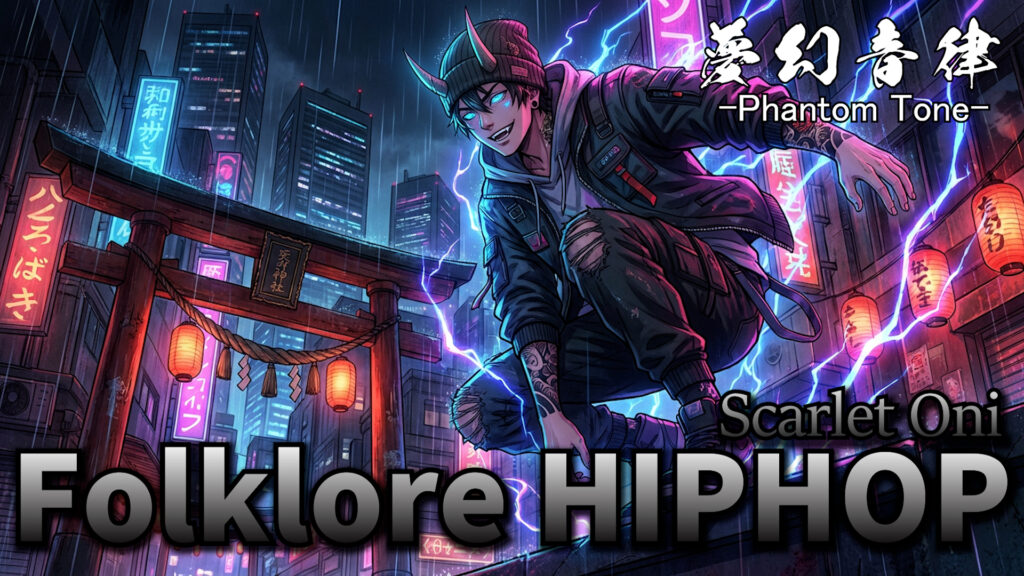
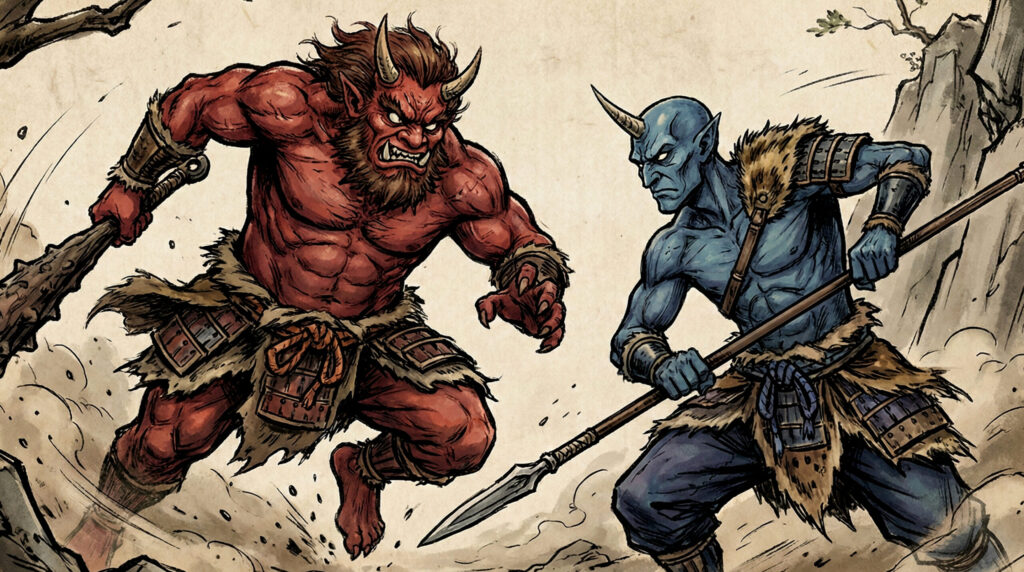
Two oni embodying moral contrast.
They represent sacrifice and deception.
Primary Sources
Oni Folklore & Moral Tale Records
- Konjaku Monogatari-shū (今昔物語集)
- Otogi-zōshi (御伽草子)
- Yanagita Kunio — Oni belief studies
- Komatsu Kazuhiko — Yōkai Encyclopedia
Aka-oni and Ao-oni – The Color-Coded Division of Oni in Japanese Folklore
Aka-oni (Red Oni) and Ao-oni (Blue Oni) are not individual beings, but a conceptual pair that defines the moral, emotional, and functional spectrum of oni in Japanese folklore. Their distinction lies not in origin, but in attribute.
They are not rivals.
They are not siblings.
They are a system.
Aka-oni and Ao-oni embody the division of excess.
Origins in Color Symbolism and Cultural Logic
Color has long carried semantic weight in Japanese thought. Red and blue are not arbitrary opposites; they encode contrasting forms of intensity.
- Red signifies heat, blood, anger, vitality, and immediacy
- Blue signifies cold, shadow, restraint, sorrow, and endurance
When applied to oni, these colors do not merely decorate. They classify.
The oni is one.
Its excess is divided.
From Singular Oni to Functional Duality
Early oni appear without fixed color. Over time, as oni became moral and narrative tools, differentiation became necessary.
Aka-oni absorbs outward violence.
Ao-oni absorbs inward suffering.
Together, they externalize human extremes.
Aka-oni – The Oni of Violence and Heat
Aka-oni represents destructive force expressed openly:
Rage and impulsive aggression
Physical strength and brutality
Greed, excess, and appetite
Immediate threat
In folklore and later pedagogy, Aka-oni is the oni that must be driven out, punished, or expelled.
It burns brightly.
It is seen immediately.
Ao-oni – The Oni of Suppression and Cold
Ao-oni embodies suffering turned inward:
Jealousy and resentment
Loneliness and endurance
Silent cruelty
Emotional stagnation
Ao-oni is often portrayed as more tragic than monstrous. Its danger lies in persistence rather than explosion.
It does not rush.
It remains.
Moral Structure and Social Function
The pairing of Aka-oni and Ao-oni serves a didactic function:
- Aka-oni warns against uncontrolled action
- Ao-oni warns against unexpressed emotion
Together, they map a moral boundary for acceptable human behavior.
The oni is what happens when balance fails.
Relationship to Buddhism and Psychology
In Buddhist-influenced thought, Aka-oni aligns with anger and desire, while Ao-oni aligns with ignorance and attachment. They are not evil by nature, but by imbalance.
Psychologically, they externalize extremes of emotion:
Aka-oni is explosive trauma.
Ao-oni is depressive fixation.
Representation in Folklore and Modern Media
Aka-oni and Ao-oni appear prominently in festivals, children’s stories, and iconography. Their visual clarity allows immediate recognition of moral role.
Despite simplification, the underlying structure remains intact.
Color teaches faster than words.
Symbolism and Themes
Duality of Excess
Different paths to imbalance.
Visibility vs Persistence
Immediate harm versus long-term damage.
External vs Internal Failure
Action and stagnation.
Moral Mapping Through Color
Emotion rendered visible.
Related Concepts
Oni (鬼)
Demonic beings.
→Oni
Moral Contrast Folklore
Good and evil duality.
Village Boundary Spirits
Beings guarding human limits.
Aka-oni and Ao-oni in Cultural Memory
The persistence of this pairing suggests cultural utility. Rather than a single monster, the oni becomes a framework for understanding destructive tendencies.
People recognize themselves in one—or both.
The oni is familiar because it is human.
Modern Cultural Interpretations
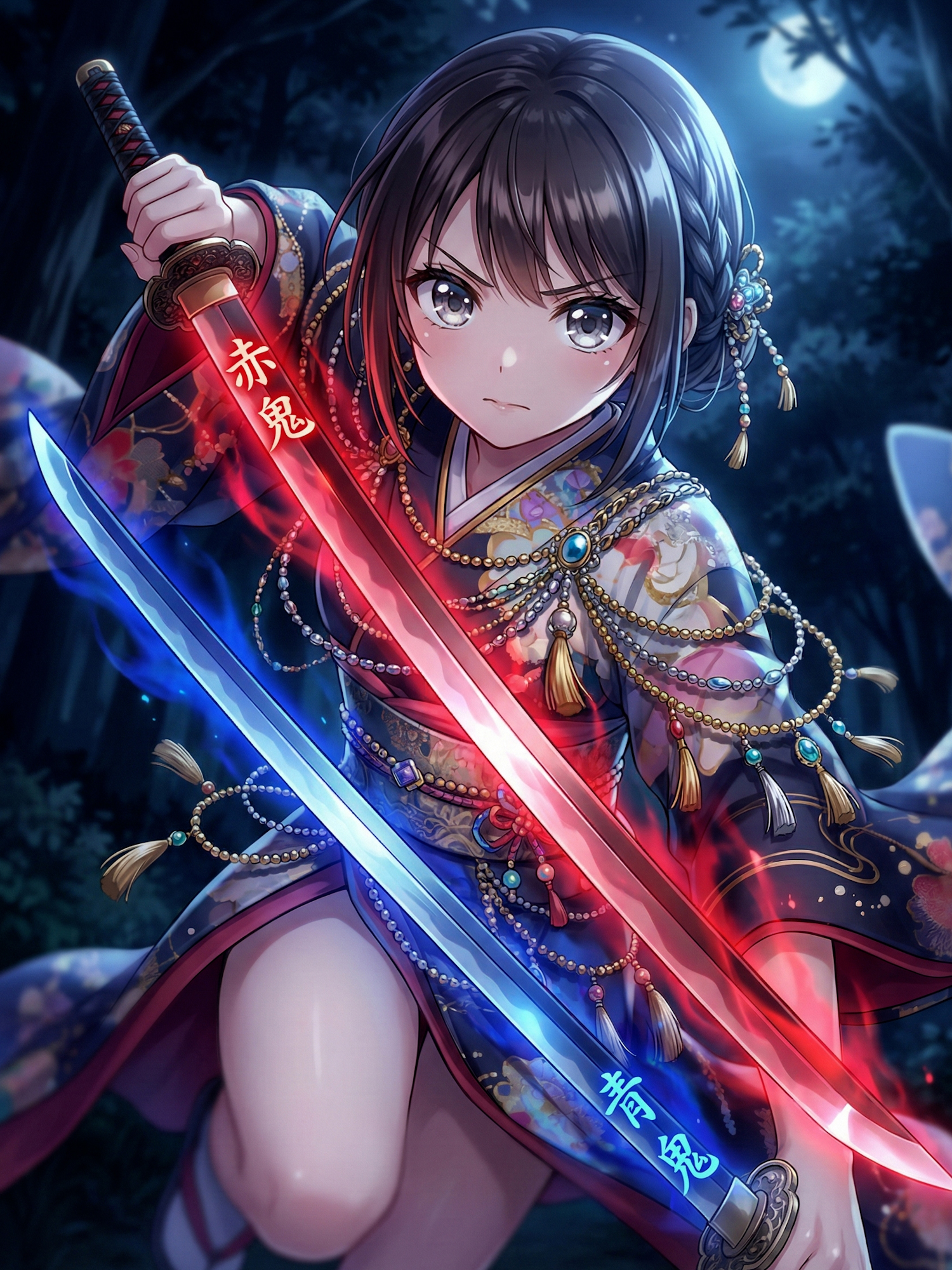
This blade symbolizes moral division and sacrificial justice.
It visualizes kindness purchased by exile.
Modern creators often reinterpret Aka-oni and Ao-oni beyond simple moral binaries, emphasizing psychological nuance rather than pure good and evil.
Aka-oni becomes a symbol of unchecked impulse, while Ao-oni embodies unaddressed despair — two emotional extremes that coexist within human experience.
In some modern visual reinterpretations, Aka-oni and Ao-oni manifest as twin yōtō — paired blades that mirror excess and withdrawal. One burns with volatile heat; the other absorbs light into stillness.
Their endurance reflects ongoing relevance.
Modern Reinterpretation – Aka-oni & Ao-oni as the Dual Faces of Excess
In this reinterpretation, the twin oni are no longer crude villains, but living symbols of emotional imbalance. Aka-oni burns with impulsive desire and fury — the embodiment of motion without reflection. Ao-oni freezes in melancholy and doubt — the paralysis of feeling turned inward. They are not opposites but echoes, circling one another within the same spectrum of excess.
The “beautiful girl” reinterpretation channels this duality through contrast. The red aspect radiates heat and immediacy: eyes glowing with restless flame, garments alive with movement. The blue aspect emanates silence and inward weight: pale light pooled around her, a still surface concealing endless depth. Between them lies tension — not conflict, but recognition.
They are the same emotion seen from two directions: eruption and implosion. Aka-oni destroys by acting too quickly; Ao-oni by never acting at all. Together, they reveal that imbalance does not always shout — sometimes it whispers.
In this visual and conceptual synthesis, the oni cease to be cautionary figures and become psychological portraits. Their horns are metaphors for extremes that pierce the self from within. Their gaze is human, their power inevitable.
Through this lens, Aka-oni and Ao-oni are no longer external monsters — they are mirrors. To face them is to confront the instability that defines every human threshold between passion and despair.
Musical Correspondence
The corresponding composition embodies polarity and reconciliation. It begins in violent syncopation — pounding percussion and distorted bass articulating Aka-oni’s volatile rhythm. Then, the tempo slows; textures thin; resonant, frozen harmonies emerge, expressing Ao-oni’s suspended melancholy.
Across the piece, these two energies collide and blend. Bursts of sound fade into hollow drones, while silences become charged, vibrating with withheld motion. The midpoint of the composition achieves fragile symmetry — heat and cold balanced just long enough to suggest understanding.
By oscillating between explosion and stillness, the music captures the essence of the twin oni: destruction not as external punishment, but as inner imbalance seeking release. The final note holds neither warmth nor chill — only the quiet aftermath of emotion made whole.
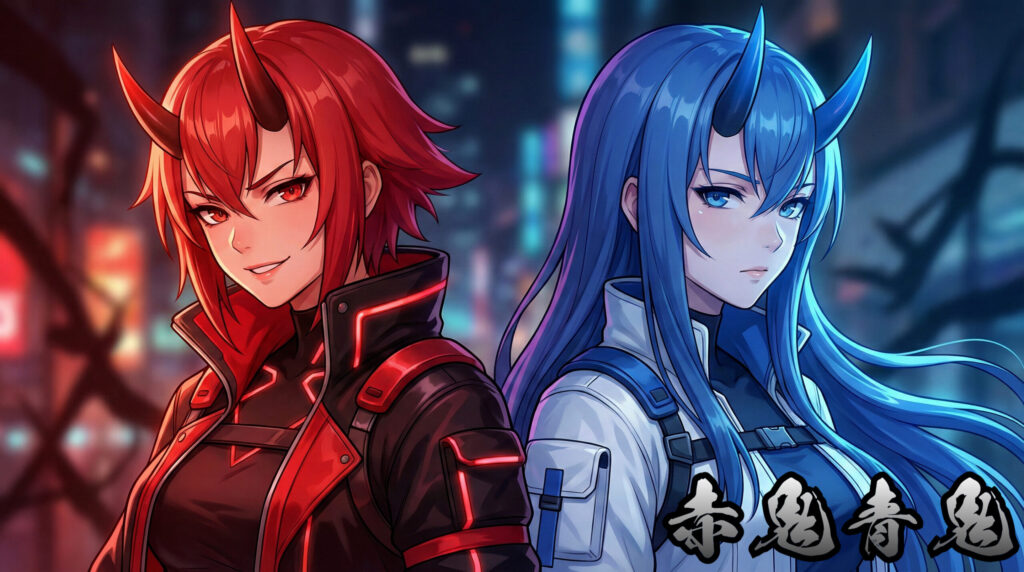
She embodies moral contrast and quiet exile.
Her presence reflects kindness that costs belonging.
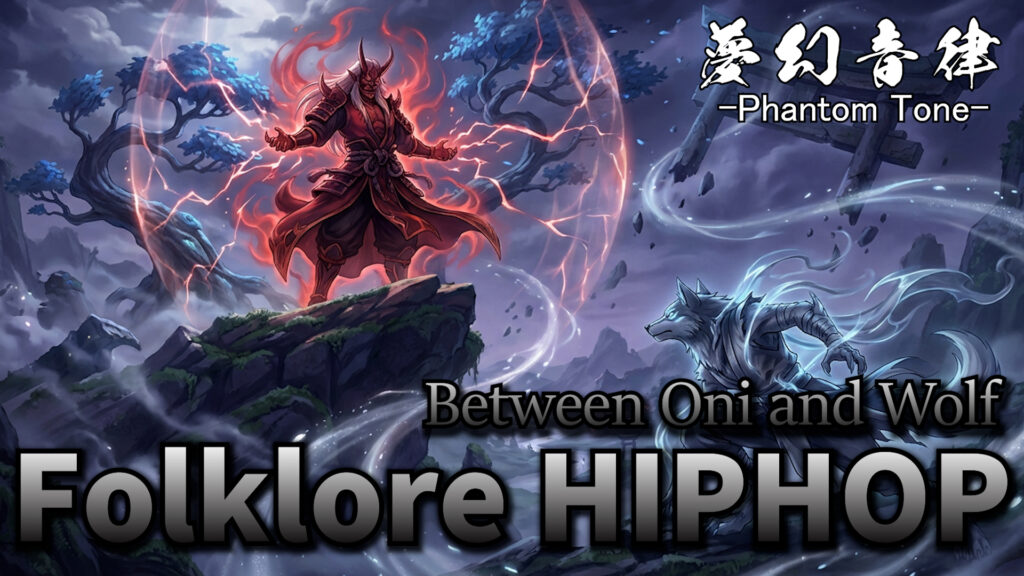
Between Oni and Wolf
Genre: Japanese Folklore Hip-Hop, Ritual Lo-Fi Poetry Produced by: Phantom Tone | Suno AI | Kotetsu Co., Ltd. Tags: #AIgeneratedMusic #JapaneseHipHop #Folklore…
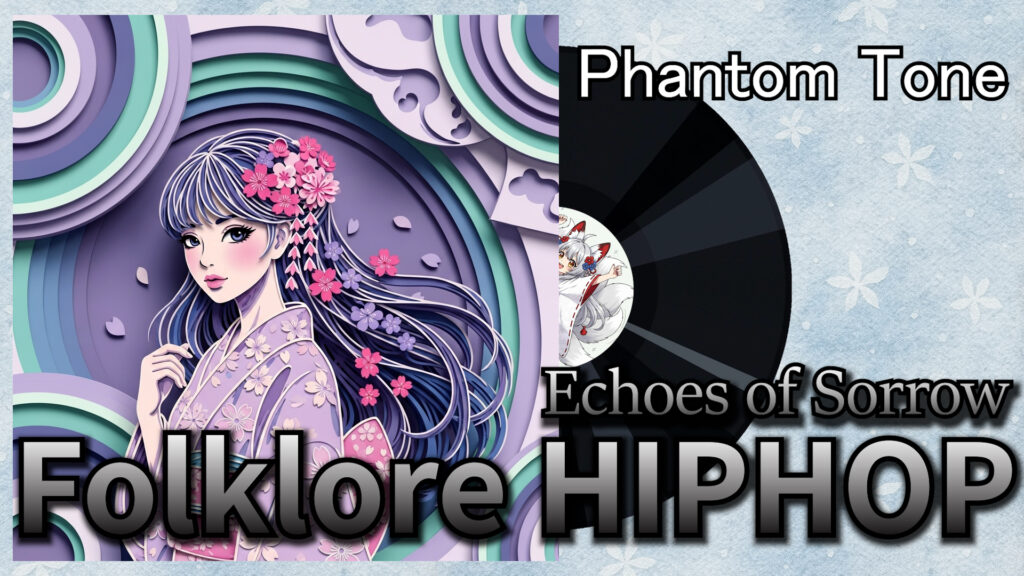
Echoes of Sorrow
Genre: Japanese Folklore HipHop / Darkwave Lo-Fi Produced by: Phantom Tone | Suno AI | Kotetsu Co., Ltd. Tags: #JapaneseFolklore #OniMyth #AIgeneratedMusic #Ph…
Scarlet Oni
Genre: Japanese Folklore HipHop / Darkwave Enka Trap Produced by: Phantom Tone | Suno AI | Kotetsu Co., Ltd. Tags: #JapaneseFolkloreHipHop #AIGeneratedMusic #P…