Nurikabe – Barrier Spirits of Japanese Folklore
Nurikabe are one of the most enigmatic and quietly unsettling figures in Japanese folklore: invisible walls that appear without warning, blocking travelers in the dark. Unlike yokai that attack, deceive, or possess, nurikabe do nothing overtly hostile. They simply exist — immovable, silent, and inexplicable.
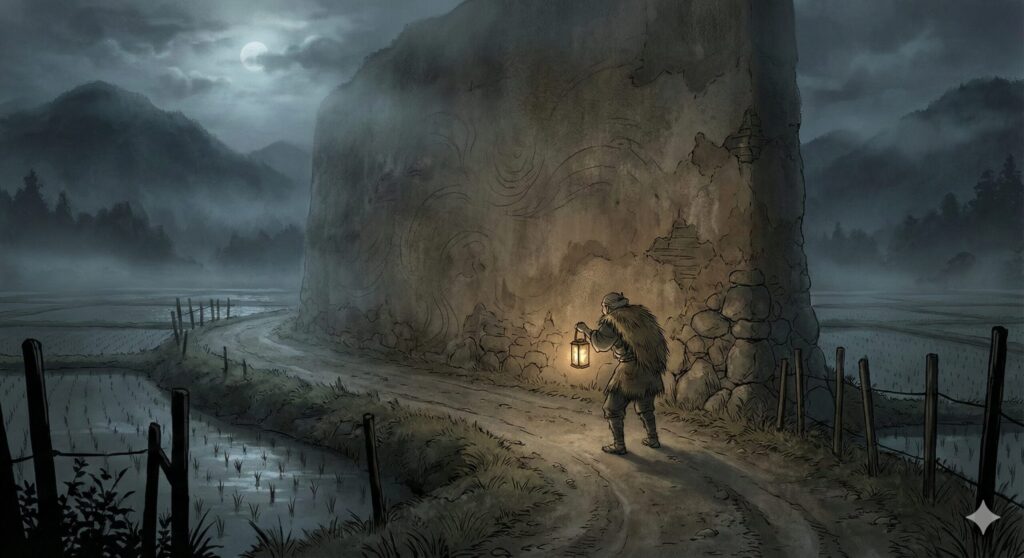
Encountered most often at night on lonely roads, mountain paths, or village outskirts, nurikabe manifest as unseen barriers that prevent forward movement. No matter how one tries to go around them, the obstruction persists. The traveler is not harmed, but disoriented, delayed, and forced to confront the impossibility of progress.
Nurikabe embody the fear of obstruction itself — the moment when the path ahead simply ceases to exist.
Origins and Early Accounts
The earliest references to nurikabe appear in regional folklore rather than formal literature. Travelers reported being unable to proceed along familiar routes, as if an unseen wall stood before them. No physical object was visible, yet the sensation was unmistakable: resistance, pressure, refusal.
The name nurikabe (塗壁) literally means “plastered wall,” suggesting a flat, smooth surface like the walls of traditional Japanese buildings. This terminology implies not a creature in motion, but an architectural intrusion into open space — a wall where no wall should be.
These encounters often occurred during nighttime travel, when visibility was poor and orientation uncertain, reinforcing the idea that nurikabe inhabit liminal states between perception and reality.
From Phenomenon to Yokai
Originally, nurikabe may have functioned as an explanation for getting lost, fatigued, or disoriented in darkness. As with many yokai, repeated experiences hardened into narrative form, transforming an abstract phenomenon into a supernatural entity.
Unlike yokai that gained elaborate personalities over time, nurikabe remained minimalistic. They did not speak, transform, or pursue. Their defining trait was persistence — the refusal to yield.
This restraint makes nurikabe unusual: they are not dramatized threats, but manifestations of denial itself.
Appearance and Presence
Nurikabe are rarely described in detail, precisely because they are not meant to be seen. Common characteristics include:
Complete invisibility or darkness
A flat, vertical surface blocking movement
An unyielding, immovable presence
Disappearance once the traveler gives up or changes direction
In later visual interpretations, nurikabe are sometimes anthropomorphized as tall, wall-like figures with faint faces or eyes. However, this imagery is secondary; the original terror lies in absence, not form.
Nurikabe are felt, not observed.
Nurikabe and the Night Road
Nurikabe are inseparable from night travel. They appear on roads where landmarks vanish, sounds fade, and orientation relies on memory rather than sight.
In folklore, the correct response to encountering a nurikabe is not force, but humility. Some tales advise travelers to lower themselves, crawl beneath, or strike the ground rather than the wall. Others suggest simply turning back.
These responses emphasize acceptance over resistance — an acknowledgment that some obstacles cannot be confronted directly.
Symbolism and Themes
Obstruction Without Malice
Nurikabe do not punish or judge. They block indiscriminately, embodying obstacles that arise without reason or intent.
The Illusion of Progress
Their presence challenges the assumption that effort guarantees movement. No matter how determined the traveler, progress is denied.
Liminal Space and Disorientation
Nurikabe appear at thresholds — between village and wilderness, certainty and confusion, movement and stagnation.
Psychological Reflection
Many interpretations view nurikabe as externalizations of exhaustion, doubt, or fear, projected into the landscape when the mind falters.
Nurikabe in Literature and Art
Compared to more dramatic yokai, nurikabe occupy a subtle role in folklore collections. They appear briefly, often without resolution, reinforcing their purpose as narrative dead-ends.
In modern art and illustration, nurikabe are often depicted:
As towering walls with faint expressions
Emerging from darkness without clear boundaries
Blocking narrow paths or corridors
Appearing emotionless and impassive
These depictions give form to something originally formless, translating psychological obstruction into visual metaphor.
Regional Variations and Folk Beliefs
Different regions offer varied explanations and countermeasures for nurikabe encounters. Some believe:
Nurikabe appear only to those who travel alone
They vanish if approached at ground level
They test patience rather than strength
They mark boundaries that should not be crossed
These beliefs frame nurikabe as silent custodians of space, enforcing unseen rules rather than inflicting harm.
Modern Interpretations
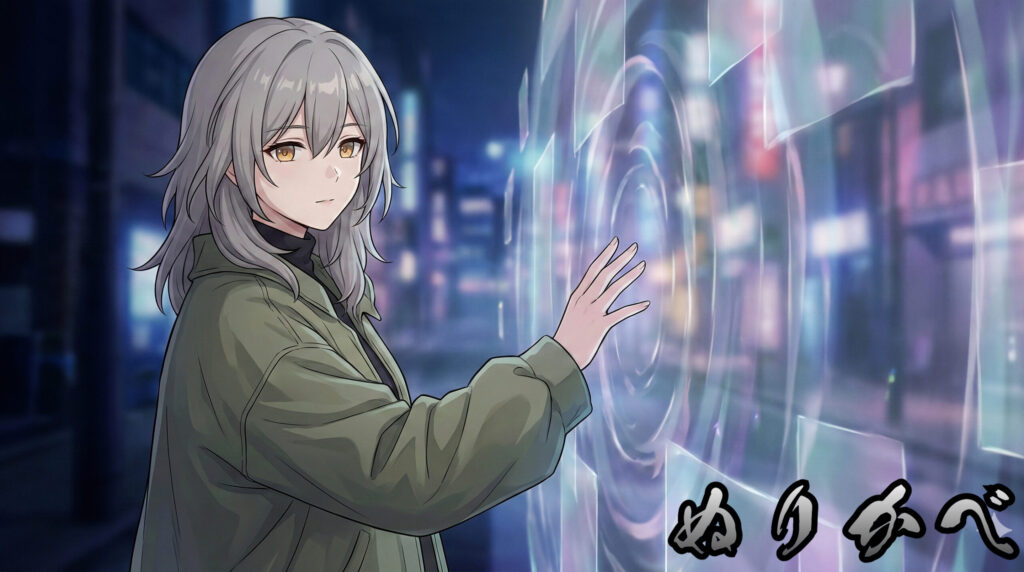
In contemporary media, nurikabe are often reimagined as symbols of existential blockage — representing stagnation, depression, or systemic barriers. Anime and games may portray them as literal monsters, but often preserve their core function: denial of passage.
Modern interpretations emphasize their psychological resonance. Nurikabe become metaphors for invisible limits imposed by society, fate, or the self — walls that cannot be broken, only navigated around.
Conclusion – Nurikabe as Spirits of Denied Passage
Nurikabe represent one of the quietest horrors in Japanese folklore. They do not chase, threaten, or deceive. They simply stand in the way.
As spirits of obstruction, they force travelers to stop, reconsider, and often retreat. In doing so, nurikabe remind us that not every path is open, not every effort is rewarded, and not every barrier announces itself.
They are the embodiment of refusal — a wall where there should be none.
Music Inspired by Nurikabe
Music inspired by nurikabe often emphasizes stillness, tension, and unresolved progression. Sustained tones, minimal harmonic movement, and repeating motifs that never quite resolve can evoke the sensation of being blocked.
Slow-building structures that stall rather than climax mirror denied motion, while muted textures and restrained dynamics reflect the silent presence of the wall. Abrupt stops or looping phrases reinforce the feeling of reaching a boundary without release.
Through these techniques, music inspired by nurikabe captures not fear or violence, but suspension — the unsettling quiet of standing before an invisible wall, unable to move forward.
Dreamy and stylish
Genre: Ritual Japanese HipHop / Darkwave Folklore Produced by: Phantom Tone | Suno AI | Kotetsu Co., Ltd. Tags: #JapaneseHipHop #AIgeneratedMusic #Yokai #Phant…
 Phantom Tone – Japanese Folklore Hip-Hop Project