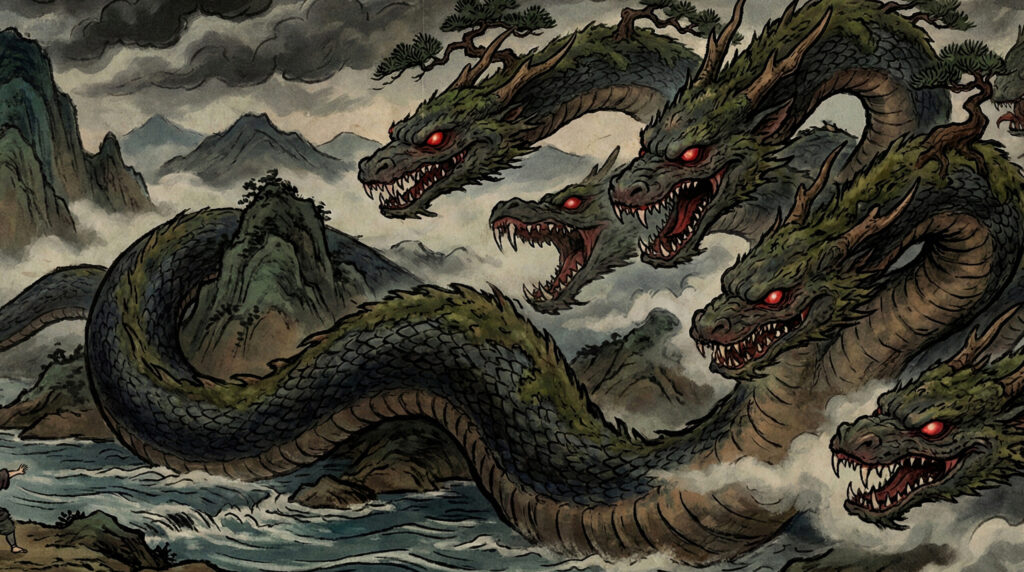
An eight-headed serpent demanding sacrifice.
It embodies primordial chaos.
Primary Sources
Serpent Deity & Slaying Lore
- Kojiki (古事記)
- Nihon Shoki (日本書紀)
- Izumo mythological records
- Yanagita Kunio — Serpent deity belief studies
- Komatsu Kazuhiko — Yōkai Encyclopedia
Yamata no Orochi – Eight-Headed Serpent of Chaos and Kingship in Japanese Myth
Yamata no Orochi is one of the most colossal and symbolically charged beings in Japanese mythology: an eight-headed, eight-tailed serpent whose presence embodies overwhelming chaos, natural disaster, and sacrificial terror. Appearing in the Kojiki and Nihon Shoki, Orochi is not a mere monster, but a mythic force that demands tribute, devours order, and reshapes destiny through its defeat.
Unlike yōkai who haunt margins, Yamata no Orochi dominates the landscape. Its body spans valleys, its blood stains rivers, and its appetite consumes generations. The myth unfolds not as a scare tale, but as a foundational narrative about order wrested from devastation.
Orochi represents chaos so vast that only divine intervention can confront it.
Origins in the Ancient Chronicles
The earliest accounts of Yamata no Orochi appear in Japan’s oldest texts, where the storm god Susanoo encounters the serpent in the land of Izumo. There, Orochi has terrorized the region, devouring the daughters of an elderly couple year after year until only one remains.
This ritualized consumption situates Orochi as more than a beast. It is a cyclical calamity—flood, famine, or epidemic—given form. The myth encodes communal memory of repeated disaster, framed as an entity that must be confronted at its source.
Susanoo’s intervention transforms the narrative from despair to restoration.
Form and Monstrous Scale
Descriptions of Yamata no Orochi emphasize excess and multiplicity:
Eight heads and eight tails
A body extending across mountains and valleys
Eyes glowing like red winter cherries
A back overgrown with moss, trees, and cypress
Blood flowing from its body like rivers
This imagery fuses serpent, mountain, and flood into a single organism. Orochi is not just in nature; it is nature in a hostile configuration. Its many heads suggest uncontrolled proliferation, while its tails imply inescapable reach.
The monster’s scale denies ordinary heroism.
Sacrifice and the Weight of Fear
Central to the Orochi myth is the demand for sacrifice. The serpent’s yearly consumption of daughters reflects the terror of communities forced to offer what they cannot spare. The ritual is resigned, not resisted—until intervention arrives.
This pattern reveals Orochi as a figure of inevitability. People adapt to its presence rather than challenge it, underscoring the myth’s portrayal of disaster as normalized suffering.
The turning point comes not through strength alone, but through strategy.
The Defeat by Cunning and Intoxication
Susanoo does not confront Orochi directly. Instead, he prepares eight vats of strong sake, placing them before the serpent. Each head drinks, becomes intoxicated, and falls into stupor. Only then does Susanoo strike, severing the heads and tails.
This victory through intoxication reframes heroism as intelligence over brute force. Order is restored not by matching chaos head-on, but by exploiting its excess.
Within Orochi’s tail, Susanoo discovers the sacred sword Kusanagi—linking destruction to the birth of kingship.
Orochi and the Birth of Authority
The emergence of Kusanagi from Orochi’s body ties the serpent’s defeat to the legitimization of rule. Chaos, once overcome, yields the instruments of order.
This motif elevates the myth beyond monster-slaying. Yamata no Orochi becomes a necessary adversary whose existence enables transformation. Without the serpent, there is no sword; without disaster, no renewal of authority.
The myth encodes a cycle: devastation, confrontation, and restoration.
Symbolism and Themes
Multiplicity and Chaos
Orochi’s many heads represent uncontrolled proliferation and disorder.
Natural Disaster Personified
Floods, storms, and famine converge in its form.
Sacrifice and Survival
Communities endure loss until change becomes possible.
Order Born from Destruction
The defeat of chaos produces sacred authority.
Related Concepts
Storm & River Serpent Motif
Multi-headed serpent deities.
Sacrifice Folklore
Legends of appeasing monsters.
Divine Slaying Myth
Kami defeating primordial beasts.
Yamata no Orochi in Art and Cultural Memory
Throughout Japanese art, Orochi is depicted as vast and overwhelming, often coiling across the frame while Susanoo appears small yet resolute. Artists emphasize scale disparity, reinforcing the myth’s existential stakes.
In later literature and performance, the serpent becomes a symbol invoked to represent insurmountable obstacles or systemic calamity. Its name endures as shorthand for overwhelming threat.
Despite stylization, its mythic weight remains intact.
Modern Cultural Interpretations
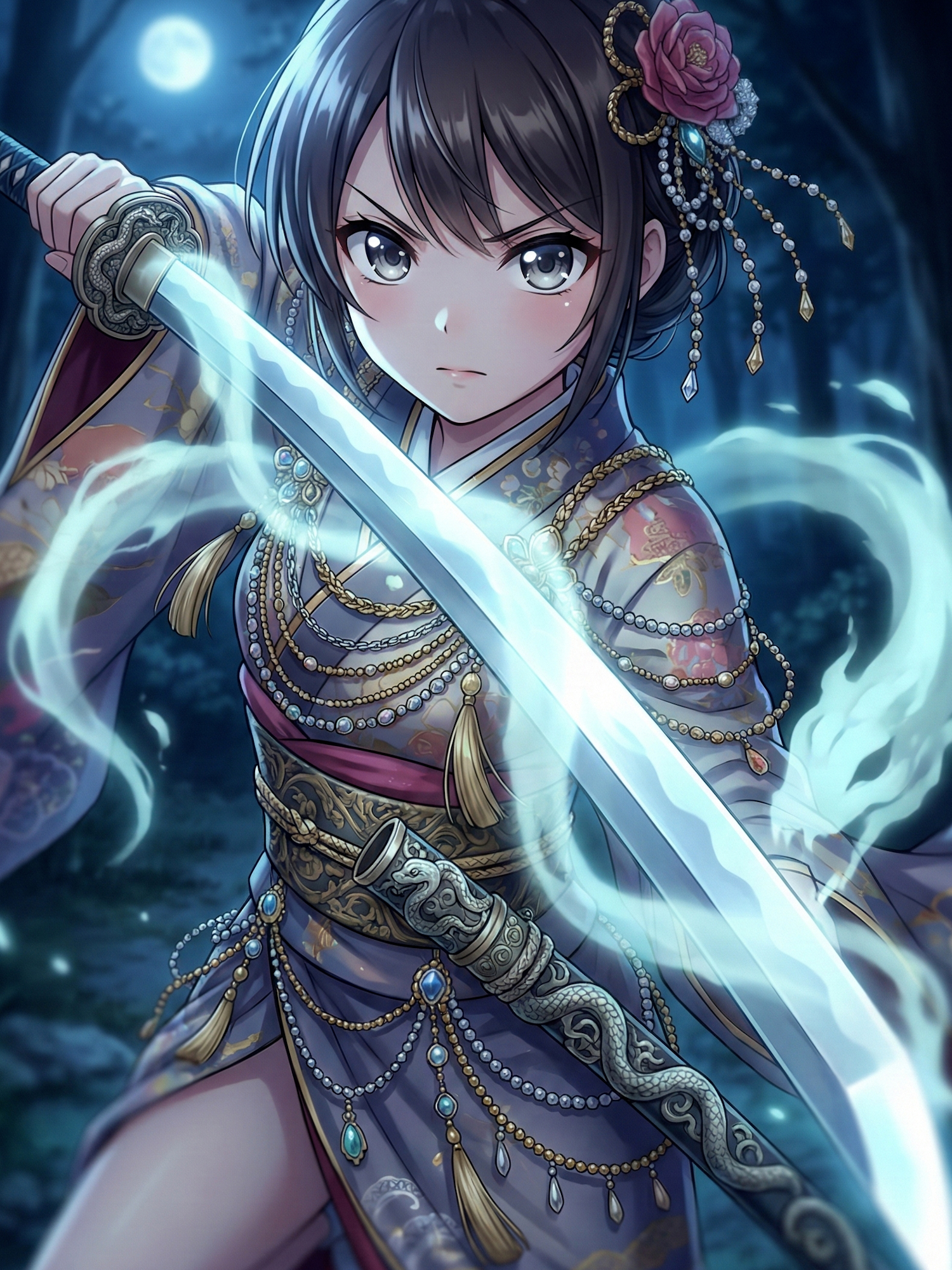
This blade symbolizes primordial execution and flood-bound chaos.
It visualizes ancient disaster sealed into steel.
In modern media, Yamata no Orochi frequently appears as an ultimate antagonist — an embodiment of ancient evil or primal chaos. Games and anime amplify its scale and ferocity, translating myth into spectacle.
Yet even in these forms, the original structure persists: chaos is vast, but not invincible; intelligence and resolve can prevail.
In some modern visual reinterpretations, Yamata no Orochi manifests as a yōtō — a blade formed from coiling scales. The sword bears segmented ridges like severed heads, embodying crisis rendered into form.
Orochi endures because it represents crises that feel too large to face — until they are faced.
Modern Reinterpretation – Yamata no Orochi as the Shape of Catastrophe
In this reinterpretation, Yamata no Orochi is not simply a beast of destruction, but the embodiment of crisis itself — chaos too vast to comprehend until it collapses under its own weight. It represents every force that grows unchecked: desire, power, or disaster taking form in scale and motion.
The “beautiful girl” visualization draws from that paradox — beauty as danger structured. Her hair coils like serpents, each strand glinting with the sheen of scales. Her kimono ripples in eight flowing layers, echoing Orochi’s bodies twisting through mist and river. Her expression is calm, neither benevolent nor wrathful — the stillness of inevitability.
She does not rage; she emanates pressure. Around her, the landscape bends, air vibrating with the tension before collapse. Her presence is not about domination but magnitude — a living threshold between destruction and renewal.
In this form, Orochi becomes catastrophe made humanly visible: the moment just before order reasserts itself. She is crisis incarnate, the world learning its own limits.
Through the “beautiful girl” lens, Yamata no Orochi transforms from monster to embodiment of consequence — power that tests comprehension, beauty born from chaos, and the knowledge that every collapse begins with motion too grand to name.
Musical Correspondence
The accompanying track translates magnitude into sound. Layered percussion mimics the movement of many bodies — overlapping strikes, deep resonance, and rhythmic dissonance that builds into near-chaos before resolving. Low drones roll beneath, like a river forced through narrow stone.
Melodic fragments emerge briefly, only to be consumed by mass and noise, suggesting the futility of clarity within turmoil. Yet as the intensity peaks, harmony begins to cohere — dissonance folding into order, rhythm stabilizing into pulse.
Through cycles of eruption and restoration, the music captures Orochi’s duality: catastrophe and catharsis intertwined. It becomes the sound of collapse giving birth to structure — chaos yielding, at last, to balance.
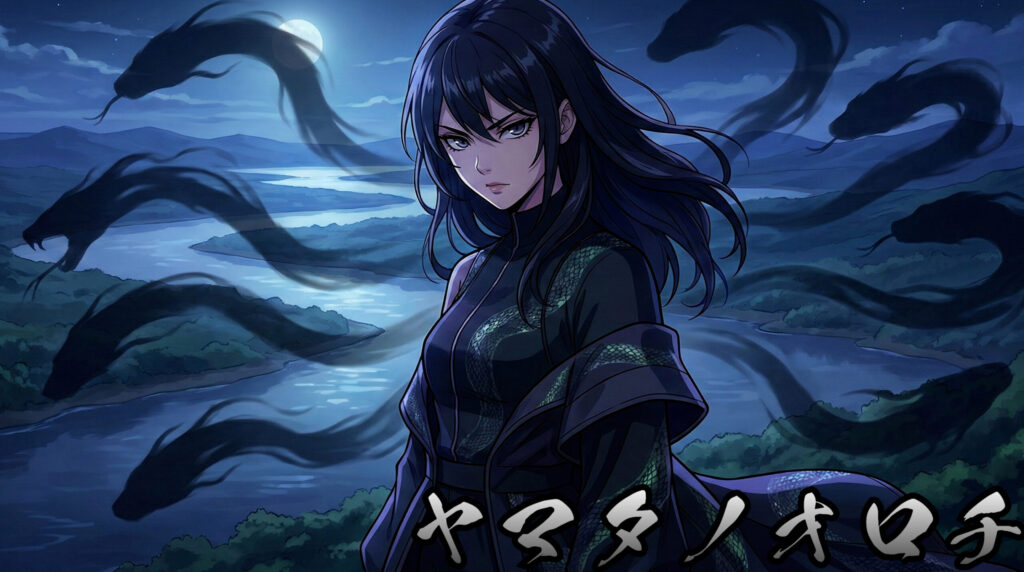
She embodies primordial hunger and river chaos.
Her calm presence conceals ancient calamity.
Dreamy and stylish
Genre: Ritual Japanese HipHop / Darkwave Folklore Produced by: Phantom Tone | Suno AI | Kotetsu Co., Ltd. Tags: #JapaneseHipHop #AIgeneratedMusic #Yokai #Phant…