
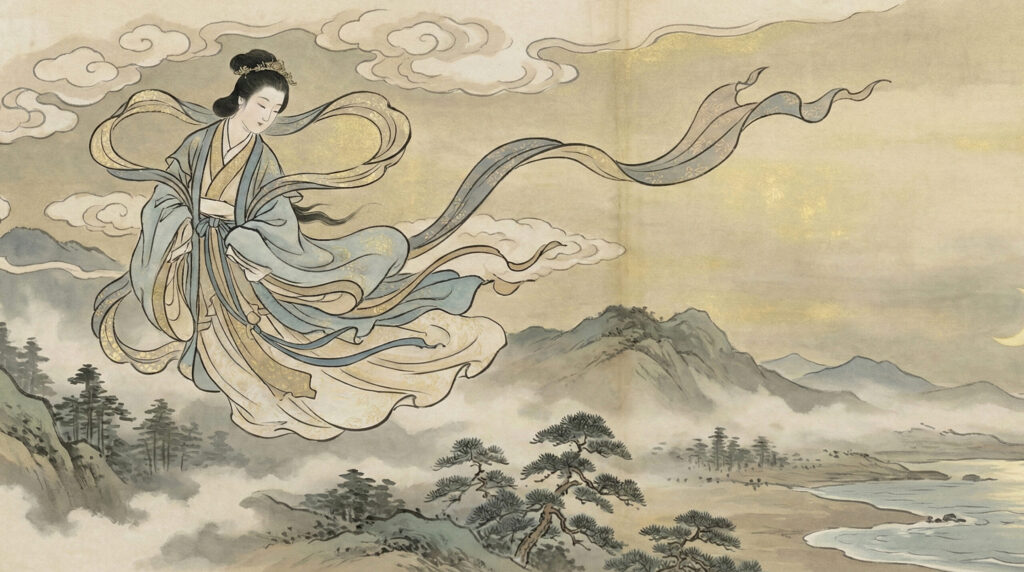
A heavenly maiden descending to bathe.
Her robe binds her to the sky.
Primary Sources
Heavenly Maiden & Robe Lore
- Tennyo Hagoromo (羽衣天女伝説)
- Konjaku Monogatari-shū (今昔物語集)
- Yanagita Kunio — Celestial maiden folklore
- Komatsu Kazuhiko — Yōkai Encyclopedia
Tennyo – Celestial Maidens Between Heaven and Earth in Japanese Folklore
Tennyo are among the most graceful and melancholic figures in Japanese folklore: celestial maidens who descend from the heavens to the human world, often bathing in secluded lakes or rivers. Neither yōkai nor mortal, tennyo embody beauty, purity, and separation—beings whose presence brings wonder, yet whose fate is defined by impermanence.
Unlike monsters that intrude violently, tennyo arrive silently. Their stories are not driven by fear, but by longing. When a human encounters a tennyo, the meeting is fleeting, marked by awe and inevitability. The human world can never fully contain them.
Tennyo represent the sorrow that arises when heaven and earth briefly touch—and must part.
Origins and Cultural Background
The tennyo legend has roots in Buddhist cosmology, particularly the apsaras of Indian and Chinese tradition—heavenly dancers who serve the gods. Through cultural transmission, this image entered Japan and merged with local folktales, producing uniquely Japanese narratives centered on loss and separation.
By the medieval period, tennyo stories had spread widely across regions, each adapting the motif to local geography. Lakes, mountains, and forests became sites of descent, grounding celestial myth in familiar landscapes.
Unlike doctrinal figures, tennyo are shaped by oral storytelling, poetry, and performance, making them emotionally resonant rather than theologically rigid.
Appearance and the Hagoromo
Tennyo are typically described with restrained elegance:
Ethereal beauty without excess ornament
Flowing robes that shimmer like clouds or water
A serene, distant expression
The hagoromo—feathered robe or celestial mantle
The hagoromo is central to tennyo lore. It is not merely clothing, but the means by which the tennyo return to heaven. Without it, they are trapped on earth, bound to human time and limitation.
This garment becomes the axis of many tales—hidden, stolen, or withheld—transforming beauty into captivity.
The Descent and Human Encounter
Most tennyo legends follow a similar structure. A tennyo descends to bathe. A human—often a fisherman, woodcutter, or farmer—discovers her and takes the hagoromo. Deprived of her robe, the tennyo cannot return to heaven and remains in the human world.
In some versions, she becomes a wife and bears children. In others, she lives quietly, longing for the sky. Eventually, the hagoromo is returned or rediscovered, and the tennyo ascends, leaving behind family, memory, and silence.
The human gains wonder, then loss. The tennyo regains freedom, at the cost of attachment.
Love Without Permanence
A defining feature of tennyo stories is the imbalance of desire. Humans cling; tennyo endure. Even when love is genuine, it cannot overcome the fundamental divide between worlds.
The tennyo’s departure is rarely framed as betrayal. It is necessity. Heaven calls not out of cruelty, but because it is where she belongs.
This framing shifts the tragedy away from moral failure and toward existential incompatibility.
Symbolism and Themes
Beauty as Impermanence
Tennyo embody beauty that cannot be possessed or preserved.
The Cost of Desire
Human longing leads to temporary closeness, followed by inevitable loss.
Separation of Worlds
Heaven and earth touch only briefly, then part.
Freedom Over Attachment
Return to the sky represents restoration, not abandonment.
Related Concepts
Celestial Maiden Motif
Beings descending from heaven.
Hagoromo (羽衣)
Heavenly robe enabling return.
Marebito (稀人)
Sacred visitors from beyond.
→Marebito
Regional Variations and Performance
Tennyo legends appear throughout Japan, most famously in the Hagoromo legend associated with Miho no Matsubara. These stories became foundational material for Noh theater, where slow movement, restrained emotion, and poetic language emphasize distance and inevitability.
In performance, the tennyo is often portrayed as both radiant and sorrowful—already aware that the encounter will end.
This performative tradition cemented the tennyo as symbols of fleeting grace rather than narrative resolution.
Modern Cultural Interpretations
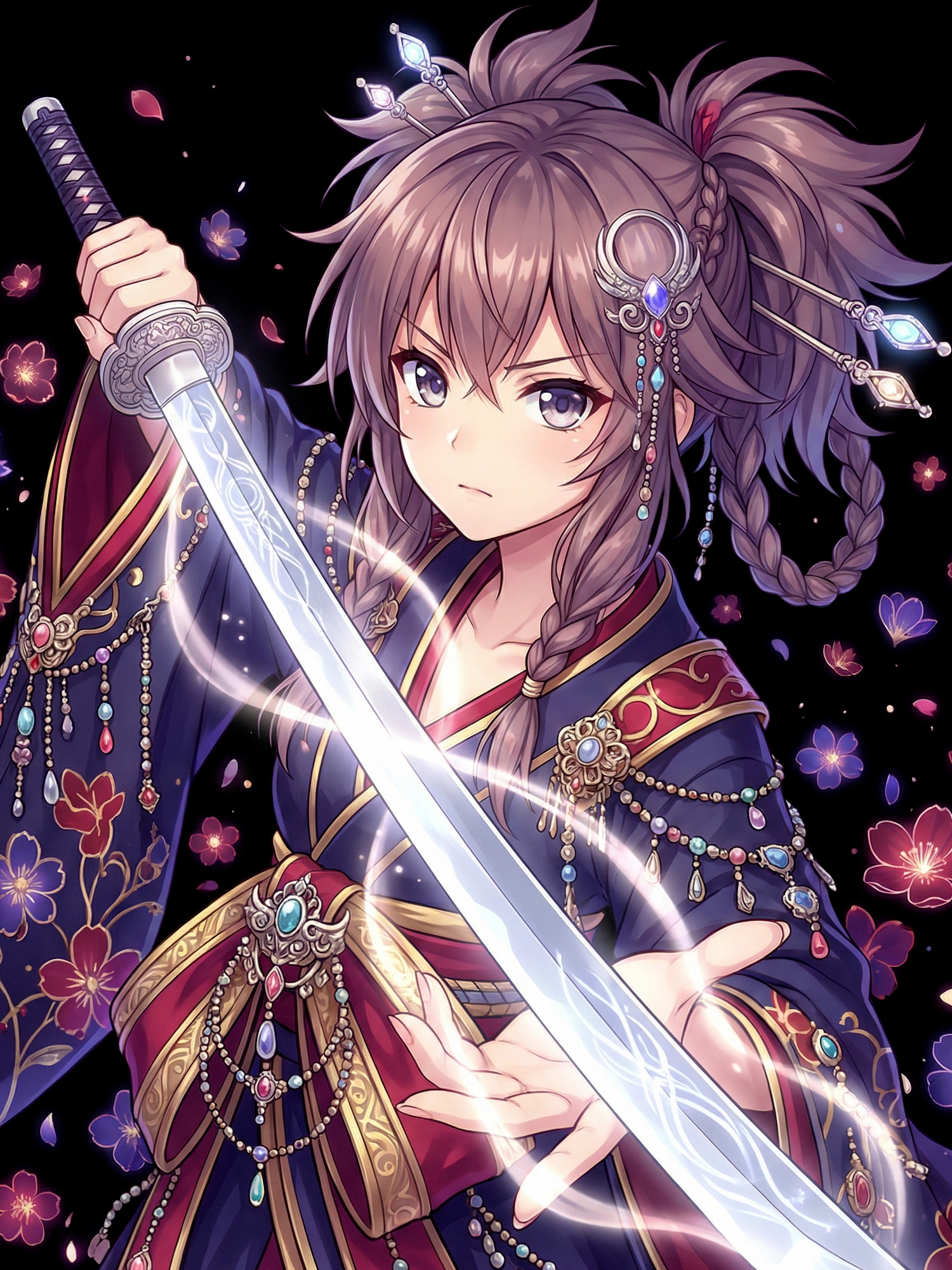
This blade symbolizes sealed return and stolen transcendence.
It visualizes exile through loss of heaven.
In modern media, tennyo are often romanticized as angelic figures or idealized feminine forms. Some interpretations soften the sorrow, emphasizing fantasy over loss.
However, their traditional power lies in restraint. Tennyo are compelling not because they stay, but because they leave. Their stories resist happy endings, favoring quiet departure over resolution.
In some modern visual reinterpretations, tennyo manifest as a yōtō — a blade that dissolves into light as it moves. The sword cannot be held for long, embodying beauty remembered rather than retained.
They remain symbols of beauty remembered, not retained.
Modern Reinterpretation – Tennyo as the Spirit of Fleeting Grace
In this reinterpretation, the Tennyo is not a celestial reward or messenger, but the embodiment of impermanence made visible — the radiance that visits only once. She is beauty freed from possession, the gentle proof that transience itself is sacred.
The “beautiful girl” form captures that weightless divinity. Her robes shimmer like sunlight through mist, each fold dissolving at its edges into air. Her hair floats as if moved by an unseen current, and her gaze seems aware of both presence and departure at once — kind, distant, unreturning.
She does not linger; she bestows. Every motion feels like a benediction given to impermanence, a dance between light and gravity. Around her, the air holds a faint, luminous sadness — not mourning, but acceptance.
Her beauty is defined by its exit. To remember her is to understand that permanence would ruin what made her divine. She leaves the world brighter precisely because she cannot remain within it.
In this visual reinterpretation, the Tennyo becomes the spirit of fleeting grace — beauty seen once, kindness carried in memory, and light that teaches the value of its own disappearance.
Musical Correspondence
The accompanying track translates ascent into resonance. Airy strings and sustained tones drift upward in slow arcs, each phrase dissolving into silence as if exhaled by the sky itself. Reverb and long decay create the illusion of distance — sound already half departed.
Flutes or ethereal synth layers add glimmers of motion, rising and fading in overlapping cycles. The tempo remains fluid, breathing rather than counting, mirroring the rhythm of wings leaving the horizon.
Through suspension, luminosity, and gradual disappearance, the music captures Tennyo’s essence: presence that never stays, beauty that teaches by leaving, and harmony that vanishes into light.
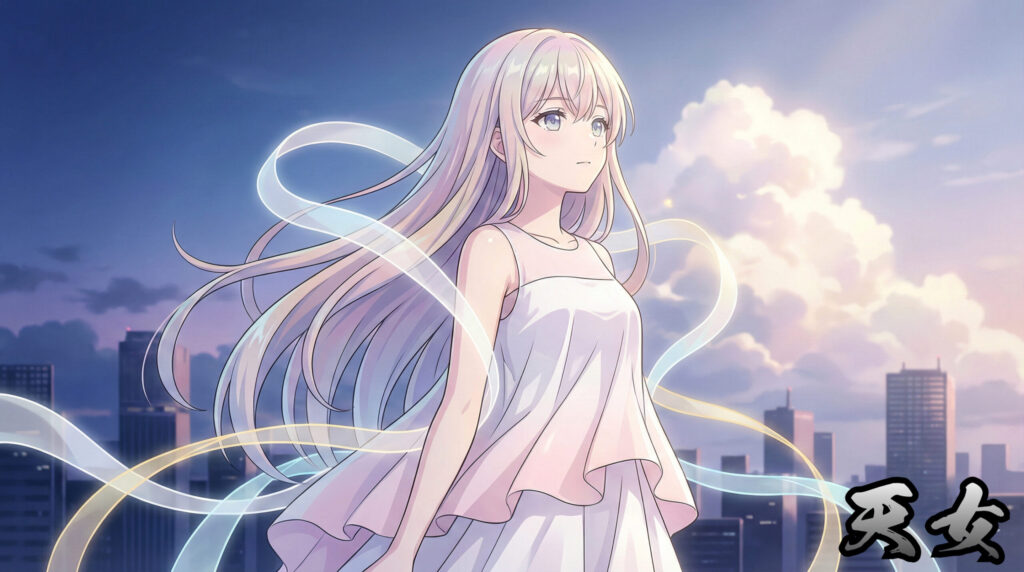
She embodies stolen transcendence and silent exile.
Her presence remains where heaven cannot be reached.
Silk in the Dust
Genre: Japanese Folklore Hip-Hop, Ritual Lo-Fi Poetry, Mythic Narrative Produced by: Phantom Tone | Suno AI | Kotetsu Co., Ltd. Tags: #AIgeneratedMusic #Japane…
Dreamy and stylish
Genre: Ritual Japanese HipHop / Darkwave Folklore Produced by: Phantom Tone | Suno AI | Kotetsu Co., Ltd. Tags: #JapaneseHipHop #AIgeneratedMusic #Yokai #Phant…