
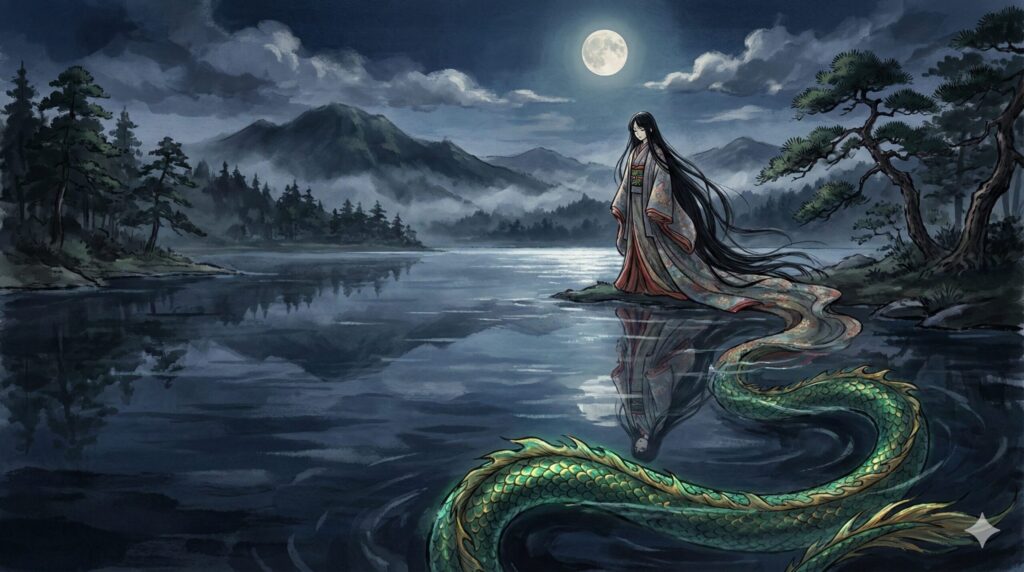
A maiden transformed into a lake dragon.
It represents eternal youth and exile.
Primary Sources
Dragon Maiden & Lake Folklore
- Regional Tazawako (田沢湖) folklore records
- Yanagita Kunio — Lake spirit belief studies
- Komatsu Kazuhiko — Yōkai Encyclopedia
Tatsuko-zō Legend – The Dragon Maiden of Lake Tazawa
The legend of Tatsuko, often symbolized today by the Tatsuko Statue (たつこ像), is one of Japan’s most poignant transformation myths: a tale of beauty, desire, and eternal preservation bound to the depths of Lake Tazawa in Akita Prefecture. Unlike monstrous yokai or divine dragons born as such, Tatsuko begins as a human — a young woman whose wish for lasting beauty leads her beyond the limits of humanity.
Tatsuko’s story occupies a quiet, tragic space within Japanese folklore. It is not a tale of punishment through cruelty, but of transformation through longing. Her final form — a dragon dwelling beneath the lake — embodies both fulfillment and loss, immortality and isolation.
The Tatsuko legend speaks to the price of desire when it seeks to halt time itself.
Origins and Regional Background
The Tatsuko legend is deeply rooted in the Lake Tazawa region, an area long associated with depth, mystery, and sacred natural presence. Lake Tazawa is Japan’s deepest lake, its dark, cold waters reinforcing the sense of an unseen realm beneath the surface.
According to folklore, Tatsuko was a village maiden renowned for her beauty. As she matured, she became consumed by the fear of aging and the desire to remain beautiful forever. Seeking a solution beyond human means, she prayed fervently to spiritual forces.
Her prayers were answered — but not in the way she expected.
From Maiden to Dragon
In the most widely known version of the legend, Tatsuko receives guidance to drink from a sacred spring hidden deep in the mountains. She drinks endlessly, driven by desperation, until her body begins to change.
Over time, her form elongates, scales emerge, and she transforms into a dragon. Realizing she can no longer return to human society, Tatsuko descends into Lake Tazawa, where she remains eternally.
This transformation is neither violent nor sudden. It is gradual, irreversible, and quiet — reinforcing the tragedy of a wish granted too completely.
Tatsuko and the Dragon Motif
Unlike ancient dragons born as divine beings, Tatsuko represents a liminal dragon — one born from human desire rather than cosmic order.
As a dragon, she becomes a guardian of the lake rather than its ruler. Some versions of the legend describe her as a protective presence, ensuring the lake’s depth and purity. Others emphasize her solitude, dwelling forever beneath the surface, unseen.
Her dragon form symbolizes transcendence achieved at the cost of belonging.
Symbolism and Themes
Eternal Beauty and Its Cost
Tatsuko’s wish reflects a universal human fear: the loss of youth. Her transformation suggests that immortality freezes not only beauty, but also connection.
Transformation Without Return
Unlike heroes who move between worlds, Tatsuko’s change is absolute. There is no redemption or reversal — only continuation in altered form.
Water as Preservation
The lake functions as both sanctuary and prison, preserving Tatsuko while separating her from human life.
Quiet Tragedy
The legend lacks dramatic conflict. Its power lies in inevitability rather than confrontation.
Related Concepts
Dragon Maiden Motif
Human transformed into dragon.
Lake Deity Folklore
Spirits governing lakes.
Immortality & Exile Themes
Transformation through prayer.
Tatsuko-zō and Visual Representation
The modern Tatsuko Statue, standing at the edge of Lake Tazawa, depicts Tatsuko as a serene, golden female figure gazing across the water. This representation emphasizes memory rather than monstrosity.
The statue bridges human and mythic forms — a reminder of the woman she once was, rather than the dragon she became. It transforms folklore into landscape, anchoring the story physically within the region.
Regional Variations and Related Myths
Some versions of the legend connect Tatsuko to Ryūjin, the Dragon God, suggesting she becomes his consort or subordinate. Others focus solely on her individual fate.
Local beliefs often portray Lake Tazawa as sacred, its depth explained through Tatsuko’s presence. Offerings and prayers emphasize respect rather than fear, framing the legend as protective rather than cautionary.
Modern Cultural Interpretations

This blade symbolizes immortal longing and sealed transformation.
It visualizes beauty that cannot return.
In modern culture, the Tatsuko legend is frequently interpreted through themes of identity, beauty standards, and self-sacrifice. Literature, visual art, and music emphasize emotional resonance over supernatural spectacle.
Tatsuko is often portrayed as a symbol of quiet resistance against impermanence — a figure who chooses eternity even when it requires surrendering humanity.
In some modern visual reinterpretations, Tatsuko manifests as a yōtō — a blade that gleams beneath still water. The sword appears motionless yet eternal, embodying choice rather than force.
Tatsuko endures because longing still resists time.
Modern Reinterpretation – Tatsuko as the Spirit of Still Time
In this reinterpretation, Tatsuko is not a creature of spectacle, but the embodiment of longing made permanent — beauty choosing duration over change. She is the quiet decision to remain, turning desire into a shoreline the centuries wash against.
The “beautiful girl” form holds the calm of deep water. Her hair drifts as if submerged; her gaze is lucid, reflective, and far away. Light gathers on her like lake-sheen at dusk, a shimmer that suggests motion yet never breaks the surface. Around her, the world slows, as though time itself were listening.
She is not absence; she is preservation. Each gesture feels ritual and deliberate, a vow renewed without words. She does not ask to be understood — only to be witnessed, the way a lake keeps its secrets by remaining clear.
Her beauty is the paradox she chose: to keep is to lose, to endure is to separate. In her stillness, longing survives by becoming form.
In this visual reinterpretation, Tatsuko becomes the spirit of still time — beauty held beneath the surface, desire refined into patience, and eternity realized as the gentlest refusal to move.
Musical Correspondence
The accompanying track translates suspension into tone. Long, glassy harmonies glide with almost no pulse, while faint overtones bloom and fade like light descending through water. Each phrase rises a little, then settles, mirroring transformation without struggle.
Low, resonant textures suggest depth rather than darkness. Subtle repetitions return like ripples, not to progress but to persist — a memory renewing itself in place.
Through calm ascent, soft immersion, and unhurried recurrence, the music captures Tatsuko’s essence: the sound of beauty preserved, the hush of time held still, and the patient radiance of a wish that chose to remain.

She embodies eternal youth and lake exile.
Her presence remains where return is denied.
Prayer in the Lake
Genre: Japanese Folklore HipHop / Ethereal Lo-Fi Produced by: Phantom Tone | Suno AI | Kotetsu Co., Ltd. Tags: #JapaneseFolklore #AIgeneratedMusic #PhantomTone…