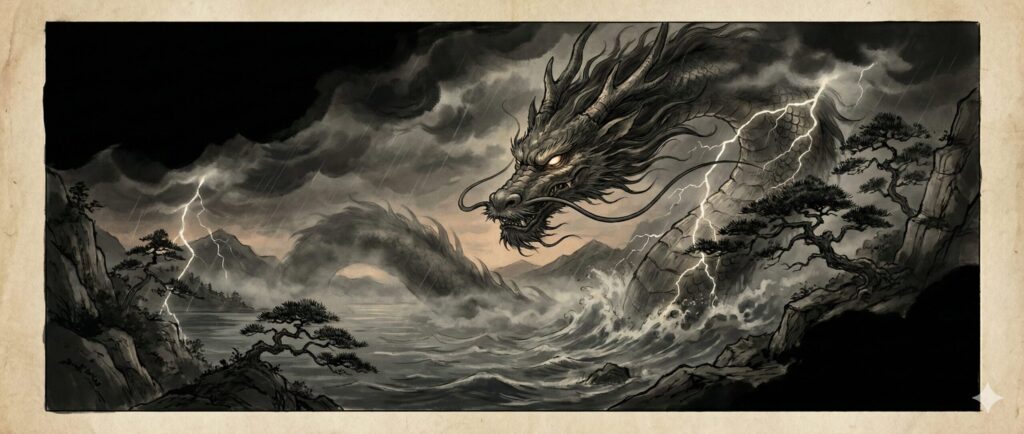
A serpentine dragon governing water and rain.
It embodies divine authority over storms.
Primary Sources
Dragon & Water Deity Lore
- Nihon Shoki (日本書紀)
- Kojiki (古事記)
- Hitachi Fudoki (常陸国風土記)
- Yanagita Kunio — Water and dragon belief studies
- Komatsu Kazuhiko — Yōkai Encyclopedia
Ryū – Divine Serpents of Japanese Folklore
Ryū, the dragons of Japanese folklore, are among the most powerful and revered beings in the mythological landscape of Japan. Unlike Western dragons associated with hoards and destruction, Japanese ryū are primarily water deities — serpentine spirits governing rain, rivers, seas, and the life-sustaining cycles of nature.
Typically depicted as long, sinuous creatures with clawed limbs, flowing whiskers, and jewel-like eyes, ryū move freely between sky and water. They are not merely monsters or animals, but divine forces whose presence shapes weather, fertility, and the fate of entire regions.
Ryū embody authority without cruelty and power without excess — symbols of natural order rather than domination.
Origins and Early Beliefs
The concept of the dragon entered Japan through continental influences from China and Korea, where dragons were already established as celestial and aquatic deities. However, in Japan, the dragon image merged seamlessly with older indigenous beliefs centered on water spirits, serpents, and sacred natural sites.
Ancient Japanese communities depended heavily on rainfall and river systems, making water a central concern of ritual and myth. As a result, ryū became objects of worship rather than fear. Shrines and legends portray them as guardians of springs, lakes, waterfalls, and coastal waters.
Early myths describe dragons dwelling beneath seas or within mountains, emerging only when balance is disrupted or divine intervention is required.
From Water Spirit to Divine Authority
Over time, ryū evolved from localized water spirits into figures of cosmic significance. In classical mythology, they appear as rulers of underwater realms, such as Ryūjin, the Dragon God of the Sea.
Unlike many yokai, ryū are often explicitly divine. They interact with gods, emperors, and heroes, granting boons or enforcing natural law. Their power is vast but measured — floods and storms occur not out of malice, but as consequences of imbalance or disrespect.
This transformation reflects a worldview in which nature itself possesses hierarchy and intention.
Appearance and Form
Japanese dragons are characterized by fluid, elongated bodies designed for movement rather than brute force. Common traits include:
Serpentine bodies without wings
Clawed limbs, usually three-toed
Flowing whiskers and mane-like hair
Horned heads with expressive eyes
Pearls or jewels symbolizing wisdom and power
Their ability to fly without wings underscores their supernatural nature — movement governed by spiritual force rather than physical mechanics.
Ryū and Water
Water defines the ryū’s domain. Dragons control rainfall, tides, currents, and storms, linking them directly to agriculture and survival.
Many legends describe villagers offering prayers and rituals to appease dragons during droughts or floods. Ryū respond not to individual desire, but to collective harmony — emphasizing balance between human activity and natural systems.
This relationship positions the dragon as mediator between humanity and the environment.
Symbolism and Themes
Authority Without Tyranny
Ryū represent rulership that maintains order rather than exploits power.
Fertility and Renewal
As bringers of rain, dragons symbolize growth, harvest, and the continuation of life.
Balance Between Heaven and Earth
Moving freely between sky, land, and water, ryū embody connection across realms.
Sacred Distance
Though benevolent, ryū remain fundamentally otherworldly — revered rather than approached casually.
Related Concepts
Ryūjin (龍神)
Dragon gods of water.
Water Boundary Kami
Spirits governing rivers and seas.
Storm & Rain Folklore
Deities controlling weather.
Ryū in Mythology and Art
Ryū appear prominently in foundational texts such as the Kojiki and Nihon Shoki, as well as in shrine legends and temple iconography.
In art, dragons are commonly depicted:
Coiling through clouds and waves
Emerging from waterfalls or the sea
Encircling sacred jewels
Carved into temple ceilings and shrine gates
These images emphasize motion, flow, and restrained power, shaping the iconic Japanese dragon aesthetic still recognized today.
Regional Variations and Local Legends
Across Japan, specific lakes, rivers, and coastlines are associated with named dragon spirits. Local legends tell of:
Dragons inhabiting mountain lakes
Serpents transformed into divine ryū
Dragons marrying humans or interacting with heroes
Sacred sites protected by dragon guardians
These regional stories root cosmic dragons firmly in local geography, reinforcing their role as place-bound deities.
Modern Cultural Interpretations
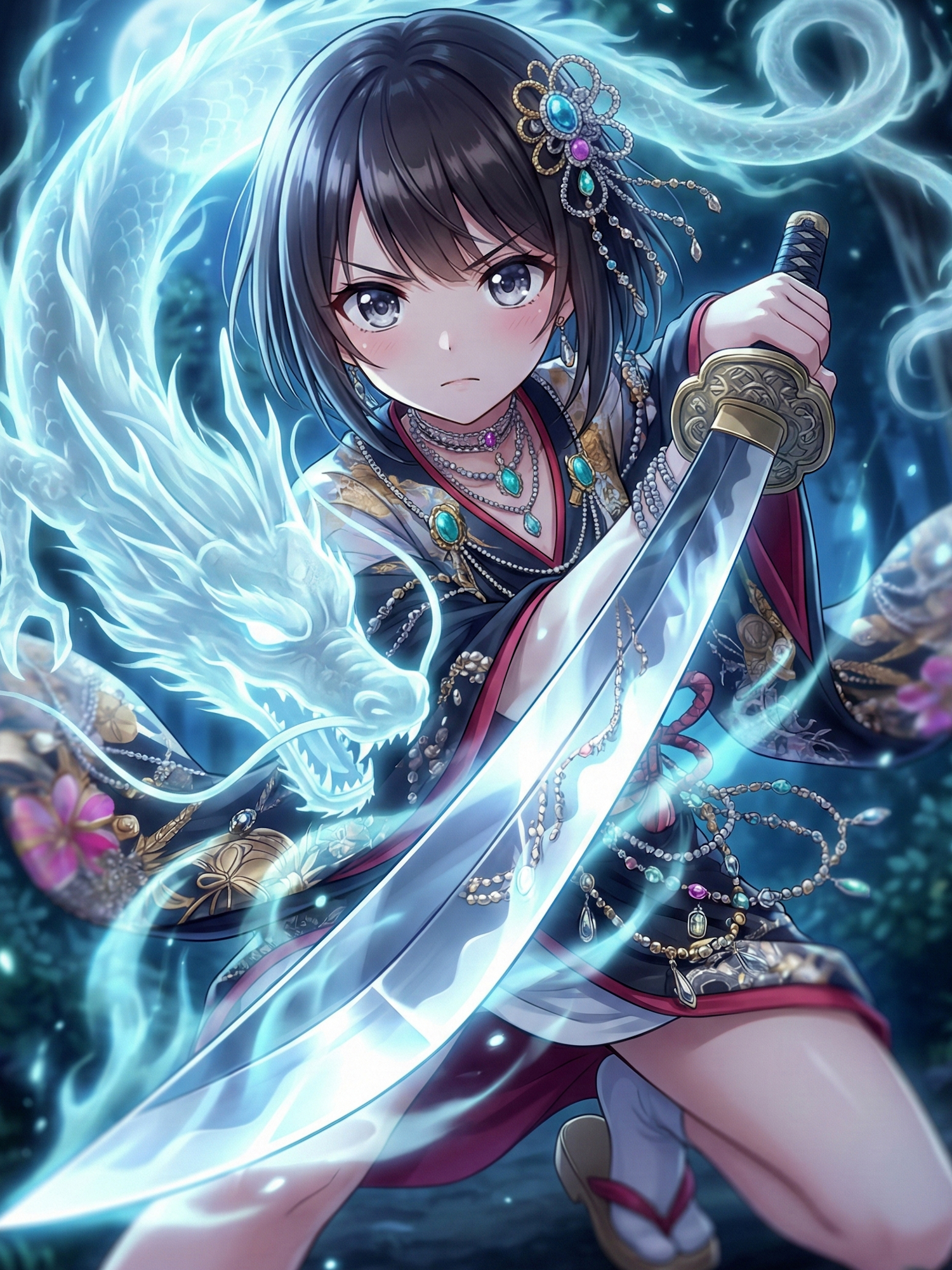
This blade symbolizes sky-water law and divine execution.
It visualizes fate delivered by rain and storm.
In modern media, Japanese dragons are often portrayed as wise, ancient beings rather than mindless beasts. Anime, games, and literature depict them as guardians, teachers, or manifestations of elemental order, distancing them from purely destructive imagery.
Contemporary interpretations emphasize elegance, restraint, and spiritual authority. The dragon is framed not as a conqueror, but as a regulator of balance — an existence that governs flow, weather, and moral alignment rather than domination.
In some modern visual reinterpretations, the dragon is expressed as a yōtō — a blade that embodies harmony rather than aggression. The sword does not hunger for conflict; it moves like a current or a wind, correcting imbalance through precise, minimal action. To wield it is not to command power, but to submit to it.
The dragon endures because harmony itself must be continuously maintained.
Modern Reinterpretation – Ryū as the Spirit of Living Balance
In this reinterpretation, the Ryū is not a destroyer of storms or hoarder of treasures, but the embodiment of flow — the silent equilibrium between movement and restraint. It represents continuity itself: power disciplined by awareness, divinity expressed through harmony.
The “beautiful girl” form translates that philosophy into grace. Her hair and garments drift as if carried by unseen currents, each motion measured and fluid. Her eyes hold the stillness of deep water — reflective, unshaken, yet always alive with motion beneath calm. Around her, faint traces of mist and luminous scales suggest the dragon’s true form residing just beyond perception.
She is not a god to worship, but a rhythm to align with. Her gestures evoke correction rather than command — each movement restoring balance rather than asserting will. The air around her hums with quiet order, the sense that everything excessive is gently reabsorbed into peace.
Her beauty is not ornamental but structural, a symmetry that feels inevitable. She embodies the principle that strength is not the opposite of gentleness — it is its perfected state.
In this visual reinterpretation, the Ryū becomes the spirit of living balance — beauty as order in motion, wisdom given shape, and the infinite patience of water teaching sky how to move.
Musical Correspondence
The accompanying track renders balance as sound. Long, fluid melodies flow between low resonance and bright harmonics, evoking both depth and elevation. Percussion is sparse, entering only where rhythm becomes necessary — never excess, always pulse.
Textures unfold gradually, like ripples that never collide. Drones and sustained tones create a sense of expansion, while subtle shifts in harmony evoke the dragon’s transition between sea and cloud, matter and spirit.
Through restraint, continuity, and luminous balance, the music captures the Ryū’s essence: divinity that moves like breath, order that hums beneath chaos, and the eternal rhythm that sustains the world without needing to rule it.

She embodies sky-water authority and sacred judgment.
Her presence commands rain and departure.
Endless Sky
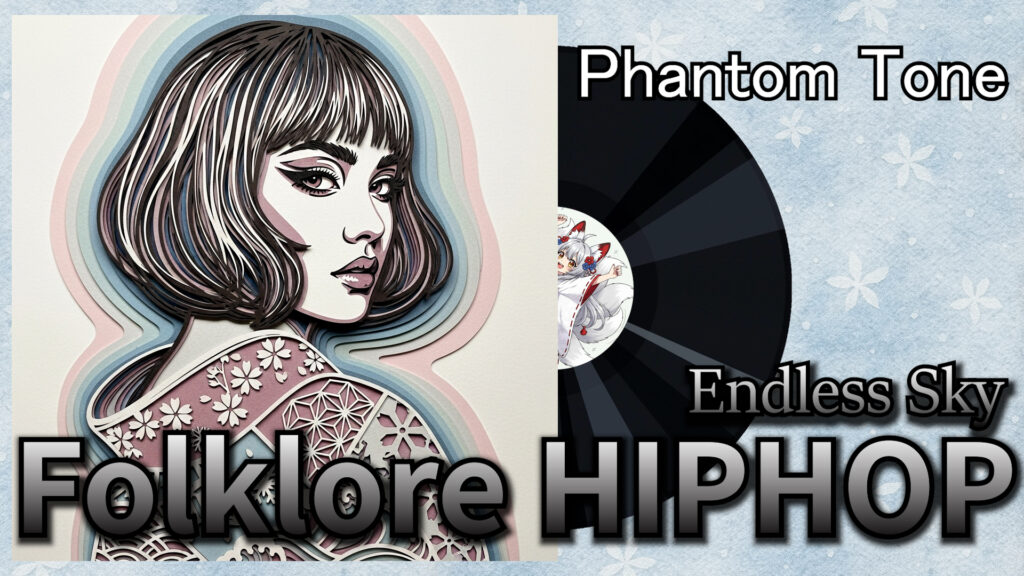
Genre: Japanese Ritual HipHop / AI Art Fusion Produced by: Phantom Tone | Suno AI | Kotetsu Co., Ltd. Tags: #JapaneseHipHop #AIgeneratedMusic #WafuHipHop #Phan…