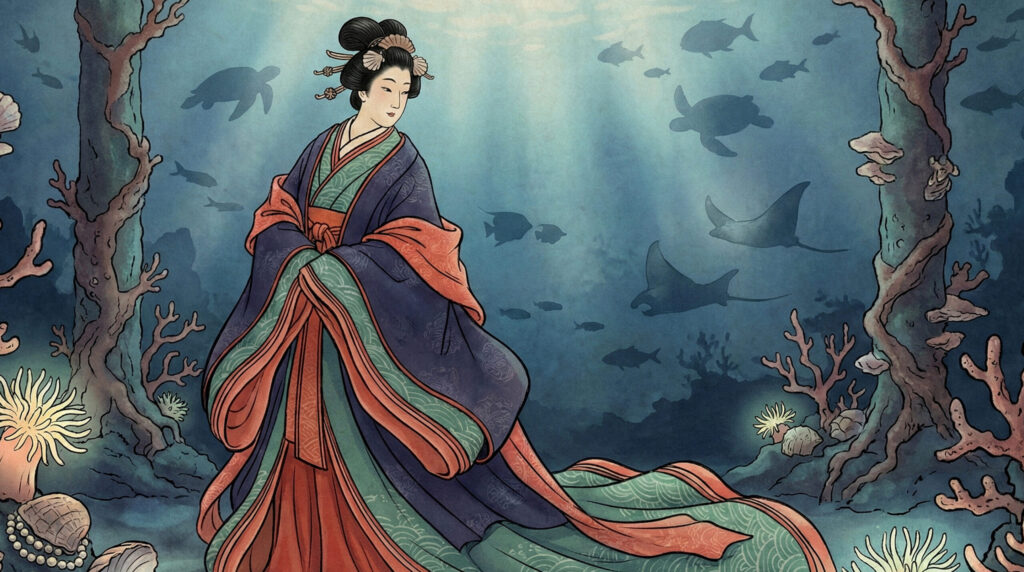
A sea princess of the Dragon Palace.
She governs time and departure.
Primary Sources
Sea Palace & Dragon Court Lore
- Nihon Shoki (日本書紀)
- Urashima Tarō legends
- Yanagita Kunio — Sea deity folklore studies
- Komatsu Kazuhiko — Yōkai Encyclopedia
Otohime – Princess of the Dragon Palace in the Urashima Legend
Otohime is one of the most enigmatic female figures in Japanese folklore: the Dragon Palace princess who welcomes Urashima Tarō into an undersea realm beyond time. Unlike monstrous yōkai or moral enforcers, Otohime embodies beauty, hospitality, and profound otherworldliness. Her presence transforms a simple folktale into a meditation on time, loss, and the cost of crossing into a realm not meant for humans.
Often depicted as serene, graceful, and emotionally composed, Otohime does not threaten or deceive overtly. Yet her kindness is inseparable from irreversible consequence. Through her, the legend of Urashima Tarō shifts from adventure to tragedy—one defined not by punishment, but by quiet separation from the human world.
Otohime represents the allure of the eternal and the sorrow of return.
Origins and Mythological Background
The Urashima Tarō legend appears in early Japanese texts such as the Nihon Shoki and later medieval folktale collections. While Urashima himself is a fisherman or hunter, Otohime belongs unmistakably to the realm of the sea gods, often identified with the Dragon Palace (Ryūgū-jō).
Her origins are layered. She may be interpreted as a daughter of the Dragon King, a sea deity, or a personification of the ocean’s benevolence and danger. Over time, her character absorbed elements of courtly aesthetics, Buddhist impermanence, and Shinto ideas of otherworldly realms.
Unlike many folklore figures, Otohime does not evolve into multiple forms. Her role remains consistent: she is the guardian of a timeless domain and the one who bridges it briefly to the human world.
Appearance and Courtly Grace
Traditional depictions of Otohime emphasize elegance rather than supernatural power:
Flowing robes resembling Heian court attire
Calm, gentle facial expression
Measured, formal speech
Surroundings of coral, jade, and luminous sea life
She is rarely shown performing magic directly. Her authority is implicit, conveyed through composure and environment rather than action. This restraint reinforces her role as a figure of order within the otherworld, not a chaotic force.
Her beauty is not seductive in a dangerous sense, but serene and distant—inviting without promising permanence.
The Dragon Palace as Timeless Space
The realm Otohime inhabits exists outside human time. In the Dragon Palace, days feel like moments, and joy seems endless. This temporal distortion is central to her character.
Otohime does not explain this difference in time explicitly. She offers hospitality, celebration, and companionship, allowing Urashima to forget the flow of his own world. In doing so, she reveals the core danger of the otherworld: not suffering, but detachment.
Her palace is not a trap, but it is incompatible with human life.
Gift, Farewell, and Silent Warning
One of the most crucial moments in the legend is Otohime’s farewell gift—the mysterious box (tamatebako). She warns Urashima never to open it, yet offers no explanation.
This act encapsulates her role. She does not forbid his return, nor does she prevent his choice. She gives him the means to leave, along with an implicit boundary he cannot fully understand.
When the box is opened and time collapses upon him, Otohime is absent. Her power is not punitive; it is structural. The rules of the otherworld apply regardless of intent.
Otohime and Emotional Distance
Unlike many folklore heroines, Otohime does not follow Urashima, mourn openly, or intervene after his fate is sealed. This emotional distance is essential to her symbolism.
She is not cruel, but she is not human. Her affection exists within the logic of her realm. What feels like love or kindness to Urashima is, from her perspective, a momentary crossing of boundaries.
This asymmetry defines the tragedy: human attachment meets eternal indifference—not malicious, but absolute.
Symbolism and Themes
The Allure of the Eternal
Otohime represents a world free from decay, effort, and urgency.
Time as Separation
Her realm exposes the incompatibility between human life and timeless existence.
Kindness Without Rescue
She offers hospitality, not salvation.
The Cost of Crossing Worlds
Contact with the otherworld leaves permanent traces.
Related Concepts
Ryūgū (竜宮)
Dragon Palace of the sea.
Watatsumi (海神)
Ocean deity.
Time Distortion Folklore
Legends of lost time.
Otohime in Art and Cultural Memory
Otohime has been depicted for centuries in paintings, scrolls, Noh-influenced imagery, and later popular media. Artists emphasize stillness, symmetry, and refinement, often placing her at the center of luminous underwater scenes.
Her image became a symbol of unreachable beauty—something remembered more than possessed. In many retellings, she is less a character than an atmosphere: the feeling of having touched something perfect and lost it forever.
Modern Cultural Interpretations

This blade symbolizes sealed return and temporal exile.
It visualizes fate that cannot go back.
Modern interpretations of Otohime often emphasize melancholy rather than fantasy. She may be framed as a symbol of nostalgia, lost youth, or the impossibility of returning unchanged from transformative experiences.
Some contemporary retellings attempt to humanize her emotions, but the traditional power of her character lies in restraint. She remains compelling precisely because she does not explain herself.
In some modern visual reinterpretations, Otohime manifests as a yōtō — a blade sealed within lacquered shells. The sword carries the finality of farewell rather than the promise of return.
Otohime endures as a figure of quiet finality.
Modern Reinterpretation – Otohime as the Spirit of Irreversible Beauty
In this reinterpretation, Otohime is not a goddess of oceanic fantasy, but the embodiment of transience made divine — the serene awareness that beauty gains meaning only through its departure. She is the pause before memory, the quiet that follows perfection.
The “beautiful girl” form conveys this ethereal melancholy with grace refined to stillness. Her garments shimmer like the inner lining of a shell, colors shifting with each movement as though reflecting unseen tides. Her expression holds both welcome and farewell — a softness that never resolves into possession.
She does not speak; she allows time to slow around her. The air itself seems filtered through distance, her presence dissolving into the rhythm of waves. To behold her is to sense inevitability — that every meeting is already a goodbye, and every touch already part of loss.
Her beauty carries no promise, only permanence through absence. In her silence, she teaches that eternity and love are incompatible not by cruelty, but by design.
In this visual reinterpretation, Otohime becomes the spirit of irreversible beauty — grace suspended in waterlight, emotion refined into memory, and a farewell so gentle it feels like peace.
Musical Correspondence
The accompanying track translates stillness into melody. Flowing strings and echoing piano lines drift with the fluid rhythm of the tide, while long, sustained harmonies evoke the deep calm beneath the sea’s surface.
Soft ambient textures rise and dissolve like bubbles ascending through silence. Each tone fades before resolution, mirroring the inevitability of parting. The tempo remains unhurried — as if sound itself resists moving forward.
Through patience, resonance, and gentle decay, the music captures Otohime’s essence: beauty that exists only through its passing, serenity intertwined with sorrow, and the eternal hush between meeting and memory.
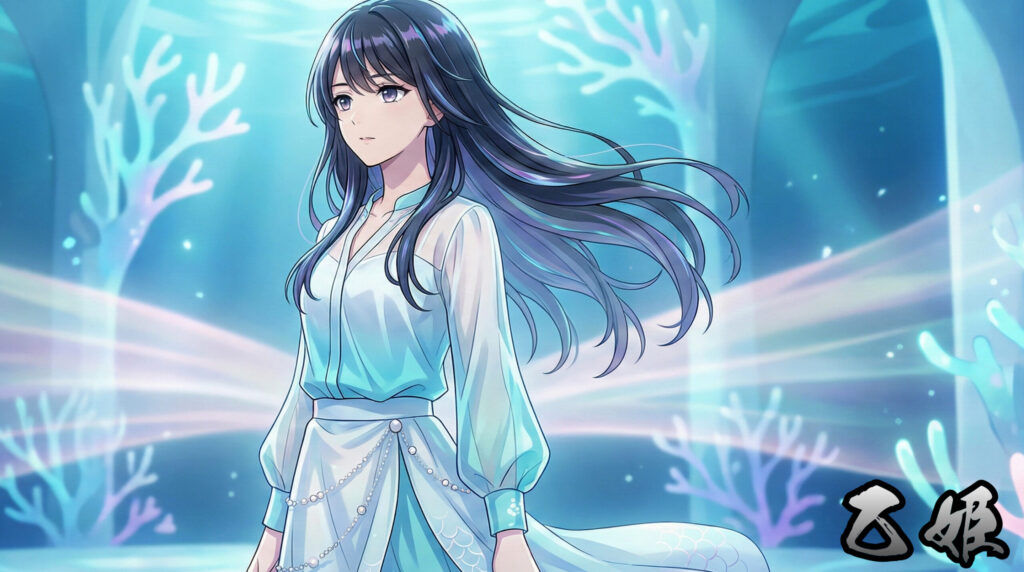
She embodies farewell sealed by time.
Her calm gaze closes return.
Hidden Between Tides
Genre: Japanese Folklore Hip-Hop, Ritual Lo-Fi Poetry Produced by: Phantom Tone | Suno AI | Kotetsu Co., Ltd. Tags: #AIgeneratedMusic #JapaneseHipHop #Folklore…
Dreamy and stylish
Genre: Ritual Japanese HipHop / Darkwave Folklore Produced by: Phantom Tone | Suno AI | Kotetsu Co., Ltd. Tags: #JapaneseHipHop #AIgeneratedMusic #Yokai #Phant…