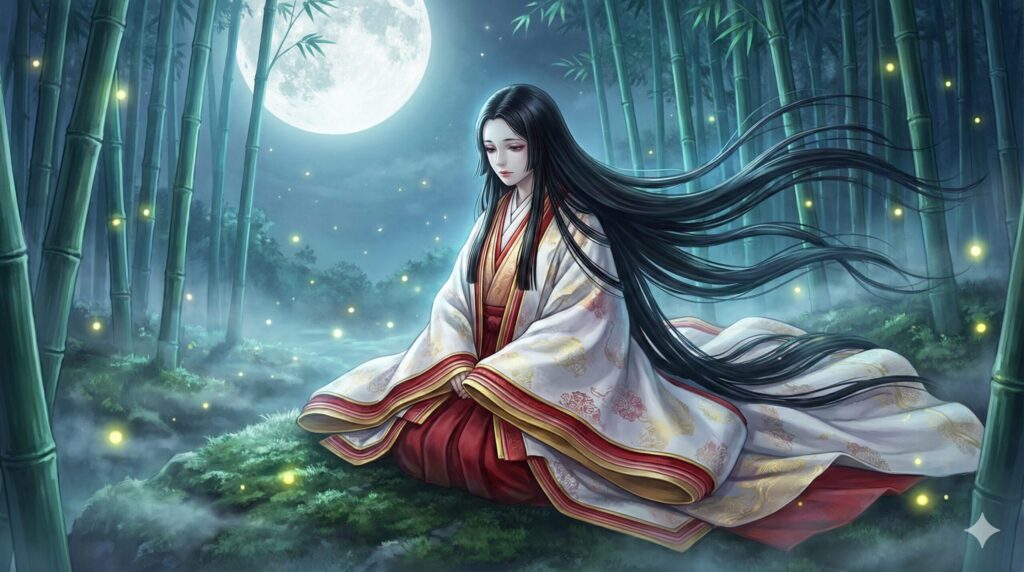
A luminous maiden discovered within a bamboo stalk.
She embodies beauty destined to depart.
Primary Sources
Classical Tale & Celestial Origin Lore
- Taketori Monogatari (竹取物語)
- Heian-period literary commentaries
- Yanagita Kunio — Folklore interpretations of celestial visitors
- Komatsu Kazuhiko — Yōkai Encyclopedia (conceptual classifications)
Kaguya-hime – The Moon-Born Maiden of Japanese Folklore
Kaguya-hime is one of the most enduring and enigmatic figures in Japanese folklore: a celestial maiden discovered inside a glowing bamboo stalk, whose beauty and otherworldly presence captivate all who encounter her. Unlike yōkai that terrify or deceive, Kaguya-hime inspires longing, obsession, and quiet sorrow. Her story unfolds not through violence or spectacle, but through emotional distance—an unbridgeable gap between the human world and the realm beyond it.
Often remembered as a tragic princess, Kaguya-hime occupies a liminal position between myth, fairy tale, and cosmic allegory. She is neither spirit nor goddess in a strict sense, yet her origin lies beyond Earth. Her tale explores impermanence, unattainable desire, and the quiet cruelty of fate, making her one of the most psychologically resonant figures in Japanese narrative tradition.
Origins and Early Depictions
The earliest and most authoritative source of Kaguya-hime’s story is Taketori Monogatari (The Tale of the Bamboo Cutter), generally dated to the late 9th or early 10th century. It is widely considered the oldest surviving work of Japanese prose fiction.
According to the tale, an elderly bamboo cutter discovers a tiny radiant girl inside a stalk of bamboo. She grows rapidly into a woman of unparalleled beauty. Her presence brings wealth and fortune to the old couple, yet her origins remain mysterious. Though she lives among humans, she never fully belongs to them.
Early depictions emphasize her luminosity and restraint. Kaguya-hime is rarely portrayed as emotionally expressive; instead, she embodies distance, silence, and inevitability. This restraint reinforces her role as a being whose true home lies elsewhere.
From Earthly Beauty to Celestial Being
As the story unfolds, Kaguya-hime attracts numerous noble suitors, including powerful aristocrats and eventually the Emperor himself. Yet she rejects all of them, setting impossible tasks that expose human arrogance, obsession, and the futility of attempting to possess what is not meant to remain.
Her rejection is not cruel in intent but absolute in outcome. Kaguya-hime does not deceive for pleasure; she enforces the boundary between worlds. When her celestial origins are finally revealed, she must return to the Moon, regardless of human sorrow or imperial authority.
This transformation—from miraculous child to unattainable celestial being—marks the emotional core of her legend. The tragedy lies not in death, but in separation.
Kaguya-hime and the Lunar Realm
The Moon in Japanese literature often symbolizes impermanence, detachment, and the distant purity of another realm. Kaguya-hime’s connection to the Moon reinforces these themes. When lunar beings descend to reclaim her, they do so without malice or negotiation. Their authority is absolute, impersonal, and final.
Kaguya-hime herself shows sorrow but no resistance. Her return to the Moon requires her to abandon earthly attachments, including memory and emotion. In some interpretations, the celestial robe she wears erases human feeling entirely—a symbolic shedding of worldly suffering.
Symbolism and Themes
Impermanence and Separation
Kaguya-hime’s story reflects the Buddhist concept of impermanence (mujō). All joy, love, and attachment are temporary, destined to end without exception.
Unattainable Desire
The suitors’ failures illustrate the futility of attempting to claim what lies beyond one’s nature or station. Desire itself becomes a source of suffering.
The Boundary Between Worlds
Kaguya-hime exists on the threshold between Earth and the Moon, human and celestial. Her tragedy is not moral but structural—she cannot remain where she is loved.
Quiet Authority
Unlike aggressive deities or yōkai, Kaguya-hime embodies a gentle yet unyielding authority. Her fate is enforced not by force, but by cosmic order.
Related Concepts
Celestial Visitor Motif
Beings arriving from other realms.
Marebito (稀人)
Sacred outsiders who bring transformation.
→Marebito
Impermanence Folklore
Beauty and loss bound to time.
Kaguya-hime in Literature and Art
Kaguya-hime has been depicted for centuries in emakimono (illustrated scrolls), paintings, and later woodblock prints. Artists often portray:
- the glowing bamboo discovery,
- her refined presence among courtiers,
- the impossible quests of her suitors,
- the silent descent of lunar emissaries.
Visually, she is associated with elegance, light, and distance rather than supernatural terror. Her imagery shaped later portrayals of celestial maidens (tennin) and lunar beings in Japanese art.
Regional and Cultural Influence
Although rooted in a courtly literary tradition, Kaguya-hime’s story spread widely and influenced regional folklore, poetry, and ritual symbolism. The tale has been reinterpreted through Buddhist, Shinto, and secular lenses, each emphasizing different aspects: moral instruction, cosmic order, or emotional tragedy.
Her narrative also influenced later stories involving otherworldly brides, impossible tasks, and lovers separated by supernatural law.
Modern Cultural Interpretations

This blade symbolizes unattainable purity and inevitable separation.
It visualizes beauty that cannot remain.
In modern literature, animation, and music, Kaguya-hime is frequently reimagined as a symbol of isolation, unreachable beauty, and the pain of inevitable departure.
Contemporary interpretations often highlight her lack of agency within cosmic rules, the emotional cost of purity and transcendence, and the Moon as a metaphor for emotional distance and alienation.
In some modern visual reinterpretations, Kaguya-hime manifests as a yōtō — a blade that reflects moonlight without warmth. The sword glows with unattainable beauty, embodying longing rather than conquest.
Despite stylistic changes, her core themes remain intact.
Modern Reinterpretation – Kaguya-hime as the Spirit of Celestial Distance
In this reinterpretation, Kaguya-hime is not merely the moon princess of legend, but the embodiment of unattainable connection — a luminous presence defined by separation. She represents beauty as distance, love as memory, and perfection as something that must remain untouched to endure.
The “beautiful girl” form captures this serenity through ethereal stillness. Her attire glows faintly like woven moonlight, and her expression carries the calm of someone who has already accepted farewell. Around her, air shimmers in soft gradients — neither warm nor cold, as though emotion itself has entered orbit.
She is not sorrowful, yet she is never free from longing. Every gesture feels suspended in time, the poise of a being who lives in perpetual parting. Her radiance is not invitation but reflection — the light that remains after presence departs.
She embodies the silence between closeness and distance, reminding that divinity is not above humanity, but parallel to it — visible, unreachable, and always returning at the edge of memory.
In this visual reinterpretation, Kaguya-hime becomes the spirit of celestial distance — beauty too complete to remain, and emotion purified into light that refuses ownership.
Musical Correspondence
The accompanying track translates her remoteness into tone. Slow, luminous melodies drift over suspended harmonies, evoking the rhythm of breath beneath starlight. Gentle reverberation gives each note the illusion of distance — sound that shines, then fades before arrival.
Soft traditional instruments, such as koto or shakuhachi, intertwine with ambient textures, forming a soundscape that feels both ancient and infinite. Each cadence dissolves into unresolved quiet, mirroring her final ascent back to the moon.
Through restraint, stillness, and radiance, the music captures Kaguya-hime’s essence: the grace of departure, the pain of permanence, and the faint glow of memory that outlasts every goodbye.
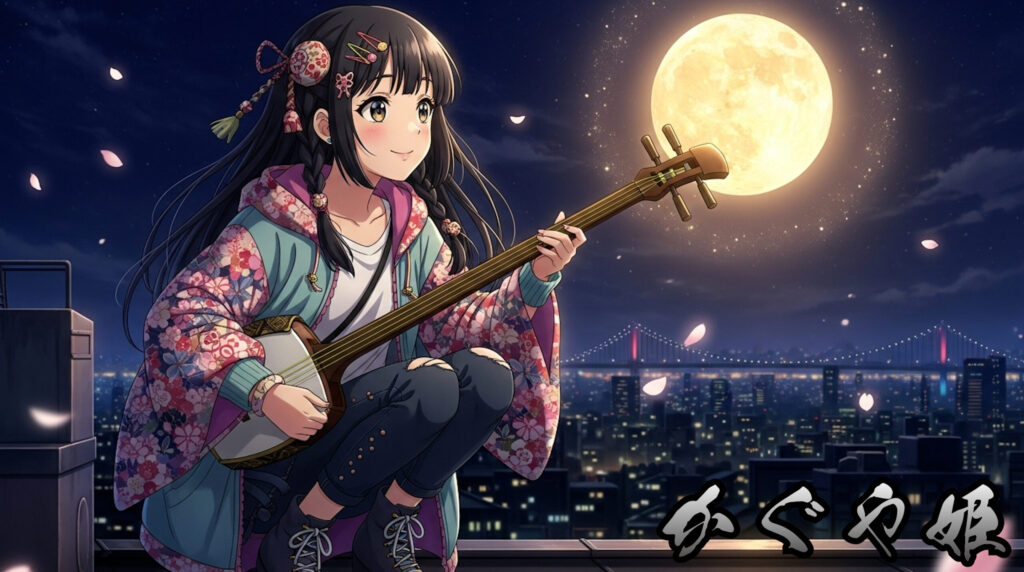
She embodies celestial distance and gentle loss.
Her presence fades the moment attachment forms.
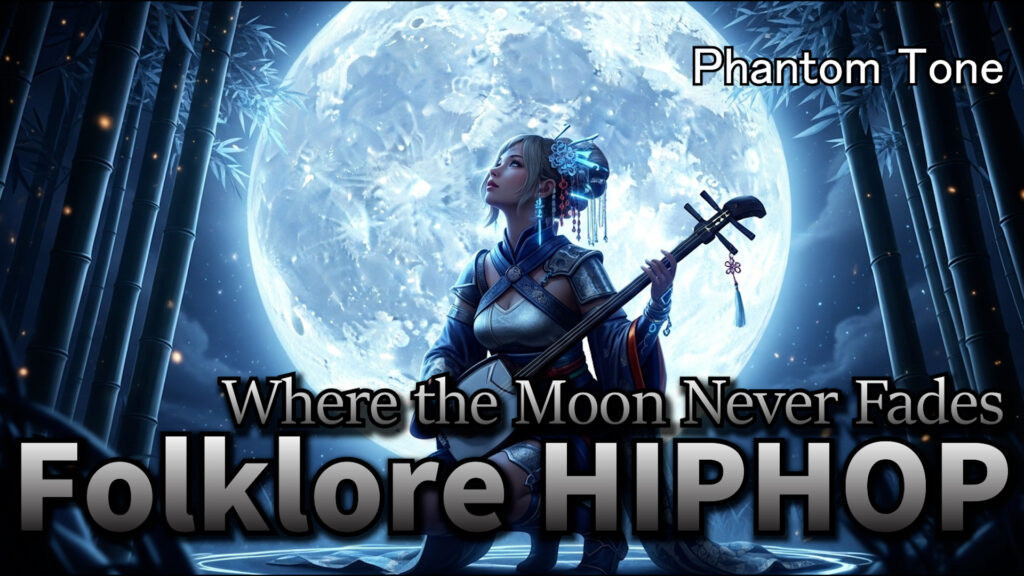
Where the Moon Never Fades
Genre: Japanese Folklore HipHop / Ethereal Lo-Fi Ballad Produced by: Phantom Tone | Suno AI | Kotetsu Co., Ltd. Tags: #AIgeneratedMusic #JapaneseHipHop #Phanto…