
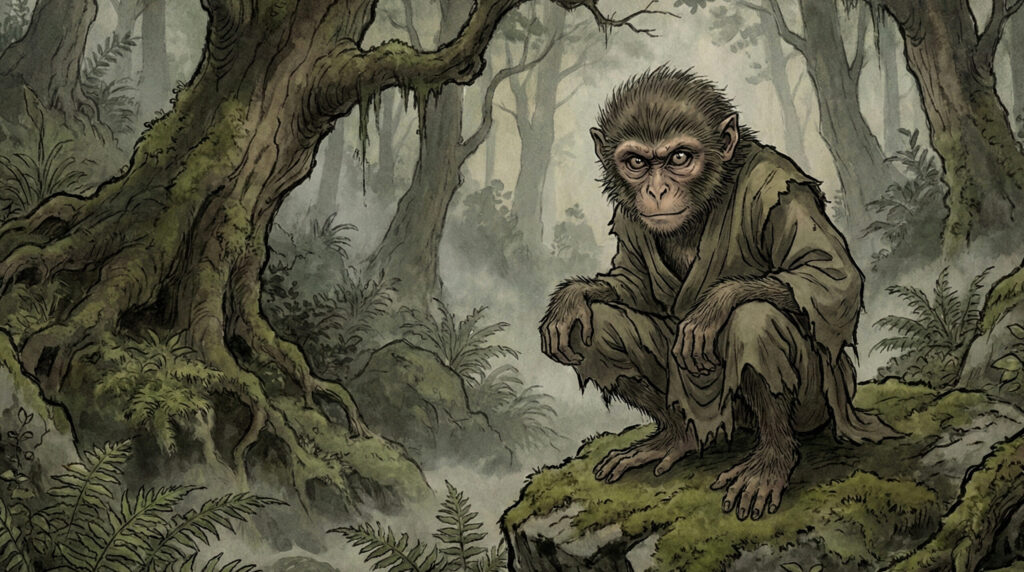
A mountain spirit that reads thoughts.
It kills by revealing intent.
Primary Sources
Mind-Reading & Mountain Folklore
- Yanagita Kunio — Mountain spirit belief studies
- Komatsu Kazuhiko — Yōkai Encyclopedia
- Regional mountain pass folklore collections
Satori – Mind-Reading Mountain Anomalies in Japanese Folklore
Satori(覚) are mountain-dwelling anomalies in Japanese folklore distinguished not by physical violence or deception, but by their ability to read human thoughts directly. Unlike yokai that act through illusion, possession, or transformation, satori confront humans at the level of inner speech and unspoken intention.
They are not teachers of enlightenment, despite the shared character 覚. Rather, satori are unsettling presences that expose the vulnerability of the human mind when removed from social and ritual protection—deep in the mountains.
Origins and Folkloric Context
Accounts of satori appear in regional folklore and later compilations, particularly associated with mountainous areas where human presence is sparse and vigilance is required. These narratives describe encounters with beings that:
- Respond before a question is spoken
- Reveal thoughts the person intended to keep hidden
- Undermine the sense of mental privacy
Satori are thus defined not by appearance, but by cognitive intrusion. The mountain setting reinforces this, as isolation strips away the social buffers that normally protect the self.
The Mountain as a Space Without Mental Shelter
In Japanese folk belief, the village is a place of shared language, norms, and mutual surveillance. The mountain, by contrast, is a zone where:
- Words are unnecessary
- Intent precedes action
- The self is exposed
Satori belong to this environment. They do not chase or attack; they wait for the human mind to reveal itself. The fear they generate comes from the realization that thought itself is no longer private.
Distinction from Religious “Awakening”
Despite the shared character 覚, satori yokai are explicitly non-religious in function.
- Buddhist awakening is achieved through discipline and insight
- Satori yokai impose awareness involuntarily
- Enlightenment liberates; satori exposure destabilizes
This contrast is crucial. Satori are not spiritual guides but anomalies that invert sacred concepts, turning insight into threat.
Mechanism of Fear – Thought as Liability
Satori operate through a simple but devastating mechanism:
- The human thinks
- The satori responds
- The human realizes concealment is impossible
At this moment, fear escalates—not because of what the satori does, but because nothing can be hidden. Even hostile intent becomes dangerous, as it is immediately known.
Relationship to Other Mountain Anomalies
Satori occupy a unique position among mountain-related beings.
- Tengu test skill and pride
- Ōgumo hunt through ambush
- Yamako represent functional presence
Satori alone target the mind itself, making them anomalies of cognition rather than space or body.
Symbolism and Cultural Meaning
Fear of Inner Exposure
Satori embody anxiety about one’s true thoughts being revealed—resentment, fear, or intent that social life keeps hidden.
Discipline of Thought
Some interpretations suggest satori encounters warn against careless thinking. In the mountains, thought itself must be controlled.
The Non-Human Mind
Satori imply a consciousness that does not rely on language, suggesting intelligence that bypasses human norms entirely.
Related Concepts
Mind-Reading Yōkai
Beings that read human thoughts.
Mountain Pass Spirits
Yōkai guarding dangerous crossings.
Psychological Fear Motif
Spirits exposing inner intent.
Regional Variation and Narrative Style
Descriptions of satori vary, but consistently lack detailed physical form. This absence reinforces their nature as mental rather than visual threats.
Encounters are often brief, unresolved, and end with retreat—human withdrawal rather than yokai departure.
Modern Cultural Interpretations

This blade symbolizes exposed intent and mental execution.
It visualizes death triggered by thought.
In modern readings, satori are sometimes interpreted as metaphors for anxiety over surveillance, loss of mental autonomy, and the fear of being understood too well.
These interpretations align with traditional logic, which treats privacy of thought as conditional rather than guaranteed.
In some modern visual reinterpretations, satori manifest as a yōtō — a blade that reflects thought before motion. The sword appears to answer intention itself, unsettling those who attempt to act without concealment.
Satori persist because inner worlds still feel exposed.
Modern Reinterpretation – Satori as the Spirit of Exposed Thought
In this reinterpretation, the Satori is not a creature of malice, but the embodiment of radical transparency — the dissolution of privacy where even silence confesses intention. It is the terror of being seen too clearly, of thought no longer belonging solely to the self.
The “beautiful girl” form captures this psychic intimacy with poised unease. Her gaze is direct yet unreadable, reflecting the thoughts of those who meet it rather than her own. Around her, faint mirrored surfaces shimmer in the air, bending perception like liquid glass — every movement an echo of someone else’s mind.
She does not invade; she receives. The space around her feels weightless, yet inescapably aware — a room where even unspoken emotion finds reflection. Her expression carries both empathy and inevitability, the calm of one who knows everything and forgives nothing because nothing can be hidden.
She is not a voyeur, but a mirror made sentient — the boundary between self and observer dissolved into quiet revelation. Her beauty is unsettling not for what it shows, but for how effortlessly it understands.
In this visual reinterpretation, the Satori becomes the spirit of exposed thought — beauty that listens too well, presence that completes your sentence before you speak, and the haunting grace of consciousness folded back upon itself.
Musical Correspondence
The accompanying track translates awareness into sound. Delayed echoes and reflected motifs create the illusion of music listening to itself — melodies anticipating their own response. Sparse tones emerge and return, forming dialogues rather than sequences.
Moments of silence stretch like breath held in recognition, while subtle dissonances mimic thought colliding with its reflection. The tempo remains suspended, resisting progression, as if the piece itself is caught between idea and realization.
Through anticipation, mirroring, and restrained resonance, the music captures Satori’s essence: awareness made audible, intimacy turned invasive, and the fragile stillness of a mind no longer alone.

She embodies exposed intent and psychological judgment.
Her calm gaze knows your thought first.
Dreamy and stylish
Genre: Ritual Japanese HipHop / Darkwave Folklore Produced by: Phantom Tone | Suno AI | Kotetsu Co., Ltd. Tags: #JapaneseHipHop #AIgeneratedMusic #Yokai #Phant…