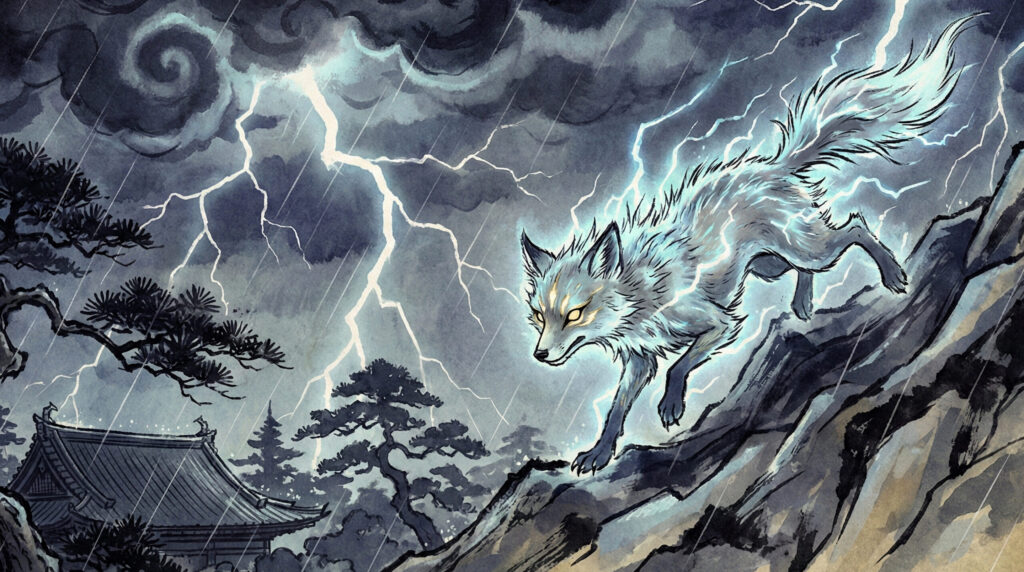
A beast of thunder that rides lightning.
It causes sudden death.
Primary Sources
Thunder Beast & Storm Folklore
- Nihon Shoki (日本書紀)
- Yanagita Kunio — Thunder spirit belief studies
- Komatsu Kazuhiko — Yōkai Encyclopedia
- Regional storm folklore collections
Raijū – Thunder Beasts at the Boundary of Nature and Yokai in Japanese Folklore
Raijū(雷獣) are mythical creatures associated with thunder and lightning, positioned at the intersection of natural phenomenon and yōjū (妖獣, supernatural beasts) in Japanese folklore. Unlike spirits driven by emotion or narrative grievance, raijū embody raw atmospheric force given animal form.
They are not merely monsters born from imagination, nor are they simple personifications of storms. Raijū function as explanatory intermediaries, translating the overwhelming power of thunder into a form that can be described, feared, and ritually acknowledged.
Thunder as Living Force
In premodern Japan, thunder was not understood as a purely physical process. It was sudden, violent, and destructive, capable of killing people, burning buildings, and igniting fires without visible cause. Such power demanded interpretation.
Raijū emerge from this need. Thunder is not abstract noise—it moves, strikes, and chooses targets. Folklore renders this agency visible by imagining thunder as a creature racing across the sky or leaping from cloud to earth.
Form and Variability of Raijū
Descriptions of raijū vary widely by region and text. They are often described as:
- Small, fast-moving beasts
- Creatures resembling dogs, wolves, weasels, or rodents
- Entities composed of light, sparks, or crackling energy
This variability is not inconsistency but function. Raijū are defined less by anatomy than by behavioral association with thunder—speed, unpredictability, and destructive contact.
Relationship with Raijin
Raijū are frequently linked to Raijin, the thunder deity. In many traditions, raijū are said to:
- Accompany Raijin
- Serve as his manifestations or extensions
- Fall to earth during thunderstorms
This relationship mirrors hierarchical cosmology: Raijin represents controlled divine force, while raijū represent released, roaming energy.
Raijū as Natural-Anomalous Beings
Raijū occupy a distinct category:
- They are not kami, as they lack ritual personality
- They are not yokai of mischief or narrative intent
- They are not animals, despite animal form
They are best understood as natural-anomalous beings—creatures that exist to bridge observation and belief. When lightning strikes unexpectedly or thunder behaves erratically, raijū provide a language for that deviation.
Interaction with the Human Body
One of the most striking aspects of raijū folklore is their supposed attraction to human bodies, particularly during sleep. Some traditions claim raijū seek:
- Warmth
- Stillness
- The human navel or abdomen
These beliefs reflect vulnerability during storms and anxiety about being struck indoors. Protective customs—sleeping face-down or placing metal objects nearby—functioned as folk risk management, not superstition alone.
Symbolism and Cultural Meaning
Nature Given Form
Raijū transform an invisible force into a visible agent, making nature intelligible without diminishing its power.
Speed and Uncontainability
Their rapid movement mirrors lightning itself—appearing, striking, and vanishing before comprehension.
Fear Without Moral Judgment
Raijū are not punishers. They do not target the wicked. They strike indiscriminately, reinforcing the idea that nature’s danger is amoral.
Related Concepts
Thunder Kami (雷神)
Deity of storms.
Storm Beast Motif
Animal-shaped lightning spirits.
Sky Boundary Spirits
Beings governing upper realms.
Later Developments and Popular Imagery
In later art and modern media, raijū are often stylized into recognizable beast forms. While visually engaging, these representations tend to stabilize what was originally fluid and unstable.
A folkloric reading preserves raijū as conceptual creatures, whose form shifts according to the storm that produces them.
Modern Cultural Interpretations
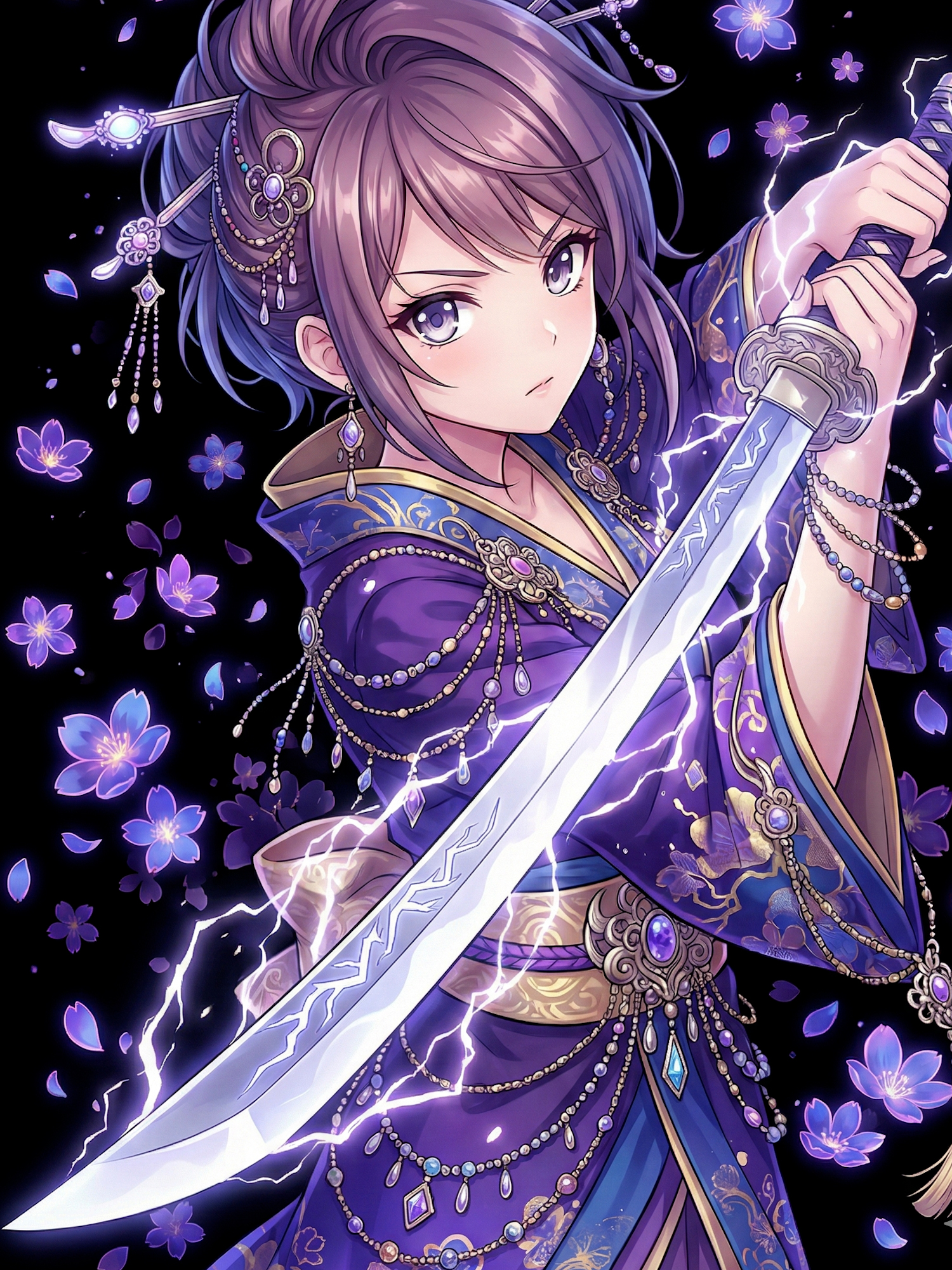
This blade symbolizes sky execution and lightning law.
It visualizes death delivered by storm.
In modern cultural readings, Raijū is often interpreted as a personification of uncontrolled energy — systems that surge, overload, and collapse beyond human command.
Psychologically, Raijū represents sudden emotional discharge: bursts of anger, panic, or inspiration that strike without warning and vanish just as quickly.
In some modern visual reinterpretations, Raijū manifests as a yōtō — a blade that crackles with unstable light. The sword does not store power; it releases it, turning momentum itself into its cutting edge.
Raijū persists because energy still escapes control.
Modern Reinterpretation – Raijū as the Spirit of Unbound Energy
In this reinterpretation, Raijū is not a monster of destruction, but the embodiment of energy freed from containment — the instant when motion outpaces intention, when force itself becomes consciousness. It is the wild voltage of emotion, the pulse that refuses to be managed.
The “beautiful girl” form captures that volatility through radiance in tension. Lightning arcs trace the edges of her silhouette, flashing like veins of living current. Her hair moves as though in permanent stormlight, each strand alive with charge. Her expression balances serenity and chaos — the calm that exists one breath before eruption.
She does not attack; she releases. Her presence feels electric, her proximity a test of control. Around her, air hums and fractures, suggesting that she is less a figure than a field — the brief consciousness of thunder remembering itself.
Her beauty lies in impermanence: brilliance that cannot last, illumination that destroys the darkness it defines. She is creation and collapse in the same instant — a phenomenon too alive to be contained by form.
In this visual reinterpretation, Raijū becomes the spirit of unbound energy — beauty charged with instability, emotion expressed as voltage, and existence that blazes only by vanishing.
Musical Correspondence
The accompanying track transforms lightning into rhythm. Sharp, percussive bursts and distorted pulses simulate voltage escaping control, while sudden silences stretch anticipation to its breaking point. The sound is kinetic — movement without pattern, brilliance without repetition.
Metallic textures and brief harmonic flashes suggest both circuitry and sky, the intersection of natural and synthetic force. The composition thrives on contrast: intensity born from stillness, explosion followed by echo.
Through dissonance, fracture, and fleeting clarity, the music captures Raijū’s essence: the storm’s heartbeat, the mind’s electric impulse, and the beautiful violence of energy remembering it was never meant to stay still.
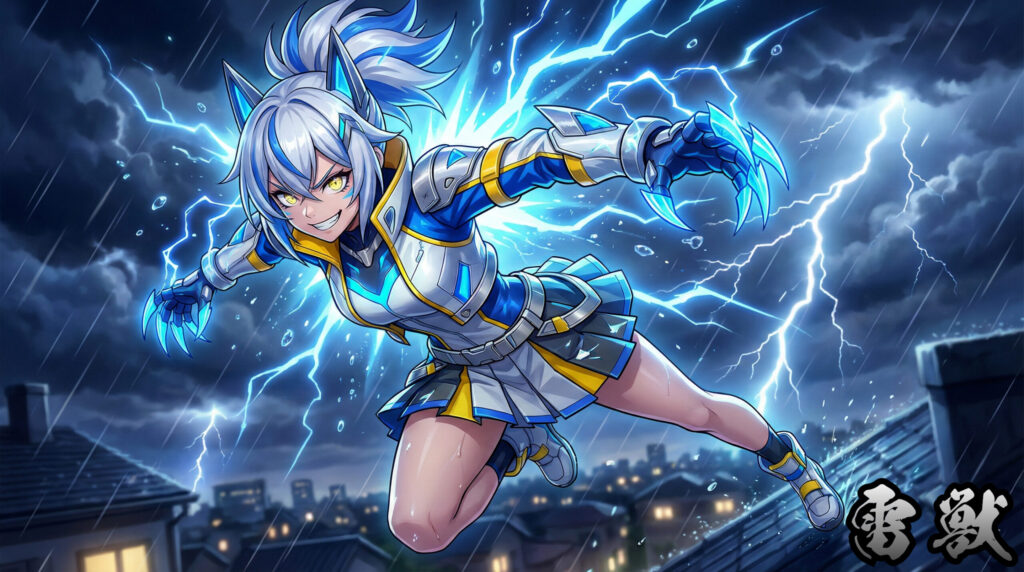
She embodies sky-bound judgment and lightning fate.
Her presence crackles with silent thunder.
Dreamy and stylish
Genre: Ritual Japanese HipHop / Darkwave Folklore Produced by: Phantom Tone | Suno AI | Kotetsu Co., Ltd. Tags: #JapaneseHipHop #AIgeneratedMusic #Yokai #Phant…