
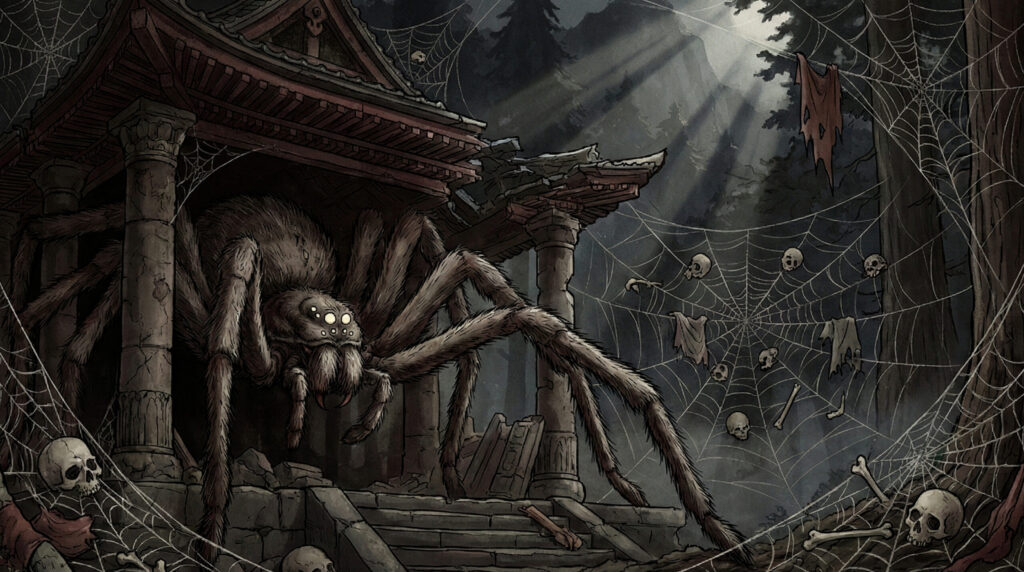
A colossal spider demon haunting caves.
It devours warriors and travelers.
Primary Sources
Giant Spider & Mountain Monster Lore
- Konjaku Monogatari-shū (今昔物語集)
- Heike Monogatari (平家物語)
- Yanagita Kunio — Giant spider folklore records
- Komatsu Kazuhiko — Yōkai Encyclopedia
Ōgumo – Mountain-Dwelling Giant Spiders in Regional Japanese Folklore
Ōgumo(大蜘蛛) refers to a broad class of giant spider entities found in regional Japanese folklore, particularly associated with mountainous and forested environments. While frequently conflated with Jorōgumo(女郎蜘蛛), ōgumo represent a separate folkloric axis, rooted in older, non-seductive, and often non-anthropomorphic conceptions of danger.
Ōgumo are not defined by transformation into women or by erotic deception. They are mountain anomalies—embodiments of predation, ambush, and territorial threat within landscapes beyond human control.
Ōgumo as a Regional Category
Unlike jorōgumo, which became relatively standardized through Edo-period literature and visual culture, ōgumo remain regionally fragmented. References appear under varying names and descriptions, but share common structural traits:
- Enormous size, often exceeding natural scale
- Association with deep mountains, ravines, caves, or forest interiors
- Direct hostility toward humans or livestock
This fragmentation suggests that ōgumo functioned as localized explanations for danger, rather than as a unified mythic figure.
Distinction from Jorōgumo
Clarifying the separation between ōgumo and jorōgumo is essential.
- Jorōgumo
- Associated with rivers, waterfalls, or inns
- Often transforms into a woman
- Uses deception and seduction
- Strongly literary and performative
- Ōgumo
- Reside in mountains and forests
- Rarely anthropomorphic
- Attack through ambush or entrapment
- Rooted in landscape fear rather than narrative trickery
Ōgumo are predators, not tempters.
Mountain Landscapes and Spider Logic
Mountains in Japanese folklore are spaces of:
- Limited visibility
- Vertical complexity
- Natural traps and dead zones
Spiders, with their web-based hunting and patience, align naturally with these environments. Ōgumo thus represent the mountain as a hunting ground, where danger is static, waiting, and territorial.
The web—whether explicitly described or implied—functions as an extension of the landscape itself.
Ōgumo as Pre-Humanized Threat
Ōgumo belong to a folkloric layer prior to moralization or anthropomorphism. They are not symbols of temptation, punishment, or social critique. They exist to explain:
- Disappearances in the mountains
- Sudden attacks from unseen positions
- Fear of entering territories without human order
Their logic is ecological rather than ethical.
Regional Variations and Transmission
Accounts of giant spiders vary significantly:
- Some describe single, unique entities guarding a mountain
- Others suggest multiple large spiders inhabiting dangerous zones
- Size, color, and behavior shift according to terrain
These variations reinforce that ōgumo are place-bound anomalies, shaped by specific geographies rather than centralized myth systems.
Symbolism and Cultural Meaning
The Mountain as Predator
Ōgumo externalize the idea that mountains themselves hunt. Paths ensnare, cliffs trap, and forests confuse—spider imagery gives this danger form.
Fear Without Negotiation
Unlike dragons or deities, ōgumo cannot be appeased. There is no ritual solution, only avoidance or destruction.
Non-Human Intelligence
Ōgumo suggest an intelligence that is patient and alien—not moral, not communicative, but effective.
Related Concepts
Spider Demon Motif
Enormous predatory spiders.
Mountain Lair Spirits
Yōkai inhabiting caves and ruins.
War & Omen Folklore
Monsters tied to heroic legends.
Later Transformations and Conflation
In later periods, especially through popular culture, ōgumo were increasingly merged with jorōgumo imagery. This fusion often softens their original terror, replacing raw predation with narrative intrigue.
A strict folkloric reading preserves ōgumo as mountain-born threats, distinct from urbanized or eroticized spider yokai.
Modern Cultural Interpretations

This blade symbolizes territorial execution and cave-bound ambush.
It visualizes death waiting in darkness.
In modern cultural readings, Ōgumo is often interpreted as a symbol of systemic entrapment — networks of power that bind, drain, and immobilize without overt violence.
Psychologically, Ōgumo represents slow consumption: the fear of being caught not by force, but by dependency, obligation, and invisible structures that tighten over time.
In some modern visual reinterpretations, Ōgumo manifests as a yōtō — a blade that spins silk-thin filaments from its spine. The sword does not cut immediately; it binds, marking targets long before harm occurs.
Ōgumo persists because invisible webs still govern movement.
Modern Reinterpretation – Ōgumo as the Spirit of Silent Control
In this reinterpretation, Ōgumo is not merely a monster of size, but the embodiment of unseen governance — the beauty of stillness masking the terror of inevitability. She is the spider that does not chase, because the world already moves within her design.
The “beautiful girl” form channels this dominance through composure. Her expression is calm, her posture deliberate, her elegance immaculate. Fine threads shimmer faintly in the air around her, barely visible — glints of order mistaken for ornament. The danger lies not in the web, but in the illusion of freedom within it.
Her grace is structural. Every tilt of her head, every trace of movement feels rehearsed by an unseen geometry. She embodies power not as force, but as inevitability — the slow tightening of circumstance mistaken for fate.
She does not need to strike. Her presence is enough to remind that some systems consume without cruelty, that stillness can be the most efficient form of domination.
In this visual reinterpretation, Ōgumo becomes the spirit of silent control — beauty woven from structure, authority expressed as patience, and a calm so total that escape feels impolite to attempt.
Musical Correspondence
The accompanying track translates control into atmosphere. Deep, suspended drones form the foundation, while subtle percussive tremors evoke movement within stillness — vibrations along invisible threads.
Silence becomes an instrument, each pause resonating like breath held under tension. Gradual dissonance creeps through the texture, mirroring the slow, inevitable constriction of space.
Through restraint, density, and calculated interruption, the music captures Ōgumo’s essence: serenity that ensnares, patience mistaken for mercy, and the quiet authority of a web already complete.

She embodies cave-bound predation and silent capture.
Her calm presence hides inescapable web.
Dreamy and stylish
Genre: Ritual Japanese HipHop / Darkwave Folklore Produced by: Phantom Tone | Suno AI | Kotetsu Co., Ltd. Tags: #JapaneseHipHop #AIgeneratedMusic #Yokai #Phant…

Hexloom Mistress
Genre: Japanese Folklore Hip-Hop / Darkwave Enka Trap Produced by: Phantom Tone | Suno AI | Kotetsu Co., Ltd. Tags: #AIgeneratedMusic #JapaneseHipHop #LoFiJapa…