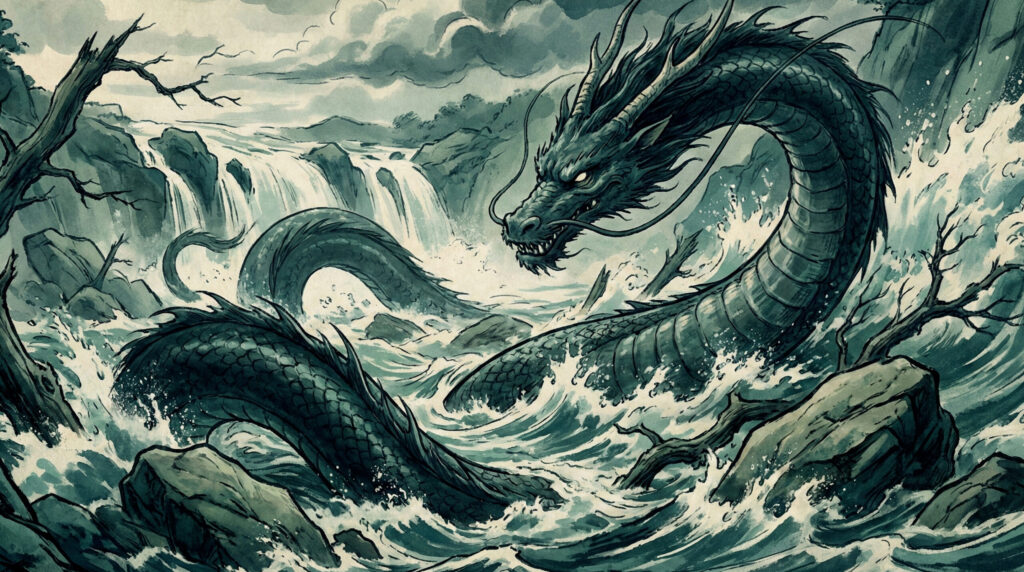
A river-dwelling serpent dragon.
It demands offerings and causes floods.
Primary Sources
Water Dragon & River Deity Lore
- Nihon Shoki (日本書紀)
- Hitachi Fudoki (常陸国風土記)
- Yanagita Kunio — River spirit belief studies
- Komatsu Kazuhiko — Yōkai Encyclopedia
Mizuchi – An Archaic Water Anomaly Distinct from Dragons and Water Deities
Mizuchi(蛟) refers to an ancient class of water-dwelling entities in Japanese tradition, best understood as proto-aquatic anomalies that predate later, more systematized concepts such as dragons (龍) or fully developed water deities (水神). Mizuchi occupy a deep folkloric layer, where dangerous water itself is imagined as an active, hostile presence.
Unlike dragons, which often acquire cosmic order and beneficent function, mizuchi remain localized, violent, and unresolved. They are not rulers of water, but manifestations of water’s capacity to kill.
Early References and Archaic Context
Mentions of mizuchi appear in early historical and mythological sources, including classical chronicles, where they are associated with:
- Rivers prone to flooding
- Pools and gorges where people disappear
- Sites requiring appeasement or sacrifice
These references lack the elaborate cosmology later attached to dragons. Instead, mizuchi appear as named dangers, emerging directly from lived encounters with lethal waterways.
This places mizuchi among the oldest strata of Japanese water belief.
Mizuchi as Water Itself Given Hostility
Mizuchi are not consistently described in form. When they are, descriptions include:
- Serpentine or eel-like bodies
- Scaled, elongated shapes
- Indistinct forms glimpsed beneath the water’s surface
The instability of their depiction is significant. Mizuchi are not creatures in water; they are water behaving as if it were a creature.
Floods, sudden currents, and drownings are interpreted not as accidents, but as intentional acts of a resident force.
Distinction from Dragons (Ryū)
While later tradition sometimes conflates mizuchi with dragons, the two differ fundamentally.
- Dragons (龍)
- Associated with rain, order, and cosmic balance
- Often worshipped or revered
- Integrated into Buddhist and continental cosmology
- Mizuchi (蛟)
- Associated with local danger and death
- Feared rather than revered
- Lack universal symbolism
Mizuchi represent a pre-cosmological stage, before water was moralized or systematized.
Distinction from Water Deities (Suijin)
Water deities regulate and protect. Mizuchi do neither.
Where suijin require offerings to ensure fertility and irrigation, mizuchi demand appeasement simply to prevent loss. Their presence marks places where water is not a resource but a threat.
This distinction underscores mizuchi as anti-functional beings—they exist not to sustain life, but to explain its sudden removal.
Mizuchi and Sacrificial Logic
Several early accounts associate mizuchi with human or animal sacrifice. Such practices reflect a belief that:
- The water has will
- That will can be negotiated
- Failure to appease invites repetition of disaster
Importantly, these rites are transactional rather than devotional. Mizuchi are not honored; they are bought off.
Symbolism and Cultural Meaning
Water as Predator
Mizuchi invert the life-giving image of water, emphasizing its predatory potential.
Localized Terror
Unlike dragons spanning regions and heavens, mizuchi are tied to specific rivers or pools. Their danger is intimate and unavoidable.
Pre-Mythic Thinking
Mizuchi belong to a stage where myth has not yet softened fear into story. They remain raw explanations for death.
Related Concepts
River Dragon Motif
Serpent-shaped water deities.
Flood & Drowning Folklore
Spirits of lethal waters.
Water Boundary Kami
Beings governing river territories.
Later Transformation and Decline
As hydraulic engineering improved and religious frameworks evolved, mizuchi gradually lost prominence. Their functions were absorbed into:
- Dragons (cosmic order)
- Water gods (ritual control)
- Generalized “dangerous places”
Yet traces of mizuchi persist wherever water is spoken of as if it chooses victims.
Modern Cultural Interpretations

This blade symbolizes flood law and water-bound execution.
It visualizes death commanded by rivers.
In modern media, Mizuchi is often reimagined less as a single “monster” and more as a presence tied to water systems — a river-dragon force that emerges where human control over nature fails. Contemporary stories frequently connect Mizuchi to dams, floods, poisoned currents, and the illusion that waterways can be fully mastered.
Modern interpretations also emphasize liminality: Mizuchi belongs to boundaries — between upstream and downstream, village and wilderness, purification and contamination. In this reading, it becomes a symbol of environmental consequence, where the river returns what society tries to hide or discard.
In some modern visual reinterpretations, Mizuchi manifests as a yōtō — a blade that carries the river’s “memory.” The sword appears polished, yet its sheen suggests submerged scales and cold flow; it cuts like a current, not with impact, but with inevitability. To draw it is to invite the waterline to rise.
Mizuchi endures because water endures — and because what we force downstream never truly disappears.
Modern Reinterpretation – Mizuchi as the Spirit of Returning Water
In this reinterpretation, Mizuchi is not a beast of vengeance, but the consciousness of water itself — patient, unyielding, and inevitable. It is the awareness of what flows unseen, carrying memory beneath reflection. Where humans build, Mizuchi waits; where control tightens, pressure gathers.
The “beautiful girl” form captures this quiet vastness. Her presence is fluid, posture poised as if suspended within current. Her garments shimmer between translucence and opacity, resembling the surface of deep water at dusk. In her eyes, stillness conceals depth — the calm weight of consequence moving beneath the calm.
She does not attack. She rises. Her gestures feel tidal, guided by rhythm older than human will. Around her, droplets hover like fragments of language forgotten by the river, returning now to speak again. She is not wrathful — she is gravity reclaiming its path.
To look upon her is to see inevitability given grace. She reminds that what is buried flows back, and that every dam becomes a mirror when the water climbs high enough to see itself.
In this visual reinterpretation, Mizuchi becomes the spirit of returning water — beauty that accumulates quietly, memory that floods without permission, and consequence that glimmers where reflection seems serene.
Musical Correspondence
The accompanying track gives voice to submersion. Deep, resonant drones pulse like distant undertow, while slow, oscillating harmonics mimic the drag of unseen currents. Tension rises not through speed but through accumulation — weight layering upon weight.
Subtle shifts in pressure and resonance create the illusion of motion without direction. Each sound seems to pull downward, drawing the listener into suspension between breath and drowning.
Through density, rhythm, and restraint, the music captures Mizuchi’s essence: inevitability shaped as sound, the quiet insistence of the river reclaiming all that sought to contain it.
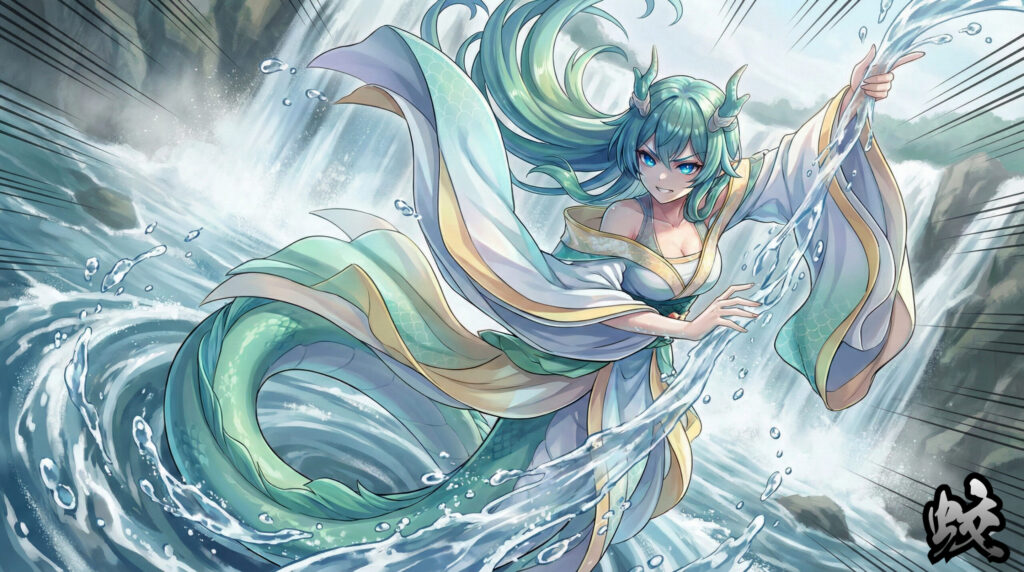
She embodies river authority and drowning fate.
Her calm presence conceals flood judgment.
Dreamy and stylish
Genre: Ritual Japanese HipHop / Darkwave Folklore Produced by: Phantom Tone | Suno AI | Kotetsu Co., Ltd. Tags: #JapaneseHipHop #AIgeneratedMusic #Yokai #Phant…