
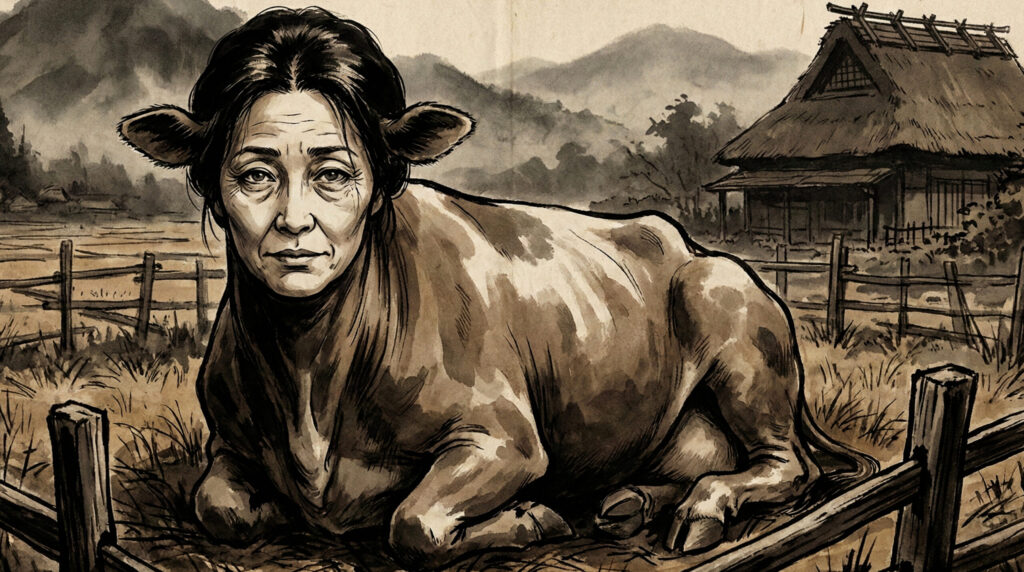
A prophetic beast born to speak disaster.
It dies after delivering its omen.
Primary Sources
Prophetic Beast Folklore
- Edo-period prophetic omen records
- Yanagita Kunio — Rural omen belief studies
- Komatsu Kazuhiko — Yōkai Encyclopedia
- Regional war-omen folklore
Kudan – The Prophetic Being That Speaks Disaster in Japanese Folklore
Kudan is a prophetic yōkai said to be born with the body of a cow and the face of a human. Unlike monsters that act or attack, Kudan exists to announce. Its role is singular and finite: to speak of calamity before dying shortly after birth.
It does not threaten.
It does not intervene.
It delivers a message.
Kudan embodies disaster given voice.
Origins in Omen Belief and Agricultural Society
Kudan emerges from agrarian culture, where cattle were central to survival and labor. The birth of a malformed calf was not merely biological anomaly—it was an event demanding interpretation.
Kudan transforms this anomaly into meaning. The abnormal body becomes a medium for warning.
The land speaks through livestock.
Appearance as Contradiction
Descriptions of Kudan emphasize dissonance:
The face of a human, often adult and expressive
The body of a calf or cow
The ability to speak clearly at birth
A short lifespan ending soon after prophecy
Human intellect bound to animal flesh signals inversion of natural order.
The form itself is the omen.
Behavior: Speech as Sole Action
Kudan does not roam or repeat itself:
It speaks once
It predicts famine, plague, war, or disaster
It instructs humans to prepare or repent
It dies after fulfilling its role
There is no continuation.
The prophecy ends the being.
Relationship with Humans
Humans cannot bargain with Kudan. They can only listen—or dismiss.
Some traditions hold that those who hear and heed Kudan’s warning survive. Others record disbelief followed by catastrophe.
Kudan does not ensure salvation.
It ensures awareness.
Kudan and the Logic of Certainty
Unlike vague omens, Kudan’s prophecies are explicit. This certainty distinguishes it from other predictive signs.
The future is not hinted.
It is stated.
This transforms fear into responsibility.
Symbolism and Themes
Voice Before Destruction
Warning precedes collapse.
Knowledge Without Power
Knowing does not prevent.
Anomaly as Message
The abnormal carries truth.
Mortality of the Messenger
Truth consumes its bearer.
Related Concepts
Omen Creature Motif
Beings that announce calamity.
Prophecy Folklore
Foretelling spirits.
Birth-and-Death Yōkai
Yōkai born to die after prophecy.
Kudan in Historical Records
References to Kudan appear sporadically from the Edo period into the early modern era, including pamphlets and local reports. Its presence increases during times of unrest, famine, or epidemic.
Whether believed or fabricated, Kudan reflects collective anxiety seeking form.
Fear demands articulation.
Modern Cultural Interpretations

This blade symbolizes unavoidable prophecy and terminal knowledge.
It visualizes fate delivered only once.
Modern interpretations often view Kudan as a metaphor for uncomfortable truth — information that arrives clearly but too late to prevent consequence.
Psychologically, Kudan represents the burden of foresight without agency: knowing what will happen while being unable to intervene.
In some modern visual reinterpretations, Kudan manifests as a yōtō — a blade that reveals before it strikes. The sword exposes outcome as reflection, forcing awareness to precede action.
Kudan persists because societies still fear knowing what they cannot change.
Modern Reinterpretation – Kudan as the Spirit of Inevitability
In this reinterpretation, the Kudan is not a prophet to be feared, but the embodiment of consequence already set in motion — truth spoken into a world too slow to change. It exists at the intersection of knowledge and helplessness, where awareness becomes its own kind of tragedy.
The “beautiful girl” form captures the serenity of doomed clarity. Her gaze is steady, not pleading; her voice calm, carrying the weight of inevitability rather than hope. Around her, fragments of light and shadow converge like fractured reflections — the moment before understanding becomes acceptance.
She does not warn to save; she speaks because silence would make her complicit. The world moves after her words fall, but never because of them. In her presence, revelation feels like an echo — truth arriving after it is already too late.
Her beauty is absolute yet fragile, the poise of someone who has seen the end too clearly to resist it. She is the reflection before collapse, the calm after certainty.
In this visual reinterpretation, the Kudan becomes the spirit of inevitability — beauty that knows, voice that speaks once, and silence that carries the rest.
Musical Correspondence
The accompanying track turns prophecy into sound. Stark piano notes or crystalline tones emerge from stillness, delivering melody with the precision of speech — each phrase clean, unembellished, irreversible.
Silence follows every statement, framing it as both message and aftermath. Sparse textures evoke distance and inevitability, allowing the listener to feel time folding inward — awareness closing behind what cannot be undone.
Through clarity, brevity, and dissolution, the music captures Kudan’s essence: revelation without rescue, truth that exists to be heard once, and the beauty of knowing when no change remains possible.

She embodies unavoidable prophecy and vanishing presence.
Her words exist only to disappear.
Dreamy and stylish
Genre: Ritual Japanese HipHop / Darkwave Folklore Produced by: Phantom Tone | Suno AI | Kotetsu Co., Ltd. Tags: #JapaneseHipHop #AIgeneratedMusic #Yokai #Phant…