
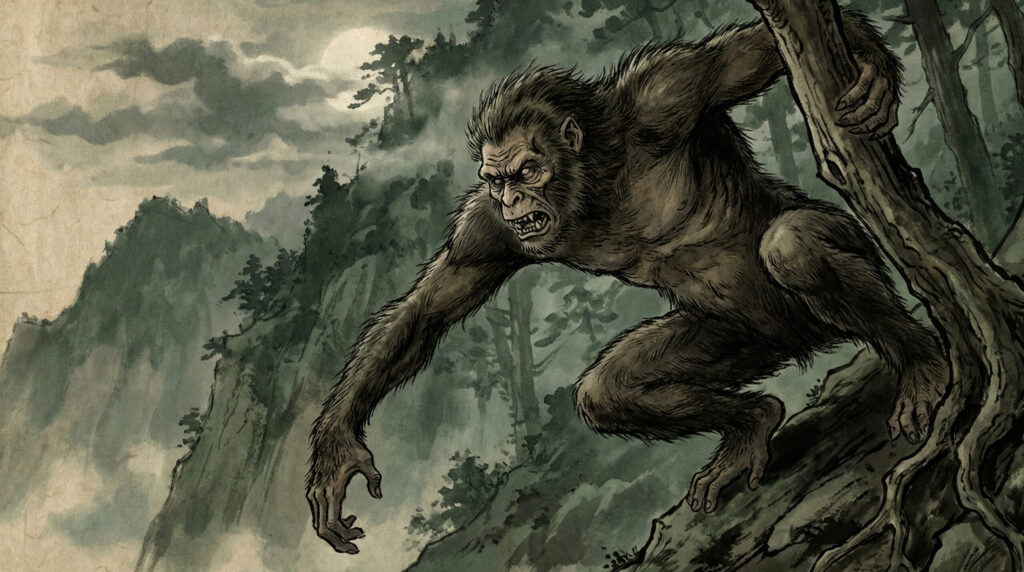
A giant baboon-like yōkai lurking in mountains.
It preys on travelers.
Primary Sources
Mountain Beast Folklore
- Konjaku Monogatari-shū (今昔物語集)
- Yanagita Kunio — Mountain beast belief records
- Komatsu Kazuhiko — Yōkai Encyclopedia
- Regional mountain village folklore
Hihi – The Mountain Beast That Preys on Humans in Japanese Folklore
Hihi is a fearsome mountain-dwelling creature described in Japanese folklore as a powerful, ape-like beast that preys upon humans. Neither a mere animal nor a moralized demon, Hihi represents predation without symbolism—a direct, physical threat emerging from the wild.
It does not deceive.
It does not warn.
It hunts.
Hihi embodies danger without narrative.
Origins in Mountain Fear and Unexplained Loss
Mountain regions in premodern Japan were sites of resource gathering and spiritual awe, but also of disappearance. Travelers vanished, woodcutters failed to return, and bodies were not recovered.
Hihi arises as an explanation for such losses—a creature large enough, intelligent enough, and ruthless enough to account for human absence.
The mountain does not explain.
It consumes.
Neither Oni nor Ordinary Beast
Hihi occupies an ambiguous classification:
- Not an oni, lacking moral or social symbolism
- Not a yōkai born of transformation or curse
- Not a known animal, exceeding natural behavior
It exists at the threshold between unknown fauna and mythic predator.
The threat is biological, not ideological.
Appearance: Ape, Shadow, or Something Worse
Descriptions of Hihi vary by region, but share core traits:
Large, muscular body resembling an ape
Dark or reddish fur
Sharp teeth and immense strength
Ability to move silently despite size
Sometimes it is said to resemble a giant monkey; other times, a shadow too large to be real.
Recognition comes too late.
Behavior: Direct Predation
Hihi does not engage humans symbolically. It attacks:
Ambushing travelers
Dragging victims into the forest
Breaking limbs with brute force
Leaving no remains
There is no possession, curse, or aftermath ritual.
The encounter ends the story.
Relationship with Humans
Humans historically responded to Hihi with avoidance:
Avoiding certain mountain paths
Traveling in groups
Marking dangerous areas
Spreading warnings through oral tradition
There is no appeasement.
Only distance.
Hihi Among Mountain Entities
Within mountain folklore, Hihi occupies a stark role:
- Sansei – mountain essence
- Mountain gods – sovereign presence
- Yako – deceptive boundary dwellers
- Hihi – apex predator
It represents physical dominance, not spiritual authority.
Symbolism and Themes
Predation Without Meaning
Violence without lesson.
The Unknowable Wild
Nature beyond interpretation.
Human Fragility
Civilization fails quickly.
Silence After Loss
No haunting, only absence.
Related Concepts
Mountain Beast Yōkai
Primate-like spirits of deep forests.
Ambush Predator Motif
Folklore of sudden mountain attacks.
Forest Boundary Spirits
Yōkai guarding deep wilderness.
Hihi in Folklore Memory
Hihi appears in regional legends and Edo-period compilations, often briefly and without embellishment. This lack of narrative suggests realism—stories told to warn, not entertain.
No moral follows.
Only fear.
Modern Cultural Interpretations

This blade symbolizes primal violence and territorial hunger.
It visualizes attack that comes from deep wilderness.
Modern interpretations often frame Hihi as a memory of extinct megafauna or exaggerated encounters with bears or large primates, echoing ancient fears of overwhelming physical power.
Psychologically, Hihi represents fear of being prey — an anxiety suppressed by modern safety but never fully erased.
In some modern visual reinterpretations, Hihi manifests as a yōtō — a blade too heavy to wield casually. The sword carries brutal mass rather than elegance, its presence evoking raw survival rather than combat ritual.
Hihi persists because wilderness still kills without reason.
Modern Reinterpretation – Hihi as the Spirit of Unreasoning Wilderness
In this reinterpretation, Hihi is not a monster of punishment, but the embodiment of primal indifference — the mountain’s raw appetite made flesh. It is nature’s reminder that survival is neither moral nor cruel, only absolute.
The “beautiful girl” form captures this paradox of savagery and stillness. Her frame carries the poise of restrained violence — strength held in silence. Her hair falls like dark undergrowth, her eyes gleam with the feral calm of a predator that does not need to chase.
She does not hate or hunt from anger. She simply acts, as the mountain acts, as the earth consumes. The faint scars along her blade-like form are not decoration but history — reminders that existence itself is a contest of endurance.
Her beauty is gravitational, heavy as the forest canopy. Around her, sound seems to narrow; even the wind hesitates. She is not warning or omen — she is the consequence of stepping too far into what never asked to be found.
In this visual reinterpretation, Hihi becomes the spirit of unreasoning wilderness — beauty forged from dominance, and power stripped of purpose beyond survival itself.
Musical Correspondence
The accompanying track translates raw force into sound. Massive percussion and subterranean drones move like distant avalanches, while abrupt impacts fracture the calm — moments of predation rendered in rhythm.
Melody is almost absent, replaced by pressure and vibration. The music breathes in heavy intervals, creating a sense of presence vast enough to crush and silent enough to conceal its motion.
Through weight, pulse, and void, the music captures Hihi’s essence: the wilderness that does not negotiate, the strength that exists without meaning, and the sound of being watched by something older than fear.
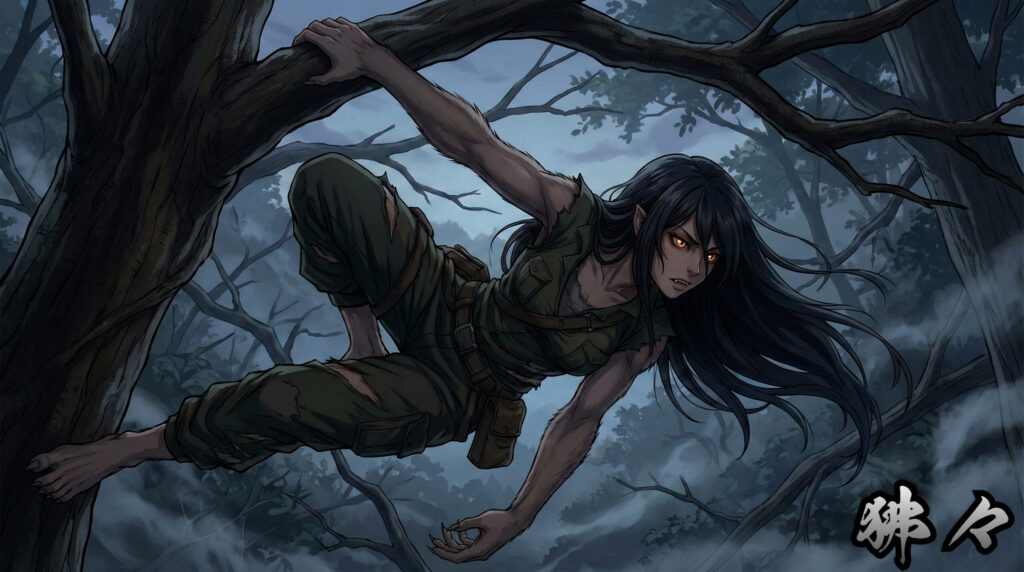
She embodies primal threat and mountain hunger.
Her calm form hides predatory instinct.
Dreamy and stylish
Genre: Ritual Japanese HipHop / Darkwave Folklore Produced by: Phantom Tone | Suno AI | Kotetsu Co., Ltd. Tags: #JapaneseHipHop #AIgeneratedMusic #Yokai #Phant…