Bakeneko and Nekomata — Shape-Shifting Feline Spirits
In Japanese folklore, Bakeneko and Nekomata occupy a unique space among supernatural beings: creatures that evolve from familiar household cats into powerful, sometimes vengeful spirits. Their transformation is rooted not in mythic distance but in everyday life — a constant reminder that the mundane can quietly cross into the uncanny.
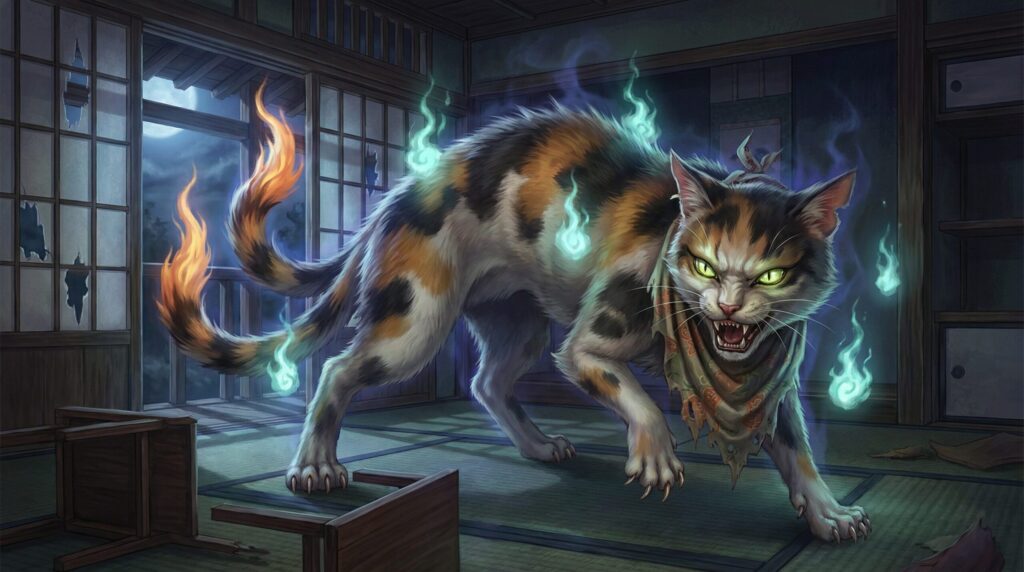
These feline yōkai begin as ordinary domestic cats. Through age, mistreatment, or accumulated spiritual energy, they acquire supernatural abilities such as shape-shifting, human mimicry, fire manipulation, or the power to control the dead. While “Bakeneko” refers broadly to shape-shifting cats, “Nekomata” represents a more advanced and fearsome form — distinguished by a distinctive split tail and heightened spiritual capabilities.
Their legends span medieval war chronicles, Edo-period urban folklore, kabuki theater, and painted scrolls. Throughout history, Bakeneko and Nekomata have been depicted as both tragic victims and terrifying avengers, reflecting anxieties about illness, household harmony, and the fragile boundaries of the home.
Origins and Historical Context
References to supernatural cats appear as early as the Kamakura and Muromachi periods. Initially feared for their association with night, death, and funerary rituals, cats gained an aura of spiritual potency. Many believed that as cats age beyond ten or twenty years, their tails grow longer and may even split, marking the transition into a yōkai state.
In the Edo period, Bakeneko tales proliferated. Urban legends described cats that danced with towels on their heads, spoke in human voices, or impersonated family members. These narratives often served as moral stories — warning against cruelty toward animals or hinting at karmic consequences.
Kabuki plays such as Bakeneko no Densetsu established many of the motifs still recognized today: the mysterious daughter, the hidden cat spirit, revenge for mistreated owners, and the slow unraveling of identity through eerie gestures and glowing eyes.
Characteristics and Abilities
Shape-Shifting and Human Mimicry
Bakeneko are renowned for their ability to imitate human behavior. They may steal their owner’s clothing, walk upright, or even take on the appearance of a specific person. Their mimicry is often unsettlingly precise, creating a liminal space between the familiar and the strange.
Fire Manipulation
Many Edo-period illustrations show Bakeneko carrying small flames or supernatural fireballs. This ability symbolizes both their spiritual potency and their connection to funerary rituals, where fire played a purifying but dangerous role.
Cursing and Possession
A recurring motif involves Bakeneko cursing abusive humans or possessing them to seek revenge on behalf of a wronged master. These stories reflect social concerns about loyalty, justice, and the hidden emotions within domestic life.
Nekomata — The Split-Tailed Cat
Nekomata are an advanced, more dangerous evolution of Bakeneko. Their identifying feature is a bifurcated tail, which symbolizes their transformation into a fully developed yōkai. Nekomata were believed to control the dead, summon ghostly fires, or lead spiritual disturbances. Their presence often signals the rupture of household harmony.
Related Concepts
Animal Shapeshifter Motif
Cats that become spirits.
Household Boundary Yōkai
Spirits born from domestic life.
Vengeful Pet Folklore
Animals retaining resentment.
Cultural Symbolism
Bakeneko and Nekomata embody the tension between affection and fear surrounding cats in premodern Japan. Their ambiguous roles mirror anxieties about domestic stability, disease, and the blurred boundary between human and animal. At the same time, they reflect the enduring fascination with beings who quietly observe daily life, gathering knowledge unseen.
In visual culture, these feline yōkai blend elegance with menace — arched backs, lantern-lit silhouettes, and glowing eyes that hint at intelligence beyond human understanding. Their imagery remains one of the most evocative in Japanese folklore.
Modern Cultural Interpretations

This blade symbolizes domestic resentment and silent vengeance.
It visualizes grudges that grow beside people.
Contemporary art, literature, and music reinterpret Bakeneko and Nekomata as symbols of transformation, hidden emotion, and the power residing in overlooked beings. Rather than appearing solely as frightening monsters, they often emerge as mysterious guardians, outsiders, or embodiments of unspoken desire.
Their presence in modern storytelling reflects a continued fascination with liminal creatures — beings that cross boundaries while retaining an air of elegance and enigma.
In some modern visual reinterpretations, Bakeneko and Nekomata manifest as a yōtō — a blade that curves like a stretching tail. The sword moves with feline timing, its edge favoring subtlety, misdirection, and sudden precision.
They persist because transformation still unsettles and attracts.
Modern Reinterpretation – Bakeneko / Nekomata as the Spirits of Hidden Grace
In this reinterpretation, Bakeneko and Nekomata are not harbingers of malice, but the embodiments of unseen transformation — beauty that conceals power, and instinct refined into ritual. They are the quiet motion in moonlight, where affection and danger purr in the same breath.
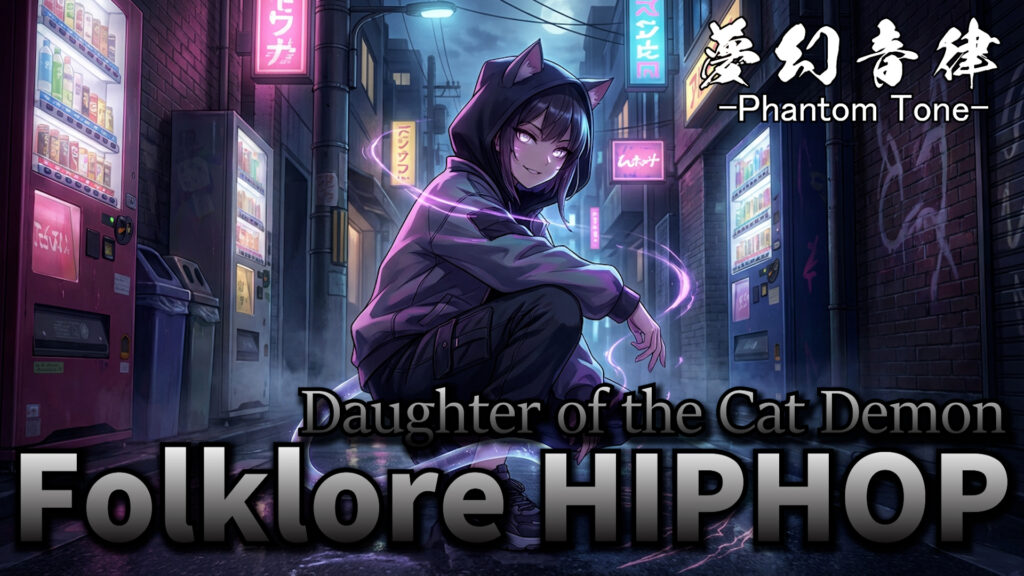
The “beautiful girl” form channels that duality through elegance touched by unpredictability. Her posture is languid yet alert, every gesture suggesting the tension between trust and claw. Her eyes gleam with knowing calm — the gaze of one who sees without revealing what she decides.
Silk and shadow weave around her as if responding to her mood. Each movement shifts the light, revealing something new and concealing something else. She is not bound by the human wish to be understood; she exists to remind that mystery itself can be a form of truth.
She neither invites nor warns — she watches. Her allure is the comfort that may bite, the serenity that can turn in an instant. To meet her eyes is to feel the world tilt, graceful and perilous all at once.
In this visual reinterpretation, the Bakeneko and Nekomata become spirits of hidden grace — beauty sharpened by instinct, tenderness edged with danger, and transformation held in poised silence.
Musical Correspondence
The accompanying track turns stealth into melody. Whispered percussion and gliding basslines evoke the sound of padded steps, while delicate strings and electronic textures shimmer like eyes in the dark.
Themes coil and release unpredictably — motifs reappear with altered tone or phrasing, mirroring the cat spirit’s seamless transition from affection to ferocity. The rhythm seems to breathe, as if the music itself were watching, waiting.
Through grace, control, and flickering tension, the music captures the essence of Bakeneko and Nekomata: transformation made elegant, power disguised as poise, and emotion that moves like moonlight across the skin.
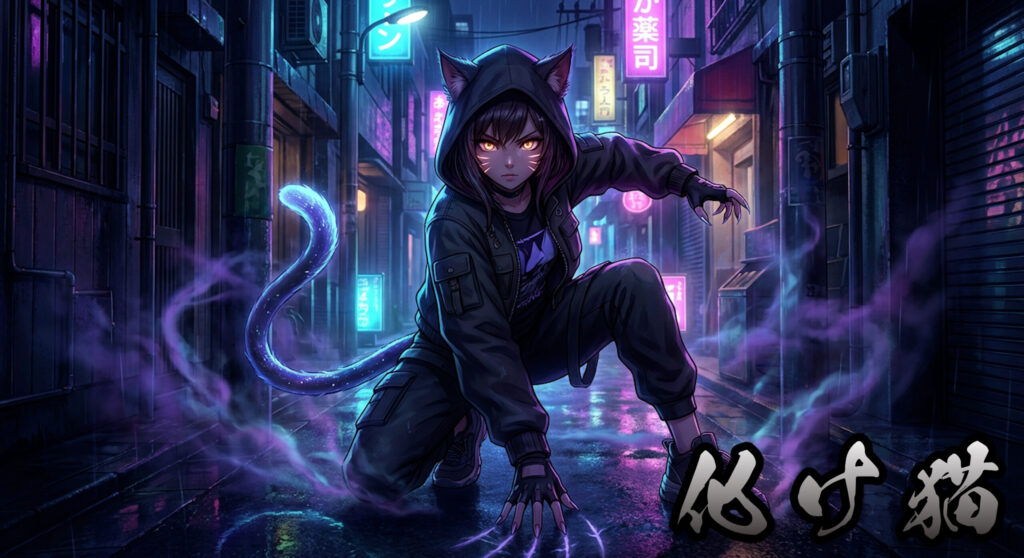
She embodies familiar resentment and quiet betrayal.
Her presence reflects grudges that grow within the home.
Daughter of the Cat Demon
Genre: Japanese Folklore HipHop / Lo-Fi Japan / Darkwave Trap Produced by: Phantom Tone | Suno AI | Kotetsu Co., Ltd. Tags: #JapaneseFolklore #Bakeneko #AIgene…