

A pale snow spirit appearing in blizzards.
She freezes travelers with breath.
Primary Sources
Snow Spirit Folklore
- Konjaku Monogatari-shū (今昔物語集)
- Yanagita Kunio — Snow spirit belief records
- Komatsu Kazuhiko — Yōkai Encyclopedia
- Regional winter folklore collections
Yuki-onna – The Snow Woman of Japanese Winter Folklore
Yuki-onna, the Snow Woman of Japanese folklore, stands as one of the most haunting and iconic spirits within Japan’s mythological imagination. Unlike Western ghosts or witches associated with malice or curse, Yuki-onna embodies the serene yet fatal beauty of winter itself — a being of white silence, cold breath, and fleeting grace.
She appears on blizzard nights, draped in pure white robes, her skin translucent as frost. Her presence evokes both wonder and dread — a manifestation of nature’s stillness that conceals its merciless power.
Yuki-onna represents winter’s spirit: breathtaking, ephemeral, and unapproachable.
Origins and Early Beliefs
The legend of Yuki-onna traces back to oral traditions from Japan’s snow-covered regions, long before her Edo-period literary appearance in kaidan (ghost story) collections. Mountain villages in northern and central Japan told of spectral women seen during storms — wanderers of snow whose touch could drain life itself.
These tales reflect a historical intimacy with nature’s extremes. In eras when travel through mountain passes meant risking death by exposure, Yuki-onna emerged as a personification of winter’s peril and the fragility of human survival.
Through generations, she transformed from a cautionary presence into a symbol — not of punishment, but of the boundary between warmth and oblivion.
Nature and Form
Descriptions of Yuki-onna share remarkable consistency across centuries:
- Tall and slender, with long black hair and skin white as new snow
- Garbed entirely in white kimono, sometimes barefoot, leaving no trace behind
- Eyes glimmering with blue or silver light
- A voice as soft as falling snow — or none at all
She glides rather than walks, moving like drifting snowflakes carried by invisible wind. Her breath freezes air and soul alike.
Some accounts describe her carrying an infant, asking travelers to hold it — only for its weight to grow unbearable, freezing them where they stand. Others depict her simply appearing at doorways, seeking warmth or water, testing the mercy of mortals against the inevitability of the cold.
From Spirit of Death to Spirit of Solitude
Over time, interpretations of Yuki-onna shifted. Earlier tales painted her as a lethal winter demon — the agent of frostbite and exhaustion. Later stories, especially during the Edo and Meiji periods, introduced emotional depth: she became a lonely, tragic being bound by nature’s curse.
Lafcadio Hearn’s Kwaidan (1904) immortalized this evolution for the modern world. In his retelling, Yuki-onna spares a woodcutter’s life out of pity, warning him never to reveal her existence. Years later, when he breaks his promise, she disappears in sorrow — both vengeful and human.
This portrayal cemented Yuki-onna as more than a ghost: she is an embodiment of compassion constrained by elemental law.
Symbolism and Themes
The Duality of Winter
Yuki-onna personifies winter’s twin nature — purity and peril, serenity and silence that can both protect and destroy.
Transience and Impermanence
Her beauty is fleeting, as are snowflakes; she embodies the Buddhist concept of mujō (impermanence) — beauty that cannot survive warmth.
Isolation and Desire
Many versions depict her seeking warmth or companionship, yet doomed by her own nature to extinguish what she touches. She is the loneliness of the season itself.
Boundaries of Life and Death
Appearing at thresholds — doors, bridges, mountain passes — Yuki-onna marks the liminal space where human and elemental worlds meet.
Related Concepts
Cold Death Motif
Spirits of lethal winter.
Frozen Boundary Yōkai
Beings of snowbound thresholds.
Seductive Apparition Folklore
Dangerous beauty motifs.
Cultural Presence and Artistic Depictions
Yuki-onna has endured as a muse for art, literature, and cinema. Her image adorns ukiyo-e prints, noh plays, and modern films. In each medium, she shifts — sometimes a silent apparition cloaked in snow, sometimes a beautiful woman dissolving into mist.
Contemporary portrayals in anime and visual art often emphasize her elegance and melancholy rather than horror. She is not merely a ghostly threat but a symbol of solitude, elegance, and the fragility of affection amid cold inevitability.
Her form — luminous white against the black of winter — remains among the most recognizable silhouettes in Japanese folklore.
Regional Variations and Local Legends
Across Japan, local traditions adapt her story to landscape and climate:
- Aomori & Akita: A snow witch who drains life-force with icy breath.
- Niigata & Nagano: A woman lost in the mountains, reborn as snow spirit, forever wandering.
- Yamagata: A benevolent apparition guiding lost travelers home.
- Gifu & Toyama: A pale mother carrying a phantom child, testing human compassion.
These variations reveal Yuki-onna’s flexibility as symbol: death, mercy, or longing, depending on how people experience the winter that surrounds them.
Essence of Yuki-onna
Yuki-onna endures because she embodies a truth that transcends folklore: beauty and death are not opposites but reflections of the same stillness.
She is the hush before dawn in a world of snow — breathtaking, sorrowful, and momentary.
Modern Cultural Interpretations

This blade symbolizes lethal cold and merciless winter law.
It visualizes death carried by snow.
In contemporary media, Yuki-onna continues to evolve. She appears as a ghostly apparition in horror films, a powerful elemental spirit in fantasy games, and a melancholic figure in literature exploring unrequited love or loneliness.
Artists frequently depict her amidst swirling snow, illuminated by moonlight that enhances her otherworldly beauty. Despite her fearsome origins, many modern portrayals highlight her emotional complexity — a spirit caught between human desires and supernatural fate.
Modern Reinterpretation – Yuki-onna as the Spirit of Frozen Longing
In this reinterpretation, Yuki-onna is not solely a harbinger of death or isolation, but the embodiment of suspended emotion — love preserved in frost, sorrow crystallized into grace. She is the stillness between falling snowflakes, the breath that vanishes before it warms the air.
The “beautiful girl” form embodies fragility made eternal. Her skin glows faintly like ice under moonlight, her expression serene yet unreadable — an elegance that conceals both mercy and memory. Around her, the snowfall feels alive, orbiting her like thoughts she will never voice.
She does not pursue warmth; she observes it, knowing that closeness would end her. Her beauty is distance incarnate — perfect because it cannot be touched. She is the tenderness of winter itself, inviting and fatal in the same breath.
In this visual reinterpretation, Yuki-onna becomes the spirit of frozen longing — beauty held at the edge of disappearance, and emotion preserved in the moment before melting.
Musical Correspondence
The accompanying track captures the sound of snowfall turned inward. Soft, crystalline tones drift through long reverb, creating the sense of a world muted by cold. Each note feels suspended, dissolving just as it forms.
Subtle strings and breathlike synths evoke the balance between tenderness and isolation. The tempo remains slow, almost breathless, mirroring a heart that beats softly beneath the ice.
Through restraint, clarity, and quiet shimmer, the music captures Yuki-onna’s essence: love too delicate to survive warmth, and beauty that endures only through stillness.
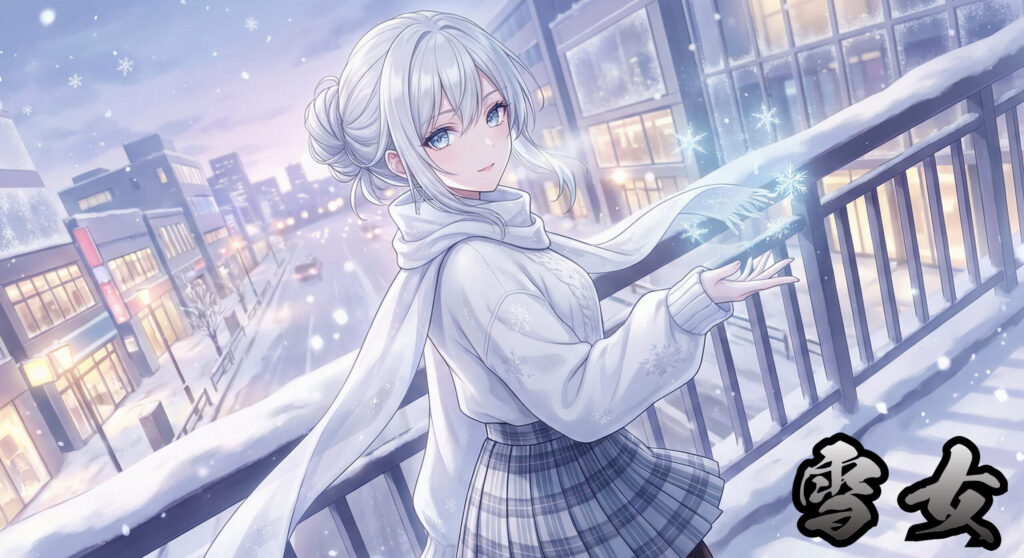
She embodies silent winter death.
Her calm beauty conceals freezing breath.
Princess icicle
Genre: Japanese Fantasy Ballad / 和風幻想 Style: Koto ・ Shamisen ・ Ethereal Vocal ・ Dreamlike Atmosphere 👉 Listen to this track on Spotify A fragile melody …

Rikka Illusion
Genre: Wafu HipHop / AI-generated Music / Lo-Fi Japan Produced by: Phantom Tone | Suno AI | Kotetsu Co., Ltd. Tags: #JapaneseHipHop #AIgeneratedMusic #PhantomT…