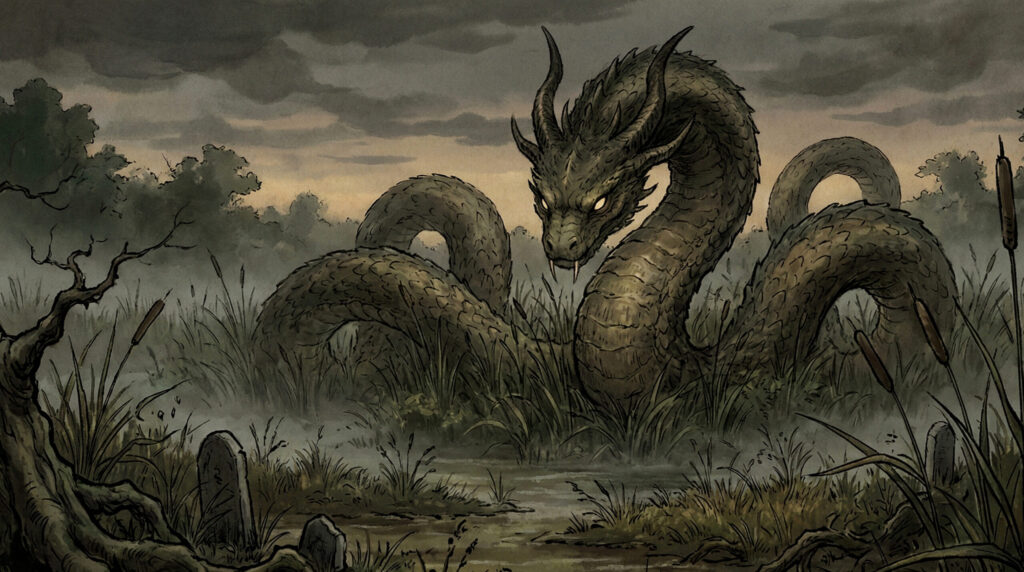
A serpent-like land deity resisting human settlement.
It enforces territorial will and demands appeasement.
Primary Sources
Serpent Deity & Land-Taming Lore
- Hitachi Fudoki (常陸国風土記) — Yato-no-Kami accounts
- Yanagita Kunio — Studies on local kami and land spirits
- Komatsu Kazuhiko — Yōkai Encyclopedia
- Regional shrine records related to serpent kami
Yato-gami – Serpent Land Deities and Cursing Power in Japanese Folklore
Yato-gami(夜刀神) refers to a class of serpentine land-bound deities in Japanese tradition, associated with specific territories, ancestral land rights, and the power to curse or bless depending on human conduct. Yato-gami are neither abstract kami nor simple yokai; they are localized divine forces bound to land itself.
Unlike universal snake gods or later systematized water deities, yato-gami emerge from place-based belief, where land ownership, cultivation, and survival intersect with fear of divine retaliation.
Origins in Early Myth and Local Cult
Yato-gami appear most clearly in early historical and mythological records, where they are described as snake-like deities inhabiting untamed land—fields, hills, or marshes not yet brought under human control.
These gods are encountered not through worship alone, but through conflict:
- Attempts to clear or cultivate land
- Encroachment on sacred or forbidden zones
- Disregard for ancestral or local taboos
Yato-gami thus arise at moments when human expansion collides with pre-existing sacred presence.
Serpent Form and Territorial Logic
The serpent form of yato-gami is not ornamental. Snakes in Japanese folklore are deeply associated with:
- The earth and underground spaces
- Water hidden beneath soil
- Sudden, lethal retaliation
As land-bound serpentine deities, yato-gami represent territory that can strike back. Their bodies mark boundaries; their movement defines ownership beyond human law.
Yato-gami as Land Deities, Not Water Gods
While often compared to water-associated snake gods, yato-gami differ fundamentally.
- Water deities regulate flow, fertility, and irrigation
- Yato-gami guard land itself—especially land in transition
They are not invoked for prosperity but feared for punishment. Their role is defensive rather than generative.
Curse and Retribution
Central to yato-gami belief is tatari(祟り), divine retribution following violation.
Common triggers include:
- Unauthorized land development
- Destruction of sacred markers
- Failure to honor local customs
Tatari attributed to yato-gami often manifests as:
- Illness
- Crop failure
- Repeated misfortune
Importantly, these are not framed as moral punishment in the abstract, but as direct consequences of territorial violation.
Relationship to Human Authority
Yato-gami belief reflects tension between:
- Centralized political authority
- Local land-based religious power
In narratives, appeasing yato-gami often requires:
- Establishing shrines
- Negotiating boundaries
- Reframing the deity as a protector
Through such processes, yato-gami may be transformed into recognized local kami, their dangerous aspect subdued but never erased.
Distinction from Oni and Yokai
Yato-gami must be clearly separated from demonic categories.
- Oni represent externalized chaos or punishment
- Yokai disrupt order through anomaly or mischief
- Yato-gami enforce order by defending land
Their violence is not arbitrary. It is conditional, activated by infringement.
Symbolism and Cultural Meaning
Land as Sacred Agent
Yato-gami embody the belief that land itself possesses will and memory.
Boundary Before Law
Before formal property systems, yato-gami defined ownership through fear and reverence.
Negotiated Coexistence
Human survival depends not on conquest, but on ritual accommodation.
Related Concepts
Serpent Kami Motif
Snake-bodied deities tied to land and water.
Land Boundary Spirits
Kami enforcing territorial claims.
Appeasement & Enshrinement Folklore
Deities pacified through ritual and relocation.
Later Transformation and Legacy
As agriculture stabilized and political control expanded, many yato-gami were:
- Absorbed into shrine systems
- Reinterpreted as benevolent guardians
- Reduced to mythic background figures
Yet their logic persists wherever land disputes are framed in terms of curse, fate, or ancestral wrath.
Modern Cultural Interpretations

This blade symbolizes land resistance and ancient territorial law.
It visualizes punishment triggered by unpermitted cultivation.
In modern cultural readings, Yato-gami are often interpreted as symbols of territorial consequence — spirits that embody the latent response of land to repeated intrusion, exploitation, or disregard.
Psychologically, Yato-gami represent environmental memory: the sense that certain places “remember” harm and eventually answer it through misfortune, unease, or resistance.
In some modern visual reinterpretations, Yato-gami manifest as a yōtō — a blade coiled like a serpent. The sword appears embedded in boundary stones and abandoned paths, its presence marking land that has learned to respond.
Yato-gami persist because territory still remembers.
Modern Reinterpretation – Yato-gami as the Spirit of Territorial Memory
In this reinterpretation, the Yato-gami is not a god of punishment, but the embodiment of the land’s capacity to remember. It is consequence given form — the awareness of soil, stone, and root responding to what has been taken.
The “beautiful girl” form reflects this buried vigilance. Her stance is still yet coiled, her garments marked with the faint patterns of maps and fault lines. Her eyes carry the depth of sediment — a patience shaped by centuries of quiet endurance.
She does not move to attack. She waits, because the land does not need to chase; it only needs to witness. The serpent’s curve in her silhouette suggests readiness without aggression — consequence sleeping beneath stillness.
She is both wound and witness. Through her, the world speaks not in words, but in shifts of wind, tremors beneath the feet, and the heaviness that lingers where boundaries have been crossed too often.
In this visual reinterpretation, the Yato-gami becomes the spirit of territorial memory — beauty carved from endurance, and awareness bound to the permanence of place.
Musical Correspondence
The accompanying track gives sound to buried awareness. Deep drones and low percussive pulses evoke the hum of the ground, while serpentine motifs rise and fall like tremors echoing through stone.
The rhythm is slow, deliberate, pressing downward instead of forward — gravity translated into sound. Each accent lands like a quiet act of remembrance, a reminder that no intrusion disappears without trace.
Through density, patience, and coiled motion, the music captures Yato-gami’s essence: the land that listens, the soil that remembers, and the unspoken power that waits beneath every step.
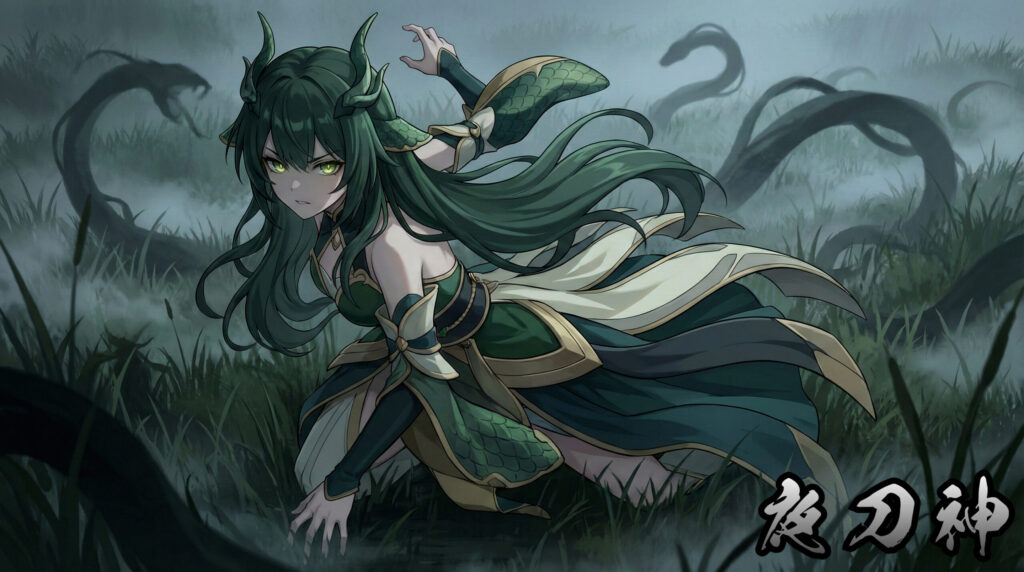
She embodies territorial memory and land-bound wrath.
Her presence marks borders written before human claim.
Dreamy and stylish
Genre: Ritual Japanese HipHop / Darkwave Folklore Produced by: Phantom Tone | Suno AI | Kotetsu Co., Ltd. Tags: #JapaneseHipHop #AIgeneratedMusic #Yokai #Phant…