
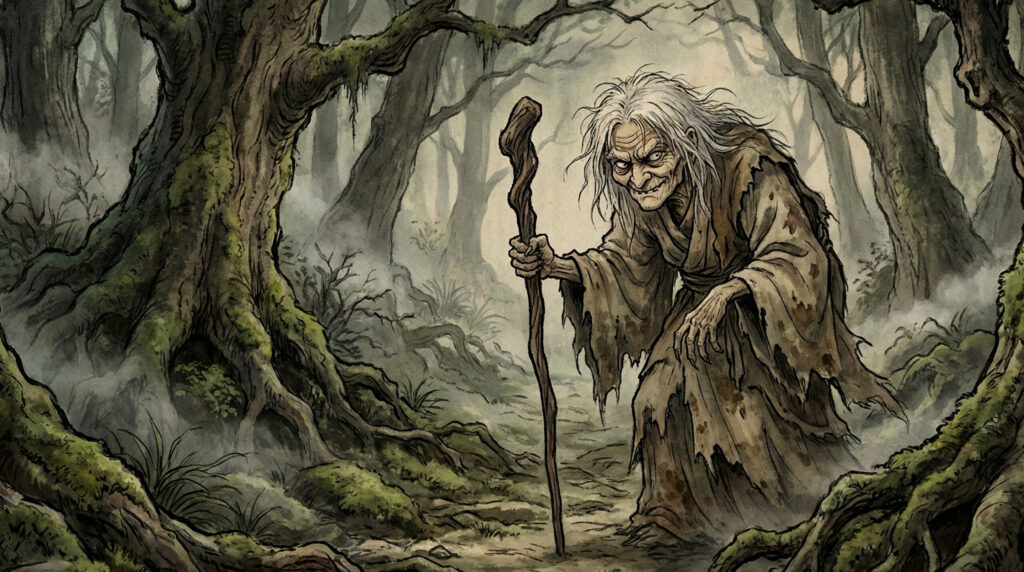
A mountain hag preying on travelers.
It represents deceptive hospitality.
Primary Sources
Mountain Hag Folklore
- Konjaku Monogatari-shū (今昔物語集)
- Yanagita Kunio — Mountain hag belief records
- Komatsu Kazuhiko — Yōkai Encyclopedia
- Regional mountain village oral traditions
Yamajibaba – The Old Woman Who Guards and Consumes the Mountain Roads in Japanese Folklore
Yamajibaba is a mountain-dwelling yōkai who appears along forest roads, passes, and liminal paths where human order thins and wilderness asserts itself. She is neither purely a predator nor a protector. She is the one who decides whether the road continues.
She waits where paths narrow.
She knows who belongs.
She remains when others pass.
Yamajibaba embodies judgment without announcement.
Origins in Mountain Roads and Liminal Travel
Mountain roads in premodern Japan were dangerous thresholds—routes for pilgrims, woodcutters, traders, and the desperate. These roads required permission not from villages, but from the mountain itself.
Yamajibaba emerged as the figure who represents that permission. She is not the mountain’s ruler, but its examiner.
The road is not public.
It is conditional.
Appearance and Familiar Unease
Descriptions of Yamajibaba emphasize unsettling familiarity:
An elderly woman with weathered features
Practical, worn clothing suited for travel
A posture suggesting both fatigue and endurance
Eyes that assess rather than threaten
She does not look supernatural at first glance. The unease comes from recognition—she seems to belong where she stands.
She is not lost.
You might be.
Behavior: Examiner of Intent
Yamajibaba does not attack indiscriminately. Her actions are selective:
She questions travelers indirectly
She offers directions that test judgment
She appears repeatedly along the same road
She blocks progress without physical force
Those who approach with arrogance, greed, or disrespect find the path lengthening, looping, or closing entirely.
The mountain listens through her.
Between Guardian and Predator
In some tales, Yamajibaba devours those who fail her test. In others, she guides the respectful safely through. These outcomes are not contradictions—they are results.
She does not change.
The traveler does.
Her morality is situational, rooted in balance rather than compassion.
Relationship to Yamanba and Other Mountain Women
Yamajibaba is often confused with Yamanba, but their roles differ:
- Yamanba survives beyond society
- Yamajibaba enforces the boundary to it
Where Yamanba represents life after crossing too far, Yamajibaba governs the moment of crossing itself.
She stands at the line.
Symbolism and Themes
Roads as Judgment
Movement requires permission.
Familiarity as Test
Trust is evaluated.
Female Authority of the Mountain
The land speaks through women.
Conditional Hospitality
Help must be earned.
elated Concepts
Yamanba (山姥)
Mountain witch spirits.
→Yamanba
Predatory Hospitality Motif
False kindness folklore.
Liminal Hut Spirits
Yōkai of isolated dwellings.
Yamajibaba in Folklore Memory
Yamajibaba appears in regional tales as explanation for failed journeys, disorientation, or sudden fear along mountain roads. She is rarely described in detail—what matters is the decision she enforces.
People remember not her face, but the turning back.
Modern Cultural Interpretations

This blade symbolizes predatory welcome and hidden hunger.
It visualizes danger disguised as shelter.
Modern interpretations often see Yamajibaba as a metaphor for gatekeeping systems, unspoken rules, and environments that accept only those who understand their implicit logic.
Psychologically, Yamajibaba represents the moment when intention is tested — when moving forward requires humility, awareness, and acknowledgment of unseen limits.
In some modern visual reinterpretations, Yamajibaba manifests as a yōtō — a blade positioned at thresholds. The sword does not pursue; it waits, answering only those who approach with balance.
Yamajibaba persists because thresholds still demand answers.
Modern Reinterpretation – Yamajibaba as the Spirit of the Testing Path
In this reinterpretation, Yamajibaba is not a monster of deception, but the living embodiment of thresholds — the sentient pause between approach and permission. She is not there to frighten; she is there to measure intent.
The “beautiful girl” form embodies this trial through calm authority. Her posture is composed, her gaze patient, and her surroundings seem to listen with her. The faint glow at her side resembles a blade at rest — silent until the question of passage is answered.
She does not move first. Her power lies in waiting. Each step toward her feels heavier, as though the mountain itself is asking who you are before deciding whether to open.
Her beauty is both invitation and judgment — soft enough to welcome, precise enough to discern. She is the guardian of humility, granting passage only to those who walk without arrogance.
In this visual reinterpretation, Yamajibaba becomes the spirit of the testing path — beauty stationed at the edge of the known, and wisdom expressed as stillness that decides when to let you through.
Musical Correspondence
The accompanying track translates evaluation into sound. Steady, deliberate rhythms evoke footsteps along a narrow mountain trail, while suspended harmonies hover between welcome and warning.
Intervals of silence act as pauses for judgment — spaces where the music itself seems to listen. Subtle modulations mirror the uncertainty of whether the next step will be accepted or denied.
Through restraint, pacing, and harmonic hesitation, the music captures Yamajibaba’s essence: the moment before the gate responds, when one’s own composure becomes the key to proceed.
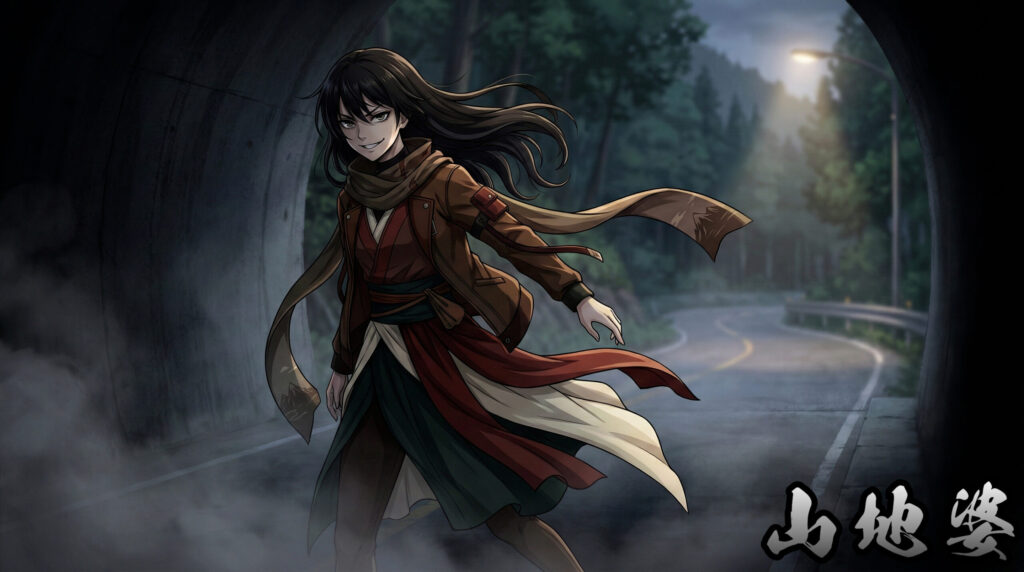
She embodies false refuge and mountain hunger.
Her calm smile conceals lethal hospitality.
Dreamy and stylish
Genre: Ritual Japanese HipHop / Darkwave Folklore Produced by: Phantom Tone | Suno AI | Kotetsu Co., Ltd. Tags: #JapaneseHipHop #AIgeneratedMusic #Yokai #Phant…