
A massive head that drops from trees.
It kills instantly without warning.
Primary Sources
Forest & Sudden Death Folklore
- Gazu Hyakki Yagyō (画図百鬼夜行) — Toriyama Sekien
- Komatsu Kazuhiko — Yōkai Encyclopedia
- Regional tree-fall folklore collections
Tsurube-otoshi – The Sudden Descent from Above in Japanese Folklore
Tsurube-otoshi is a terrifying yōkai of sudden impact in Japanese folklore, known for attacking from above without warning. It drops straight down—often as a massive head or shadow—crushing its victim in an instant.
There is no chase.
There is no sound.
There is no time to react.
Tsurube-otoshi embodies death that arrives vertically.
Origins in Forest Paths and Vertical Fear
Legends of Tsurube-otoshi are tied to forest roads, mountain paths, and areas dense with tall trees. In such environments, danger does not always approach from ahead—it waits above.
The name “tsurube” refers to a bucket lowered into a well. The motion is key: a sudden, unstoppable drop. Folklore transformed this familiar action into fear.
The sky becomes a blind spot.
Form Defined by Impact
Descriptions of Tsurube-otoshi vary, but common elements remain:
A gigantic human-like head
A dark, rounded mass
Sometimes no clear form at all—only force
Eyes that may open only at the moment of descent
It does not walk, stalk, or pursue. Its existence is defined by falling.
It is not present—
until it is.
Method of Attack
Tsurube-otoshi’s attack is singular and final:
It waits motionless above paths
It drops without sound or signal
Impact is immediate and lethal
There is no aftermath
Victims rarely understand what happened. Survivors are almost nonexistent.
This yōkai does not frighten through presence, but through inevitability.
Fear of the Vertical Unknown
Most folklore focuses on threats ahead or behind. Tsurube-otoshi exploits a different vulnerability: the human tendency to ignore what is overhead.
The attack bypasses vigilance, skill, and strength.
Awareness fails vertically.
Symbolism and Themes
Sudden Death
No warning, no escape.
Blind Spots
Danger comes from ignored directions.
Gravity as Weapon
Nature enforces finality.
Stillness Before Impact
Silence precedes catastrophe.
Related Concepts
Sudden Ambush Yōkai
Spirits that fall from trees.
Forest Execution Motif
Instant punishment folklore.
Tree-Top Boundary Spirits
Yōkai inhabiting forest canopy.
Tsurube-otoshi in Folklore and Art
Tsurube-otoshi appears in yōkai encyclopedias and illustrations as a shocking visual—often just a head descending from treetops. Artists emphasize height and emptiness above the victim.
The horror lies in anticipation after learning the legend: once known, every overhead shadow becomes suspect.
Modern Cultural Interpretations

This blade symbolizes instant execution and vertical ambush.
It visualizes death that falls from above.
Modern interpretations often read Tsurube-otoshi as a metaphor for sudden catastrophe — accidents, disasters, or events that strike without warning or buildup.
Psychologically, it represents fear of the unseen, particularly threats that exist beyond control or prediction.
In some modern visual reinterpretations, Tsurube-otoshi manifests as a yōtō — a blade that falls rather than swings. The sword descends vertically from darkness, turning gravity itself into the mechanism of harm.
Tsurube-otoshi persists because sudden loss still defies meaning.
Modern Reinterpretation – Tsurube-otoshi as the Spirit of Sudden Descent
In this reinterpretation, Tsurube-otoshi is not merely a falling object or monster, but the embodiment of inevitability — the moment before impact stretched into eternity. It is the awareness that everything standing must eventually fall.
The “beautiful girl” form captures this suspended instant between height and collapse. Her posture appears weightless, hair and garments lifted by unseen wind, eyes cast downward as though she already knows where gravity will take her.
She is not anger, nor vengeance — she is motion decided. Her serenity amplifies the violence implied, the quiet acceptance of a world where even beauty must eventually strike the ground.
Light gathers around her like the memory of altitude. Each breath she takes feels like the pause before the inevitable drop. She is both fall and fallen, the moment gravity decides.
In this visual reinterpretation, Tsurube-otoshi becomes the spirit of sudden descent — beauty transformed into inevitability, and silence broken only by the sound of return.
Musical Correspondence
The accompanying track turns stillness into tension. Long, sparse silences hang in the air until ruptured by single, overwhelming strikes — each one a sonic collapse.
Low-frequency bursts and abrupt dynamic shifts recreate the sensation of distance erased in an instant. The absence of rhythm becomes the rhythm itself, forcing listeners to wait for impact that always arrives too soon.
Through contrast, silence, and catastrophic release, the music captures Tsurube-otoshi’s essence: the terror of the fall, and the fragile grace that exists a heartbeat before it.

She embodies sudden death and vertical judgment.
Her calm form hides falling execution.
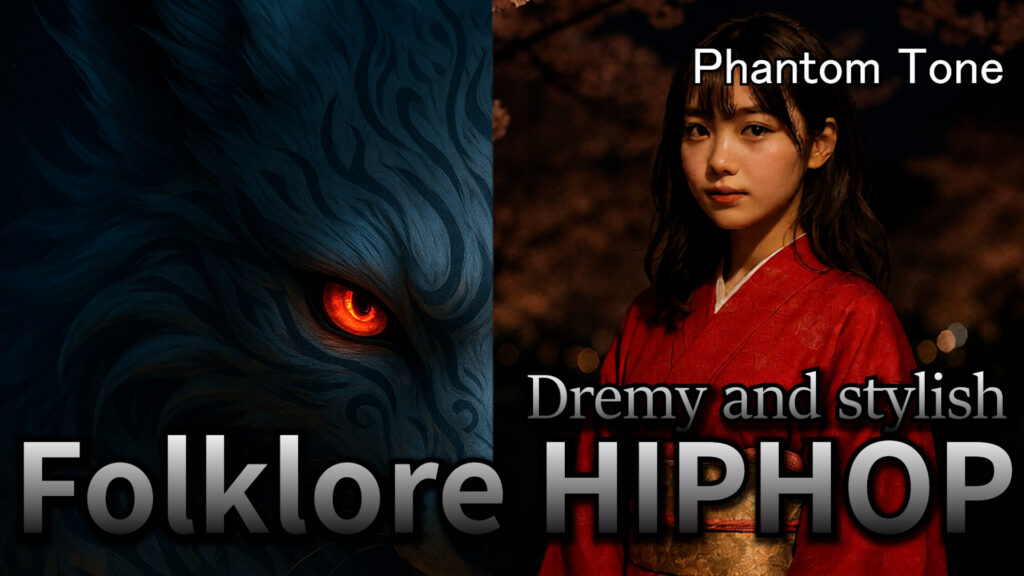
Dreamy and stylish
Genre: Ritual Japanese HipHop / Darkwave Folklore Produced by: Phantom Tone | Suno AI | Kotetsu Co., Ltd. Tags: #JapaneseHipHop #AIgeneratedMusic #Yokai #Phant…