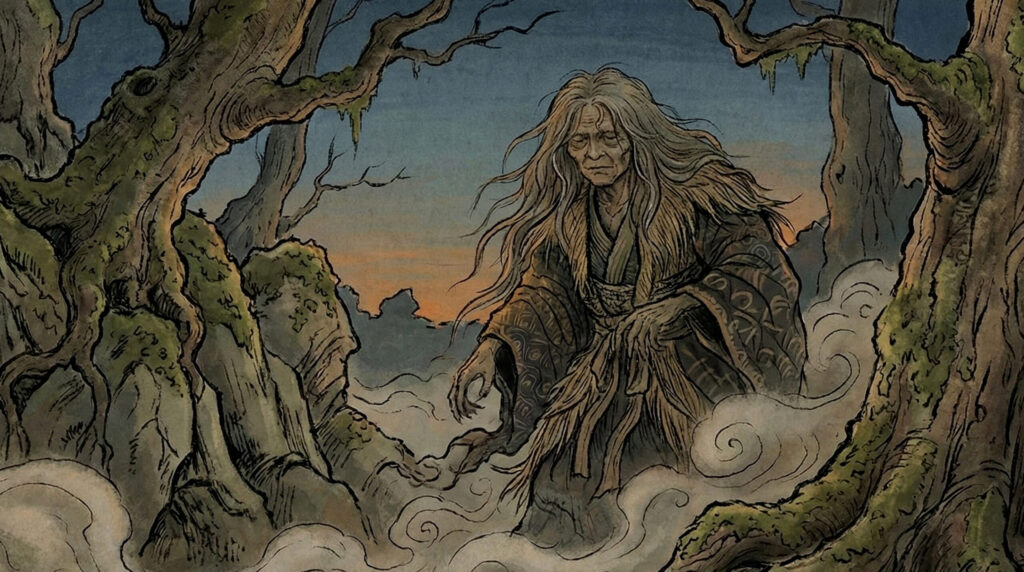
A humanoid mountain apparition.
It represents the unclaimed will of the deep forest.
Primary Sources
Mountain Spirit Records
- Konjaku Monogatari-shū (今昔物語集)
- Yanagita Kunio — Mountain spirit belief studies
- Komatsu Kazuhiko — Yōkai Encyclopedia
- Regional shrine folklore of mountain apparitions
Sansei – The Essence of the Mountain Given Form in Japanese Folklore
Sansei is not a monster, nor a god in the strict sense. It is the personification of mountain essence—a being that represents the vitality, will, and consciousness of the mountain itself. Where other yōkai act, Sansei endures.
It does not roam.
It does not hunt.
It simply exists.
Sansei embodies the mountain as a living presence.
Origins in Mountain Animism and Natural Spirits
The concept of Sansei arises from ancient animistic belief, where mountains were understood not merely as landscapes, but as living entities with awareness and temperament.
Before the mountain became a domain ruled by gods or guarded by yōkai, it was perceived as alive. Sansei emerges from this stage: the mountain’s breath, density, and quiet force condensed into presence.
It is not summoned.
It is encountered.
Neither Deity nor Yōkai
Sansei occupies a unique position in folklore hierarchy:
- Not a kami with worship rituals
- Not a yōkai defined by behavior
- Not a ghost tied to death
Instead, Sansei represents pure existence shaped by place. It has no interest in humans unless they intrude deeply or disrupt balance.
It does not judge morality.
It reacts to disturbance.
Appearance as Environment
Sansei rarely has a fixed form. When perceived, it manifests indirectly:
A towering human-like silhouette formed by rock and shadow
A dense presence felt through pressure or silence
Eyes imagined within cliffs or trees
A sense that the mountain is watching
Often, Sansei is not seen at all. Its presence is inferred through stillness, sudden quiet, or overwhelming scale.
The mountain feels heavier when it is near.
Behavior Without Motion
Unlike active yōkai, Sansei does not move or pursue. Its influence is passive yet absolute:
Paths become impassable
Weather shifts subtly
Sounds are swallowed
Human presence feels diminished
These effects are not intentional attacks. They are consequences of proximity.
Sansei does not act.
It imposes.
Relationship with Humans
Humans do not interact with Sansei directly. There are no bargains or tricks. Respect is shown through restraint—silence, offerings, or turning back.
Those who ignore these signs may feel exhaustion, disorientation, or fear without cause.
The mountain does not warn twice.
Sansei as the Precursor to Mountain Authority
Sansei can be understood as the state before hierarchy:
- Before the Mountain God ruled
- Before Yamanba survived
- Before Yamawarawa observed
Sansei is the mountain before narrative. Pure presence without story.
It is the ground from which all mountain beings arise.
Symbolism and Themes
Place as Consciousness
Land is aware.
Power Without Action
Existence outweighs motion.
Silence as Authority
Stillness commands respect.
Human Insignificance
Scale erases ego.
Related Concepts
Mountain Apparition Yōkai
Human-like spirits of deep mountains.
Forest Liminal Beings
Spirits of uninhabited regions.
Nature Retaliation Motif
Supernatural punishment for intrusion.
Sansei in Folklore Memory
Sansei appears less in named stories and more in atmosphere—moments when people felt they should not proceed further.
It survives as intuition rather than legend.
A sense that something ancient is present.
Modern Cultural Interpretations
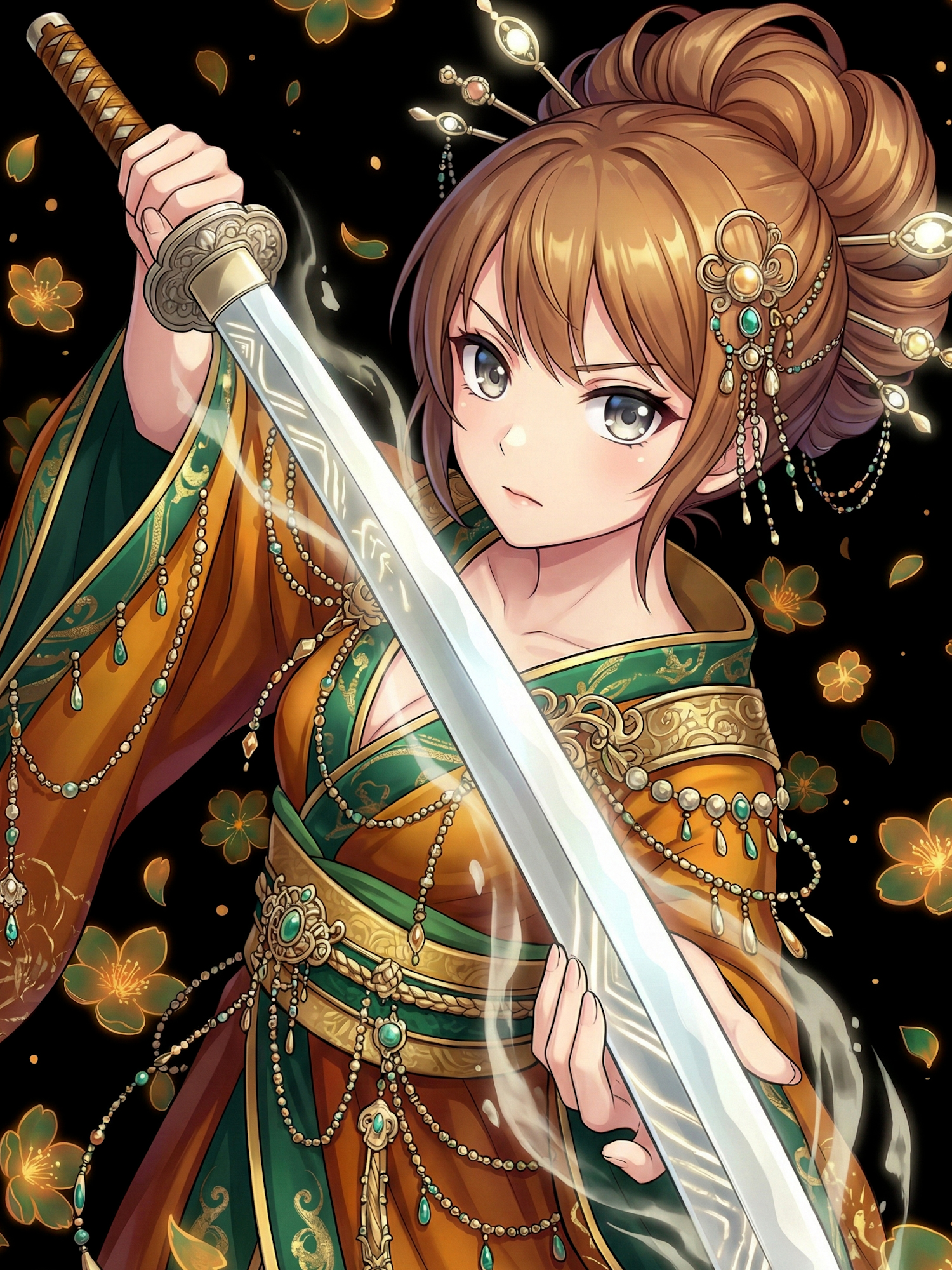
This blade symbolizes territorial will and mountain law.
It visualizes punishment triggered by intrusion.
Modern interpretations often view Sansei as a metaphor for ecological reality — systems so vast they do not respond to individual intent or presence.
Psychologically, Sansei represents environments that overwhelm identity, reminding humans of their own temporariness within larger natural orders.
In some modern visual reinterpretations, Sansei manifests as a yōtō — a blade that cannot be fully lifted. The sword resists mastery, embodying scale rather than strength. Its presence denies control rather than inflicting harm.
Sansei persists because mountains still dwarf human ambition.
Modern Reinterpretation – Sansei as the Spirit of Enduring Vastness
In this reinterpretation, Sansei is not a deity or guardian, but the quiet immensity of existence itself — the mountain’s awareness made still. It is power without motion, endurance without effort, presence so complete that it requires nothing to assert itself.
The “beautiful girl” form personifies that scale through serenity. Her figure feels monumental yet calm, her gaze distant but unwavering — a living silhouette of permanence. The folds of her attire flow like strata, each layer a record of time compressed into silence.
She does not act or speak. Her presence itself is enough to alter perception. Around her, the world slows; even wind hesitates. She is not an event but the ground from which events emerge.
To look upon her is to feel proportion redefined — a reminder that awe does not require catastrophe, only scale. She is not worshipped; she is understood by standing still long enough to feel the weight of what endures.
In this visual reinterpretation, Sansei becomes the spirit of enduring vastness — beauty expressed as immovability, and divinity realized through simple, unbroken presence.
Musical Correspondence
The accompanying track renders mass into resonance. Subsonic drones and deep harmonic layers stretch across long durations, evoking the patience of stone and the slow inhalation of the earth itself.
Melodic motion is nearly absent — instead, textures evolve imperceptibly, mirroring the quiet transformation of mountains through time. Each sound feels geological, shaped by weight rather than will.
Through restraint, depth, and sustained tone, the music captures Sansei’s essence: existence without demand, power that never declares itself, and silence vast enough to become its own form of sound.
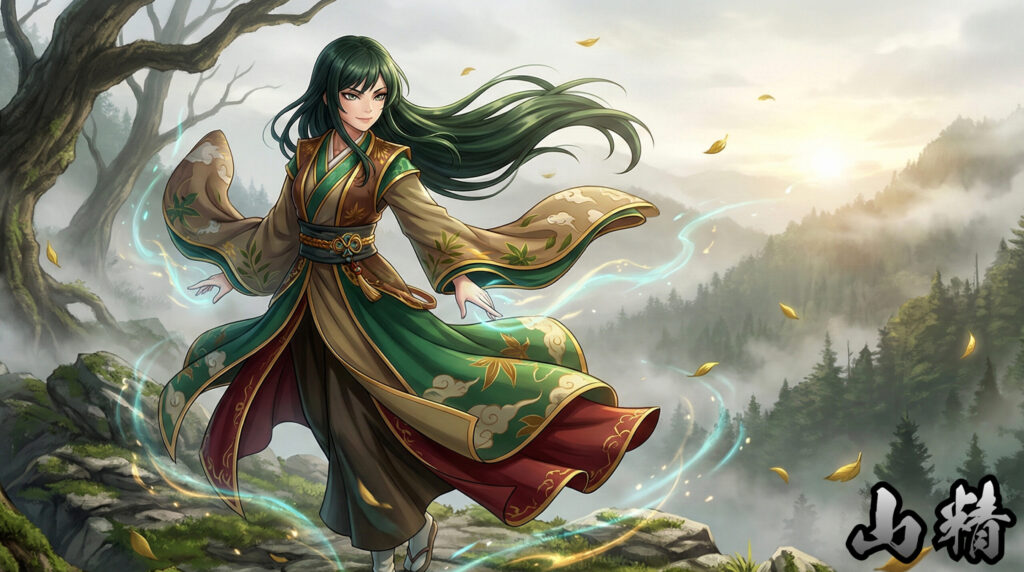
She embodies silent territorial judgment.
Her presence marks where human permission ends.
Dreamy and stylish
Genre: Ritual Japanese HipHop / Darkwave Folklore Produced by: Phantom Tone | Suno AI | Kotetsu Co., Ltd. Tags: #JapaneseHipHop #AIgeneratedMusic #Yokai #Phant…