
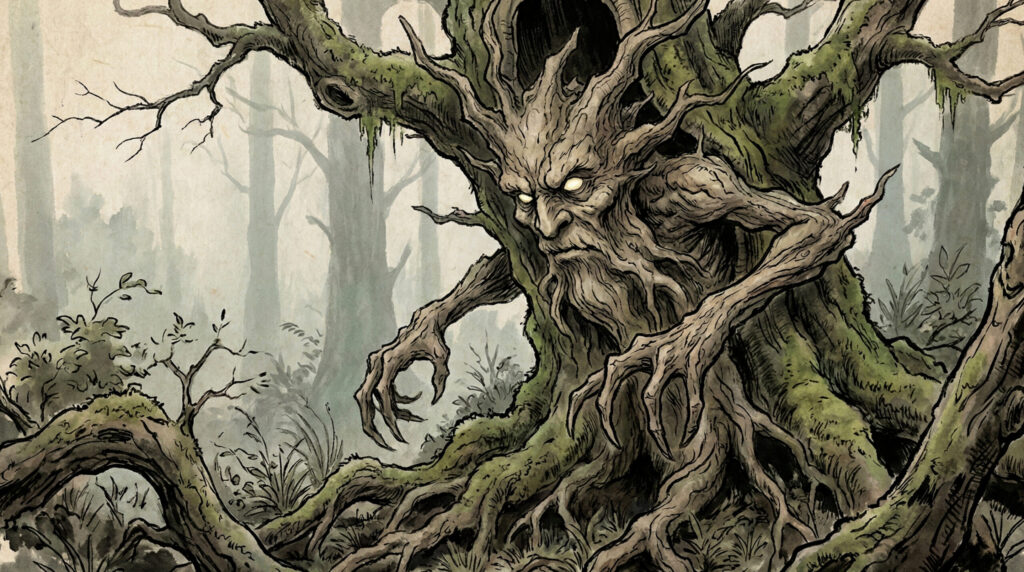
A spirit born from felled sacred trees.
It embodies forest retaliation and lingering presence.
Primary Sources
Mountain & Tree Yokai Records
- Gazu Hyakki Yagyō (画図百鬼夜行) — Toriyama Sekien
- Komatsu Kazuhiko — Yōkai Encyclopedia
- Yanagita Kunio — Mountain spirit belief records
- Regional forestry folklore collections
Komi – The Spirit That Dwells Within Trees in Japanese Folklore
Komi is a yōkai rooted deeply in forests and sacred groves of Japanese folklore. It is not a creature that moves freely, nor a spirit that seeks attention. Komi exists within trees—watching, remembering, and reacting when disturbed.
It does not walk.
It does not chase.
It waits where it has always been.
Komi embodies the awareness of wood.
Origins in Sacred Trees and Forest Animism
The belief in Komi arises from ancient animistic traditions in which trees were understood as living vessels of spirit. Old forests, shrine groves, and ancient trunks were not resources, but presences.
Komi represents the moment when a tree is no longer just alive, but aware.
To cut such a tree was not destruction.
It was provocation.
Neither Kami Nor Ghost
Komi occupies a precise liminal position:
- Not a kami worshiped directly
- Not a ghost born of death
- Not a yōkai that roams or hunts
It is bound to place. Its existence is inseparable from the tree it inhabits.
If the tree stands, Komi remains.
Appearance as Implied Presence
Komi rarely appears in full form. When perceived, it manifests subtly:
A face glimpsed in bark
Eyes suggested by knots
Shadows that seem to turn
A feeling of being watched among trees
Often, Komi is never seen—only sensed.
The forest grows quieter around it.
Behavior Triggered by Disturbance
Komi is passive until provoked. Its actions follow intrusion:
Those who cut trees without respect fall ill
Tools break or go missing
Paths become confusing
Anxiety or fear arises without cause
These are not punishments driven by anger. They are reactions.
The forest resists.
Relationship with Humans
Humans historically avoided provoking Komi by:
Offering prayers before cutting
Leaving certain trees untouched
Marking sacred groves
Observing silence
Respect neutralizes Komi. Disregard activates it.
The tree decides.
Komi as Forest Memory
Komi can be understood as the memory of the forest itself—an accumulation of years, seasons, and human contact.
Where Sansei represents mountain essence,
Komi represents localized awareness.
It does not govern territory.
It remembers it.
Symbolism and Themes
Awareness in Nature
The forest observes.
Boundaries of Exploitation
Not all wood is resource.
Memory Anchored to Place
Time embedded in matter.
Silence as Warning
Stillness signals presence.
Related Concepts
Tree-Origin Yōkai
Yōkai born from felled or decaying trees.
Forest Boundary Spirits
Spirits governing mountain territory.
Nature Retaliation Motif
Supernatural punishment for cutting sacred trees.
Komi in Folklore Memory
Komi appears most often as explanation after misfortune: illness after logging, accidents in forests, or unexplained fear.
Its stories are cautionary rather than dramatic.
Nothing leaps out.
Something lingers.
Modern Cultural Interpretations

This blade symbolizes forest vengeance and boundary violation.
It visualizes punishment caused by cutting sacred trees.
Modern interpretations often frame Komi as a metaphor for ecological consequence — damage that manifests indirectly and only after time has passed.
Psychologically, Komi represents guilt projected onto environment: the uneasy sense that a place remembers harm done to it.
In some modern visual reinterpretations, Komi manifests as a yōtō — a blade whose surface resembles scarred bark and mineralized sap. The sword carries the memory of environmental injury, cutting not flesh but negligence itself.
Komi persists because forests still watch human behavior.
Modern Reinterpretation – Komi as the Spirit of Remembering Wounds
In this reinterpretation, the Komi is not a punisher, but a witness — the consciousness of the forest that does not forget. It is harm given form, the echo of every wound left upon the land.
The “beautiful girl” form carries that memory within her body: hair the color of bark-scorch, eyes glimmering like hardened resin. Beneath her calm expression, the patience of centuries endures — not in anger, but in record.
Her presence does not accuse; it observes. She stands where axes once fell, where soil remembers weight. Her silence is the sound of acknowledgment — the world’s slow way of saying it has not healed yet.
She does not chase the guilty; she becomes the place they once harmed. To meet her gaze is to recognize that the land remembers in ways humans have forgotten.
In this visual reinterpretation, the Komi becomes the spirit of remembering wounds — beauty rooted in endurance, and consequence made visible through stillness.
Musical Correspondence
The accompanying track translates memory into vibration. Deep wooden tones and slow ambient movement evoke the pulse of roots beneath earth, while faint metallic echoes recall distant acts of cutting and repair.
Silence stretches between notes like tree rings — each pause a mark of time endured. Subtle harmonic shifts resemble the forest’s quiet breath as it records human passage.
Through texture and patience, the music captures Komi’s essence: awareness that lingers, the quiet intelligence of a world that listens long after we have gone.
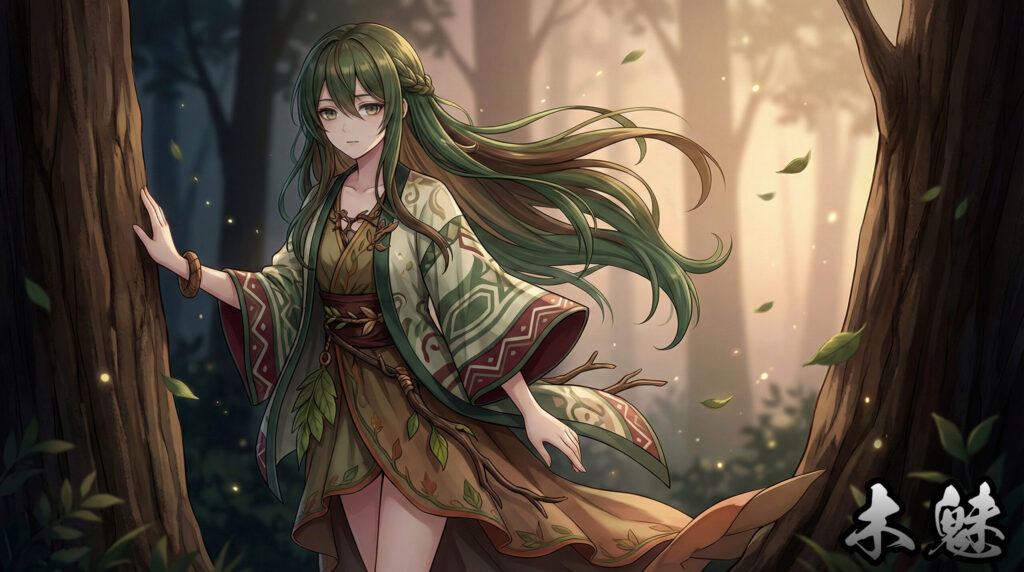
She embodies forest memory and silent retaliation.
Her presence reflects consequence carved into wood.
Dreamy and stylish
Genre: Ritual Japanese HipHop / Darkwave Folklore Produced by: Phantom Tone | Suno AI | Kotetsu Co., Ltd. Tags: #JapaneseHipHop #AIgeneratedMusic #Yokai #Phant…