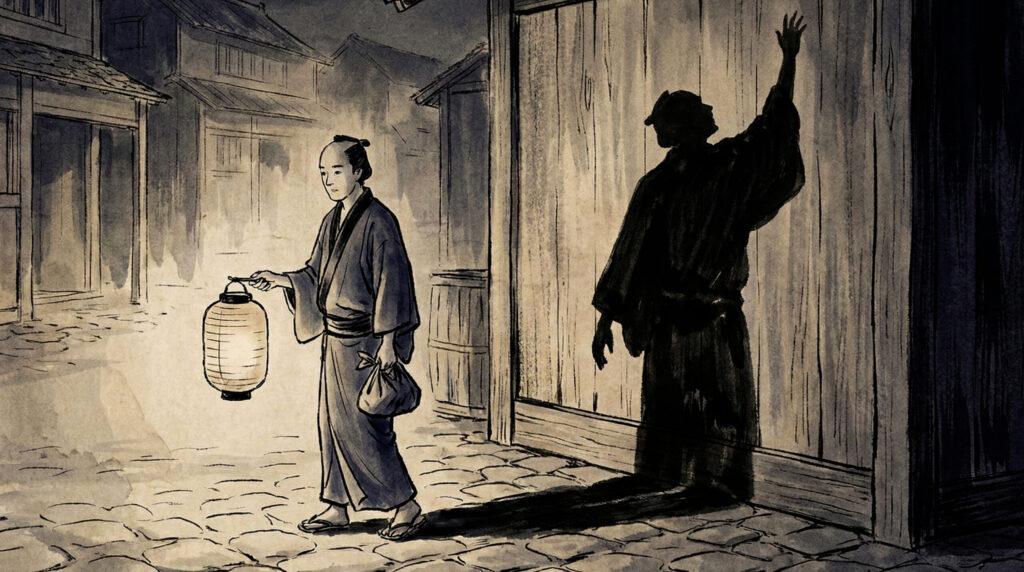
A faint star-like shadow appearing as an omen.
It signals unseen turning points.
Primary Sources
Celestial & Omen Folklore
- Yanagita Kunio — Studies of Folk Belief
- Regional star-omen folklore collections
- Komatsu Kazuhiko — Yōkai Encyclopedia
Kageboshi – Shadow-Beings of Attachment and Separation in Japanese Folklore
Kageboshi(影法師) refers not to a single yokai species, but to a conceptual category of supernatural anomaly centered on shadows. In Japanese folklore and belief, shadows are not always passive reflections; under certain conditions, they are thought to attach to people, separate from their owners, or act with disturbing autonomy.
Rather than manifesting as fully personified beings, kageboshi function as phenomena in which the shadow itself becomes the subject. They are defined by deviation: a shadow that moves incorrectly, lingers too long, detaches, or behaves as though it possesses its own will.
Conceptual Foundations – The Shadow as an Unstable Double
In premodern Japanese thought, the human self was not assumed to be singular or sealed. Body, spirit, breath, name, and shadow could be understood as loosely connected components, especially under conditions of illness, fear, exhaustion, or spiritual imbalance.
A shadow, while ordinarily obedient to light and body, occupies a liminal status:
- It resembles the human form but lacks substance
- It follows but does not touch
- It appears and disappears without consent
Kageboshi emerge when this expected obedience breaks down.
Forms of Kageboshi Phenomena
Kageboshi accounts vary widely, but they tend to fall into several overlapping patterns.
Attaching Shadows
In some traditions, a shadow is believed to attach itself to a person, growing heavier or darker over time. This attachment may cause fatigue, unease, or misfortune, as though the individual is being followed by an unseen burden.
Separating Shadows
Other accounts describe shadows that detach from their owners, remaining behind after a person leaves or moving independently along walls or ground. Such separation is often interpreted as a sign of spiritual weakness or imminent danger.
Independent Shadow Movement
A particularly unsettling form involves shadows that:
- Move out of sync with the body
- Appear where no body is present
- Linger after the light source has changed
These behaviors mark the shadow as no longer a reflection, but an autonomous anomaly.
Relationship to Other Shadow-Related Beliefs
Kageboshi should not be confused with specific yokai, though they overlap conceptually with several traditions.
- Ikiryō (living spirits) involve separation of consciousness or intent, not shadows
- Doppelgänger-like figures represent duplicated bodies, not abstract doubles
- Onryō are driven by emotion and narrative grievance
Kageboshi differ in that they lack clear emotion, intention, or story. They are disturbances rather than characters.
Symbolism and Cultural Meaning
The Self as Fragmented
Kageboshi express anxiety about the fragmentation of identity. A shadow that no longer obeys suggests that part of the self has slipped out of alignment.
Presence Without Substance
Because shadows are visible yet untouchable, kageboshi embody fear of something that exists without substance—real enough to see, impossible to grasp.
Vulnerability at Boundaries
Many kageboshi accounts occur at dusk, dawn, crossroads, or transitional spaces. These are moments when light is unstable, reinforcing the idea that boundaries invite anomaly.
Related Concepts
Star Omen Motif
Celestial signs as fate indicators.
Nocturnal Apparition
Night-vision yōkai.
Threshold Sky Folklore
Liminal sky phenomena.
Kageboshi in Oral Tradition and Everyday Fear
Unlike named yokai, kageboshi often appear in cautionary language rather than stories. People are warned to:
- Avoid walking alone at night
- Be mindful of shadows behaving strangely
- Take sudden unease seriously
This practical framing suggests that kageboshi were not meant to entertain, but to heighten awareness of vulnerability.
Modern Cultural Interpretations
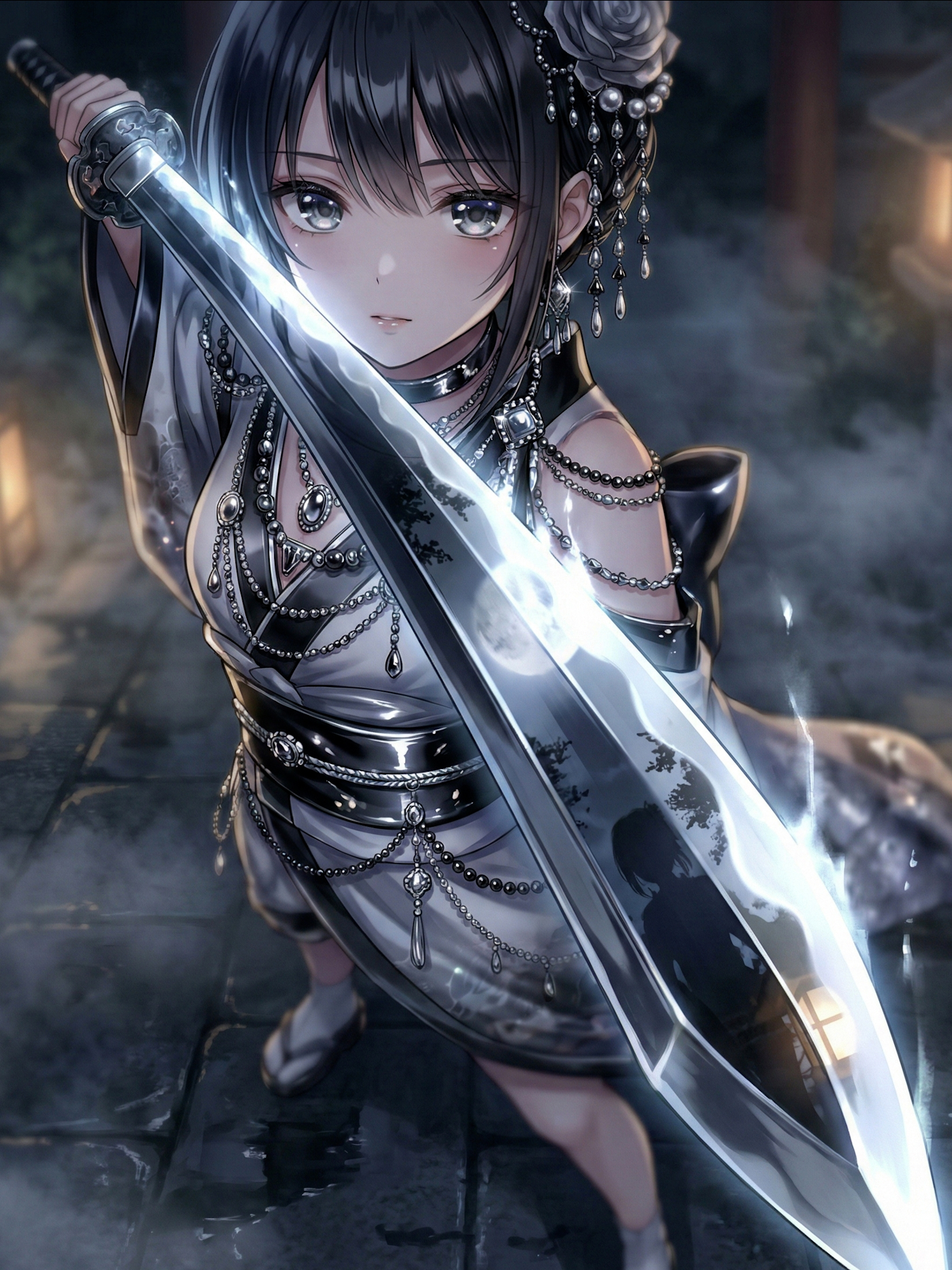
This blade symbolizes celestial omen and silent fate shift.
It visualizes destiny moving before awareness.
In modern readings, kageboshi are frequently interpreted as metaphors for dissociation, loss of self, and the lingering psychological burden of being pursued by something undefined.
Contemporary horror often literalizes these ideas, but traditional kageboshi remain more abstract — less about spectacle, more about quiet, persistent unease.
In some modern visual reinterpretations, kageboshi take the form of a yōtō — a blade that casts a shadow not aligned with its wielder. The sword does not reflect identity; it trails it. What follows is not the weapon itself, but the self that has fallen out of sync.
Kageboshi endure because the fear of being followed by oneself never fully disappears.
Modern Reinterpretation – Kageboshi as the Spirit of Self-Displacement
In this reinterpretation, the kageboshi is not a mere shadow, but the remnant of identity that drifts out of sync — a reflection that no longer answers to its source.
The “beautiful girl” form embodies this separation: her expression distant, her movements slightly delayed, as though responding to a rhythm no longer her own. She is both presence and echo, awareness detached from origin.
Her shadow follows but never aligns. The space between her and what trails her becomes the true locus of unease — where recognition begins to fail.
She is not haunted; she is the haunting itself — the quiet divergence of self and reflection, sustained by memory’s hesitation.
In this visual reinterpretation, the kageboshi becomes a modern spirit of self-displacement — beauty seen half a second too late, existing precisely in the delay between identity and its image.
Musical Correspondence
The accompanying track mirrors dislocation through subtle rhythmic drift. Beats fall fractionally behind, melodies chase themselves, and echoes return with imperceptible delay — sound existing just out of phase.
Sparse textures and blurred reverberations evoke the sensation of a self that cannot catch up. Each note feels like a step taken in pursuit of one’s own shadow.
Through controlled instability and gentle misalignment, the music captures the kageboshi’s essence — the beautiful unease of being followed by who you were a moment ago.
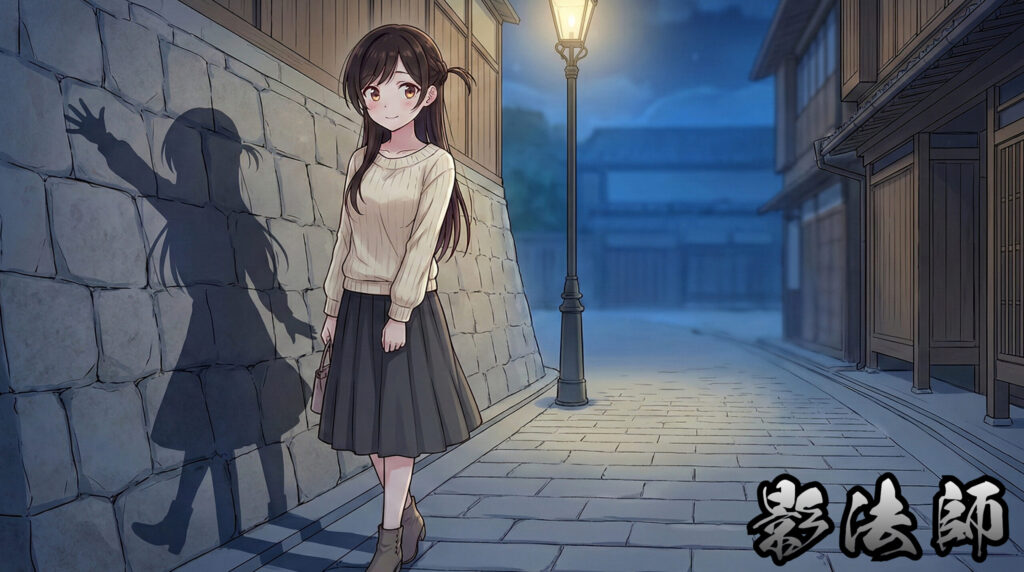
She embodies silent fate and nocturnal sign.
Her presence marks change before it is named.
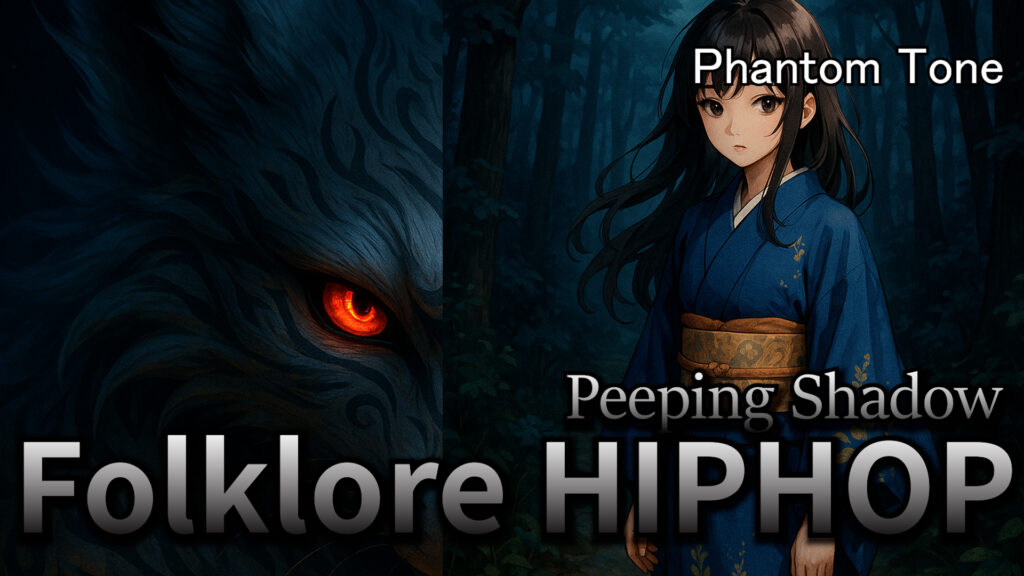
Peeping Shadow
Genre: Wafu Darkwave HipHop / Ritual Lo-Fi Produced by: Phantom Tone | Suno AI | Kotetsu Co., Ltd. Tags: #JapaneseHipHop #AIgeneratedMusic #PhantomTone #Yokai …
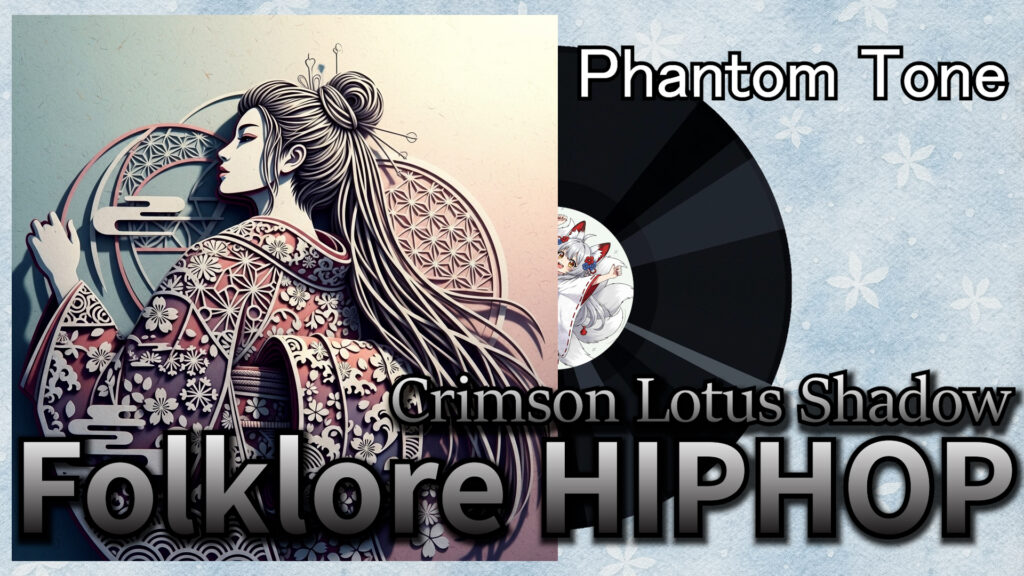
Crimson Lotus Shadow
Genre: Japanese Folklore HipHop / Spiritual Darkwave Produced by: Phantom Tone | Suno AI | Kotetsu Co., Ltd. Tags: #JapaneseHipHop #AIArtFusion #PhantomTone #C…